Taxonomy & Classification
- Kingdom
- Animalia
- Phylum
- Chordata
- Class
- Reptilia
- Order
- Squamata
- Family
- Colubridae
- Genus
- Chrysopelea
- Species
- Chrysopelea ornata

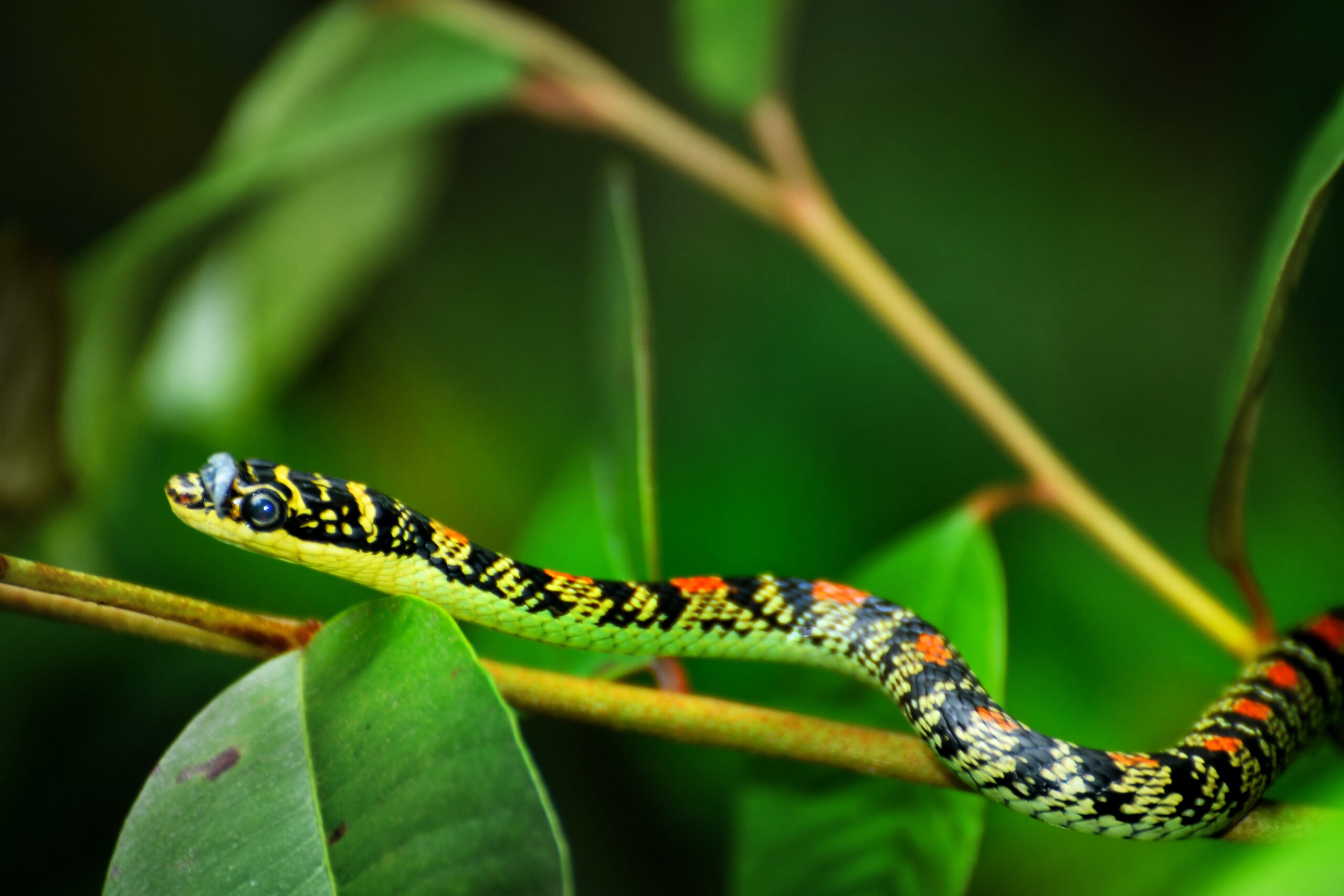 Photo Credit: Shagil Muzhappilangad / Wikimedia Commons
In the heart of Southeast Asia’s lush jungles, the flying snake, scientifically known as Chrysopelea, glides gracefully through the air, captivating all who witness its remarkable aerial feats. Imagine a vibrant green canopy, where sunlight filters through the leaves, casting playful shadows on the forest floor. Here, among the thick vines and towering trees, the flying snake emerges, its slender body stretching up to four feet long, shimmering with hues of yellow, green, and black. This stunning reptile is not just a master of camouflage; it has evolved a unique ability to glide from branch to branch, making it one of nature’s most extraordinary aerialists.
What makes the flying snake so fascinating to scientists and nature enthusiasts alike is its incredible adaptation for life in the trees. Unlike most snakes that slither on the ground, the flying snake has developed a special way to navigate its environment. By flattening its body and launching itself from high branches, it can soar through the air, covering distances of up to 100 meters in a single glide. This ability not only helps it escape predators but also allows it to hunt for food, such as small mammals and birds, with remarkable precision. As we explore the life of the flying snake, we will uncover the secrets of its gliding technique, its role in the ecosystem, and the enchanting world it calls home.
The flying snake, belonging to the genus Chrysopelea, occupies a fascinating niche in the animal kingdom. This remarkable reptile is not just another snake; it has evolved the ability to glide gracefully through the air. Found primarily in the forests of Southeast Asia, flying snakes are part of the family Colubridae, which includes many non-venomous snakes. Their unique adaptation for gliding allows them to escape predators and move between trees with ease, showcasing the incredible diversity of life forms and their adaptations in nature.
| Taxonomic Rank | Scientific Name | Meaning & Significance |
|---|---|---|
| Kingdom | Animalia | This name signifies that flying snakes are part of the vast group of multicellular organisms known as animals, which are characterized by their ability to move and respond to their environment. |
| Phylum | Chordata | Chordata means “having a notochord,” a flexible rod that supports the body. This group includes all animals with a backbone, highlighting the flying snake’s place among vertebrates. |
| Class | Reptilia | Reptilia refers to reptiles, which are cold-blooded animals with scales. This classification emphasizes the flying snake’s adaptations for life on land and in trees. |
| Order | Squamata | Squamata means “scaly,” a nod to the skin texture of snakes and lizards. This order includes all snakes, showcasing the flying snake’s close relatives. |
| Family | Colubridae | Colubridae is the family of colubrid snakes, which are mostly non-venomous. This classification highlights the flying snake’s non-threatening nature compared to other snake families. |
| Genus | Chrysopelea | Chrysopelea comes from Greek words meaning “golden” and “to fly.” This name reflects the snake’s shimmering scales and its remarkable gliding ability. |
Understanding the flying snake’s taxonomic classification reveals much about its evolutionary journey. As a member of the reptile class and the squamate order, it shares a common ancestry with other snakes and lizards. Its unique adaptations for gliding suggest a fascinating evolutionary response to its arboreal habitat, where the ability to move through the air can be a significant advantage for survival. This blend of characteristics not only highlights the flying snake’s place in the tree of life but also illustrates the intricate connections between species and their environments.
The evolutionary journey of the flying snake, belonging to the genus Chrysopelea, stretches back millions of years, intertwining with the history of snakes and their adaptations to diverse environments. These serpents are part of the Colubridae family, which includes a wide variety of non-venomous snakes. The ancestors of modern snakes emerged during the late Cretaceous period, around 100 million years ago, evolving from lizard-like reptiles. Over time, they adapted to various habitats, leading to the incredible adaptations we see today.
The transition to gliding began with the ancestors of flying snakes developing elongated bodies and a flattened shape. This change allowed them to catch the wind and glide from tree to tree in their forest homes. As they evolved, their ribs became more flexible, enabling them to spread their bodies wide during a glide, much like a parachute. This adaptation not only helped them escape predators but also allowed them to hunt for food more effectively by moving between branches without descending to the ground.
These adaptations have been crucial for the survival of flying snakes in their arboreal habitats. By mastering the art of gliding, they can evade ground-based predators and access food sources that are otherwise out of reach. Their ability to navigate the treetops with agility allows them to thrive in the lush canopies of Southeast Asia, showcasing the wonders of evolution in action.
The flying snake is a stunning example of nature’s ingenuity, captivating anyone who catches a glimpse of it. With a slender, elongated body that can reach lengths of up to 4 feet, this snake is built for both agility and grace. Its smooth, scaled skin glistens in the sunlight, showcasing a palette of vibrant colors that can range from bright greens to deep browns, allowing it to blend seamlessly into its leafy surroundings. The flying snake’s body is not just long; it is also flattened laterally, which helps it glide through the air with remarkable ease.
| Feature | Description |
|---|---|
| Weight | 1.2 to 2 pounds |
| Skin Type | Scales |
| Body Length | Up to 4 feet |
| Color | Bright greens to deep browns |
| Body Shape | Slender and laterally flattened |
The combination of these features is not just for show; they serve vital purposes in the flying snake’s life. Its lightweight body allows for effortless gliding from tree to tree, while the flattened shape increases surface area, enabling it to catch the air like a parachute. The vibrant colors provide camouflage among the leaves, helping it avoid predators and sneak up on unsuspecting prey. Together, these adaptations make the flying snake a master of its arboreal domain, showcasing the beauty and complexity of evolution in action.
The flying snake calls the lush, vibrant forests and jungles of Southeast Asia its home. Picture towering trees draped in thick vines, with sunlight filtering through the leaves, creating a dappled effect on the forest floor. This environment is alive with sounds—the rustle of leaves, the calls of exotic birds, and the hum of insects. The flying snake thrives in this rich tapestry of life, where it can easily navigate the branches and glide from tree to tree.
The climate in these regions is typically warm and humid, providing the perfect conditions for the flying snake. These snakes prefer areas where the temperature remains consistently mild, often between 70 to 90 degrees Fahrenheit. The humidity in the air helps keep their skin moist, which is essential for their health. Rainfall is abundant, nourishing the dense foliage that offers both shelter and hunting grounds.
To thrive in such environments, the flying snake has developed impressive adaptations. Its ability to glide allows it to move between trees with ease, avoiding ground predators and reaching food sources high in the canopy. The snake’s flattened body and rib structure help it catch the air, enabling it to soar gracefully through the forest. This remarkable skill not only aids in travel but also plays a crucial role in its survival, allowing it to escape danger and explore its lush habitat.
The daily life of a flying snake is a blend of agility and strategy, filled with activities that showcase its unique adaptations. As dawn breaks, these snakes emerge from their resting spots high in the trees, ready to bask in the warm sunlight. They spend their mornings soaking up heat, which helps them become more active. Once warmed up, they glide from branch to branch, using their flattened bodies to catch the air and soar gracefully through the forest. This gliding behavior not only aids in travel but also helps them evade predators and search for food, primarily small birds and lizards.
Socially, flying snakes are generally solitary creatures, but they do come together during the breeding season. Males may engage in displays of strength and agility to attract females, showcasing their impressive gliding skills. While they are not known for forming tight-knit groups, they do share their habitat with others of their kind, often seen coiling around branches or basking in the sun nearby. Communication among flying snakes is subtle; they rely on body language and scent to convey their presence and intentions, ensuring they maintain a safe distance from potential threats.
| Behavior Type | Description |
|---|---|
| Activity Patterns | Flying snakes bask in the sun to warm up, glide between trees to hunt, and rest on branches during the day. |
| Social Structure | Generally solitary, they come together during breeding season for mating displays. |
| Communication Methods | Use body language and scent marking to communicate with others, especially during mating. |
The behaviors of flying snakes are finely tuned to ensure their survival in the wild. Their ability to glide not only helps them escape predators but also allows them to access food sources that might be out of reach for other animals. By basking in the sun, they regulate their body temperature, which is crucial for their activity levels. Their solitary nature, combined with strategic social interactions during breeding, helps maintain a balance in their populations, ensuring that these extraordinary reptiles continue to thrive in their lush forest homes.
The flying snake has a diverse diet that reflects its adaptability and skillful hunting techniques. As an omnivore, it enjoys a wide range of foods, including small mammals, birds, and even the occasional frog. This snake is particularly fond of rodents, bats, and the eggs of various birds, which it skillfully captures using its remarkable gliding abilities. By launching itself from tree branches, the flying snake can glide through the air to reach its prey, making it a master of aerial ambush.
| Dietary Aspect | Details |
|---|---|
| Diet Type | Omnivore |
| Favorite Foods | Rodents, bats, birds and their eggs, frogs, smaller snakes, and lizards |
| Prey Items | Small mammals, birds, and amphibians |
| Hunting/Foraging Strategies | Glides from tree branches to ambush prey |
This varied diet plays a crucial role in the flying snake’s ecology and daily routine. By feeding on a range of animals, it helps control populations of its prey, contributing to the balance of its forest ecosystem. The ability to glide not only aids in hunting but also allows the snake to navigate its arboreal habitat efficiently, ensuring it can find food while avoiding potential predators. This dynamic lifestyle showcases the flying snake’s role as both a predator and a vital part of its environment.
When it comes to mating, flying snakes engage in a captivating courtship dance. During the breeding season, which typically occurs in the warmer months, males will often display their vibrant colors and perform intricate movements to attract females. This display is not just for show; it helps establish dominance and readiness to mate. Once a pair has formed, they will entwine their bodies, a behavior known as copulation, which can last several hours. After mating, the female prepares to lay her eggs, often seeking out a safe, warm location to ensure the best chance for her young.
| Reproductive Aspect | Details |
|---|---|
| Gestation Period | Approximately 30 days |
| Litter Size | 4 to 20 eggs |
| Age of Maturity | About 2 to 3 years |
| Name of Young | Hatchlings, snakelets |
After the eggs are laid, the female flying snake leaves them to develop on their own. The eggs incubate in the warm environment, and after about a month, the hatchlings emerge. These young snakes, known as snakelets, are miniature versions of their parents, ready to start their lives in the treetops. They are independent from the moment they hatch, relying on their instincts to find food and avoid predators. As they grow, they will gradually develop the gliding skills that make their species so extraordinary, soaring through the forest canopy just like their parents.
The flying snake plays a crucial role in its ecosystem, nestled within the food web of Southeast Asia’s lush forests. As both predator and prey, it helps maintain the balance of its environment. While it skillfully hunts small mammals and birds, it also faces threats from various predators that seek to make it their next meal. This dual role highlights the delicate interplay of life in the wild, where every creature has its place.
To survive these dangers, flying snakes have developed impressive defensive behaviors. Their ability to glide from tree to tree not only aids in hunting but also serves as an escape mechanism. When threatened, they can launch themselves into the air, using their flattened bodies to glide away from danger. Additionally, their coloration often helps them blend into the foliage, making it harder for predators to spot them. These strategies showcase the flying snake’s remarkable adaptations, allowing it to navigate the challenges of its environment with agility and grace.
A keystone species is a vital part of its ecosystem, meaning its presence and activities have a significant impact on the environment and other living things. The flying snake, belonging to the genus Chrysopelea, qualifies as a keystone species due to its unique role in the forests and jungles of Southeast Asia. By influencing the population dynamics of various species and contributing to the overall health of its habitat, this gliding reptile plays an essential part in maintaining ecological balance.
Flying snakes are skilled hunters, preying on small mammals and birds. Their ability to glide from tree to tree allows them to access food sources that many other predators cannot reach. This hunting strategy not only helps control the populations of these animals but also ensures that the ecosystem remains diverse. For example, by keeping the numbers of certain bird species in check, flying snakes help maintain the balance of plant life, as fewer birds mean less seed dispersal. This intricate relationship highlights how the flying snake’s presence supports the health of its forest home.
Moreover, flying snakes serve as prey for larger predators, such as birds of prey and some mammals. This dual role as both predator and prey is crucial for the food web, which is the interconnected network of who-eats-who in an ecosystem. When flying snakes thrive, they provide a steady food source for these larger animals, which in turn helps sustain their populations. This interconnectedness illustrates how the flying snake contributes to the overall stability of its environment.
If flying snakes were to disappear from their ecosystems, the consequences could be severe. Without these gliding reptiles, populations of small mammals and birds could surge, leading to overgrazing and overbrowsing of vegetation. This unchecked growth could disrupt the delicate balance of the forest, resulting in a decline in plant diversity and health. Additionally, larger predators that rely on flying snakes for food would struggle to find enough sustenance, potentially leading to their decline as well. The loss of the flying snake would create a ripple effect, demonstrating just how crucial this remarkable species is to the health of its ecosystem.
The flying snake, a member of the genus Chrysopelea, plays a vital role in its ecosystem, particularly in the lush forests and jungles of Southeast Asia, India, Sri Lanka, and China. This remarkable reptile has adapted to life in the trees, where it glides gracefully from branch to branch. By doing so, it helps maintain the balance of its habitat, influencing both the plant and animal communities around it. Its unique ability to glide not only aids in hunting but also in dispersing seeds and pollen, making it an important player in the forest’s health.
| Ecosystem Service | Impact |
|---|---|
| Seed Dispersal | Helps in the growth of new plants by spreading seeds as it moves through the trees. |
| Pest Control | Regulates populations of small mammals and birds, keeping the ecosystem balanced. |
| Food Source | Serves as prey for larger predators, contributing to the food web. |
| Habitat Structure | Influences the structure of the forest by interacting with various plant species. |
The flying snake’s influence can be seen in various ways. For instance, as it glides from tree to tree, it often consumes small mammals and birds, helping to control their populations. This predatory behavior is crucial because it prevents any one species from becoming too dominant, which could disrupt the entire ecosystem. Additionally, when flying snakes eat fruits and other plant materials, they inadvertently help in seed dispersal. This means that as they travel, they are also planting the next generation of trees and plants, ensuring the forest remains vibrant and diverse.
The broader ecological importance of the flying snake cannot be overstated. As a keystone species, its presence supports a complex web of life in its habitat. By regulating prey populations and aiding in plant reproduction, the flying snake contributes to the overall health and stability of the forest ecosystem. This delicate balance is essential for the survival of countless other species, making the flying snake not just a fascinating creature to observe, but a crucial component of its environment.
In the intricate web of life, symbiosis refers to the close interactions between different species, which can take on various forms. These relationships can be mutualistic, where both species benefit, parasitic, where one benefits at the other’s expense, or commensal, where one benefits while the other is neither helped nor harmed. The flying snake, with its unique adaptations and behaviors, engages in several fascinating ecological relationships that highlight the interconnectedness of life in its forest and jungle habitats.
| Species/Type | Relationship Type | Description |
|---|---|---|
| Birds | Mutualistic | Flying snakes often share their habitat with birds, which can help alert them to potential predators. In return, flying snakes may help control the population of small mammals that birds might prey on. |
| Insects | Commensal | Flying snakes may benefit from insects that live in the same trees, as these insects can provide a food source without affecting the insects’ population significantly. |
| Small mammals | Parasitic | While flying snakes primarily hunt small mammals for food, this relationship is parasitic in nature, as the mammals are harmed when they become prey. |
These relationships have evolved over time, shaped by the needs and behaviors of the species involved. The flying snake’s ability to glide allows it to access food sources and evade predators, while its interactions with other species help maintain the balance of its ecosystem. By understanding these connections, we can appreciate how each species, including the flying snake, plays a vital role in the health and stability of its environment.
The flying snake, a marvel of nature, has captivated the imaginations of many with its extraordinary gliding abilities and unique adaptations. Here are some surprising facts that showcase just how incredible this reptile truly is.
Throughout history, flying snakes have sparked curiosity and wonder among humans. In many cultures, these extraordinary reptiles have been woven into folklore and mythology. For instance, in some Southeast Asian traditions, they are seen as symbols of transformation and agility, embodying the spirit of the jungle. Ancient texts and stories often depict them as mystical beings, capable of soaring through the air, which has only added to their allure. These encounters have shaped how people view flying snakes, blending admiration with a touch of fear.
In modern times, the relationship between flying snakes and humanity has evolved. While these snakes are not typically domesticated, they are often studied for their unique gliding abilities and adaptations. Conservation efforts are underway to protect their habitats, as deforestation and habitat loss pose significant threats to their populations. However, conflicts can arise when these snakes venture into human settlements, leading to misunderstandings and fear. Educating communities about the ecological role of flying snakes can help reduce these conflicts and promote coexistence.
Looking ahead, the future of the relationship between flying snakes and humanity holds promise. As awareness of environmental issues grows, more people are likely to appreciate the vital role these snakes play in their ecosystems. By fostering a sense of respect and understanding, we can ensure that flying snakes continue to glide gracefully through the forests, inspiring future generations with their beauty and adaptability. Together, we can create a world where humans and flying snakes thrive side by side.
The flying snake, a captivating inhabitant of Southeast Asia’s lush forests, currently holds a conservation status of “Least Concern” according to the International Union for Conservation of Nature (IUCN). This means that, at present, the species is not facing an immediate threat of extinction. Population estimates are stable, and while specific numbers can be challenging to pinpoint, the flying snake appears to be thriving in its natural habitat.
| Conservation Factor | Status/Details |
|---|---|
| IUCN Status | Least Concern |
| Population Estimates | Stable, specific numbers not well-documented |
| Trend Direction | Stable |
Despite its current stable status, the flying snake faces several threats that could impact its future. Habitat loss is a significant concern, as deforestation for agriculture and urban development reduces the lush environments these snakes rely on. Additionally, climate change poses a risk by altering their habitats and food sources. As temperatures rise and weather patterns shift, the delicate balance of their ecosystem may be disrupted, affecting their survival.
Conservation efforts are underway to ensure the flying snake continues to glide gracefully through the treetops. Protected areas are being established to safeguard their habitats, and awareness campaigns are educating local communities about the importance of preserving these unique reptiles. With ongoing efforts and a commitment to conservation, the outlook for the flying snake remains hopeful, allowing future generations to marvel at its extraordinary abilities.
| Question | Answer |
|---|---|
| Where do Flying Snakes live? | Flying snakes are found in the forests and jungles of Southeast Asia, India, Sri Lanka, and China. They prefer habitats with plenty of trees, where they can glide from branch to branch. |
| What do Flying Snakes eat? | These snakes are omnivores, which means they eat both plants and animals. Their diet mainly consists of small birds, lizards, and even tree frogs, along with fruits and flowers. |
| How do Flying Snakes glide? | Flying snakes have a unique ability to glide through the air. They flatten their bodies and use their muscles to push off from a branch, allowing them to soar gracefully from tree to tree. |
| How do Flying Snakes reproduce? | Flying snakes are oviparous, meaning they lay eggs. The female typically lays a clutch of 5 to 15 eggs in a safe, hidden location, and the young hatch after about two months. |
| What are the threats to Flying Snakes? | While Flying Snakes are currently listed as Least Concern, they face threats from habitat loss due to deforestation and human encroachment. Additionally, they can be vulnerable to predators like birds of prey. |
| Are Flying Snakes dangerous to humans? | Flying snakes are not considered dangerous to humans. They are non-venomous and tend to avoid contact with people, preferring to stay high in the trees. |
| What is an interesting fact about Flying Snakes? | One fascinating characteristic of Flying Snakes is their ability to change the shape of their bodies while gliding. This helps them steer and control their direction, making them agile flyers in the treetops. |