Taxonomy & Classification
- Kingdom
- Animalia
- Phylum
- Chordata
- Class
- Mammalia
- Order
- Carnivora
- Family
- Felidae
- Genus
- Panthera
- Species
- Panthera leo × Panthera tigris

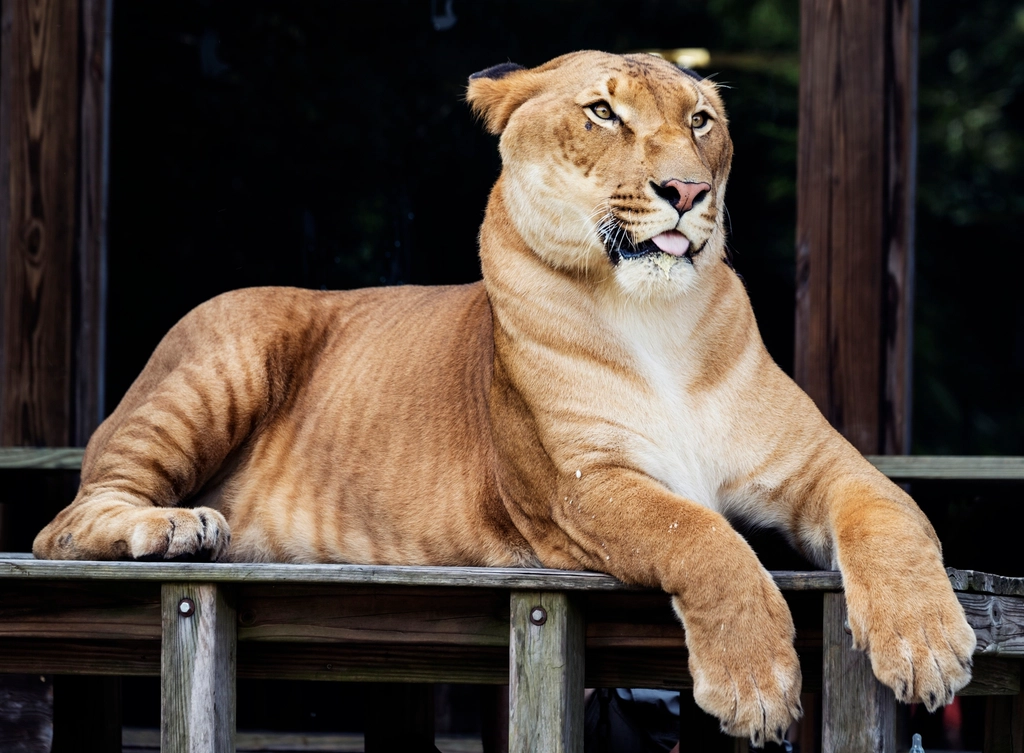 Photo Credit: Carol M Highsmith / Rawpixel
In the heart of a sun-drenched savanna, where golden grasses sway gently in the breeze, roams the liger, scientifically known as Panthera leo × Panthera tigris. This extraordinary hybrid, born from the union of a male lion and a female tiger, is a sight to behold. With its massive frame, often weighing between 400 to 600 pounds, and a striking coat that combines the tawny hues of a lion with the bold stripes of a tiger, the liger stands as a testament to nature’s creativity. Its large, powerful paws and impressive mane, which can be more pronounced than that of a lion, make it a captivating figure in the animal kingdom.
Ligers are not just remarkable for their size and appearance; they also spark curiosity among scientists and nature enthusiasts alike. These hybrids, which do not exist in the wild, are typically found in captivity, where they are bred in zoos and wildlife parks. Their unique blend of traits from both parent species raises intriguing questions about genetics and the possibilities of hybridization. As we explore the world of ligers, we will uncover their behaviors, diets, and the challenges they face, all while marveling at the wonder of this magnificent creature that embodies the best of both lions and tigers.
The liger is a captivating hybrid animal that sits at a unique intersection in the tree of life. It is the offspring of a male lion and a female tiger, showcasing the fascinating blend of traits from both parent species. This extraordinary animal belongs to the kingdom Animalia, phylum Chordata, class Mammalia, order Carnivora, family Felidae, and genus Panthera. What makes the liger particularly interesting is not just its impressive size—often larger than either parent—but also its genetic makeup, which combines the strengths of two of the most powerful big cats in the world.
| Taxonomic Rank | Scientific Name | Meaning & Significance |
|---|---|---|
| Kingdom | Animalia | This name comes from the Latin word “animalis,” meaning “having breath” or “living.” It signifies all living organisms that are not plants, fungi, or microorganisms. |
| Phylum | Chordata | Derived from the Latin “chorda,” meaning “string” or “cord,” this term refers to animals that have a notochord, a flexible rod that supports the body during development. This includes all vertebrates, like ligers. |
| Class | Mammalia | This name comes from the Latin “mamma,” meaning “breast,” highlighting the defining feature of mammals: females possess mammary glands that produce milk for their young. |
| Order | Carnivora | From the Latin “carnivorus,” meaning “meat-eating,” this classification includes animals that primarily consume meat, showcasing the liger’s predatory nature inherited from its lion and tiger parents. |
| Family | Felidae | This name is derived from the Latin “felis,” meaning “cat.” It encompasses all species of big and small cats, emphasizing the liger’s lineage from these agile and powerful hunters. |
| Genus | Panthera | From the Greek word “panthera,” which refers to large cats, this classification includes lions, tigers, leopards, and jaguars, highlighting the liger’s close genetic ties to these majestic animals. |
The classification of the liger reveals much about its evolutionary history and the fascinating dynamics of hybridization. While ligers are not found in the wild, their existence underscores the genetic connections between species within the Felidae family. This hybrid showcases how closely related lions and tigers are, sharing a common ancestor that lived millions of years ago. Understanding the liger’s place in the tree of life not only highlights the wonders of nature but also raises intriguing questions about the future of these magnificent big cats in a rapidly changing world.
The evolutionary journey of the liger is a tale that begins long before this hybrid was ever conceived. The story of the liger, a cross between a male lion and a female tiger, unfolds within the broader context of the Felidae family, which has been evolving for millions of years. The ancestors of modern big cats roamed the Earth around 10 to 15 million years ago, giving rise to various species that adapted to their environments in remarkable ways.
The Felidae family, which includes lions, tigers, leopards, and more, shares a common ancestor that lived in the Miocene epoch. Over time, these ancestors diversified, leading to the emergence of distinct lineages. Lions and tigers, both part of the genus Panthera, evolved unique traits suited to their habitats. Lions became social animals, living in prides on the African savanna, while tigers adapted to solitary life in dense forests of Asia. These adaptations were crucial for their survival, allowing them to hunt effectively and thrive in their respective environments.
The adaptations of lions and tigers not only helped them survive in their own environments but also set the stage for the creation of the liger. When these two magnificent species interbreed, the liger inherits a blend of their strengths. This hybrid showcases the social instincts of lions and the solitary prowess of tigers, making it a fascinating example of how evolution can lead to unexpected outcomes. The liger, while not a naturally occurring species in the wild, embodies the incredible diversity and adaptability of the Felidae family, reminding us of the intricate web of life that connects all animals.
The liger is an awe-inspiring sight, a magnificent blend of lion and tiger that commands attention. With its enormous head and robust body, this hybrid animal can weigh between 400 to 600 kilograms, which is about as heavy as a small car! Its powerful limbs and broad chest give it a muscular appearance, while its long tail adds to its impressive stature. The liger’s fur is a striking mix of colors, often featuring the golden hues of a lion with the distinctive stripes of a tiger, creating a stunning visual that is both regal and wild.
| Feature | Description |
|---|---|
| Weight | 400kg – 600kg (882lbs – 1,322lbs) |
| Skin Type | Fur |
| Most Distinctive Feature | Enormous head and body size |
These physical characteristics are not just for show; they play vital roles in the liger’s survival. The massive size and strength allow it to take down large prey, while the combination of fur colors helps it blend into various environments, whether in the grasslands or dense forests. The liger’s impressive stature and powerful build make it a formidable predator, showcasing the best traits of both its lion and tiger lineage. In the wild, these features would be essential for hunting and protecting territory, ensuring that this hybrid remains a captivating marvel of nature.
The liger, a striking hybrid of a lion and a tiger, does not have a natural habitat in the wild. Instead, these magnificent animals are typically found in captivity, where they are bred in zoos and wildlife parks. Imagine a spacious enclosure that mimics the savannas and forests of their parent species, complete with tall grasses, rocky outcrops, and plenty of room to roam. These environments are designed to provide a semblance of the wild, allowing ligers to exhibit some of their natural behaviors.
In captivity, ligers thrive in environments that offer a warm climate, similar to the habitats of lions and tigers. They prefer areas with plenty of sunlight and space to explore. The temperature should ideally be moderate to warm, as these hybrids are not adapted to extreme cold. Access to water for drinking and cooling off is also essential, as it helps them regulate their body temperature and stay hydrated.
To adapt to their specific environments, ligers exhibit behaviors that reflect their lineage. They enjoy basking in the sun, much like lions, and they also appreciate the cover of trees and bushes, reminiscent of tigers’ forested habitats. Their large size allows them to roam and explore, while their playful nature encourages them to engage in activities that mimic hunting and social interactions. In captivity, these adaptations help them lead a fulfilling life, even if they are far from their ancestral homes.
Ligers lead a life that is both intriguing and complex, filled with a mix of daily activities that reflect their unique heritage. These hybrids are primarily diurnal, meaning they are active during the day, although they can also exhibit nocturnal behaviors, especially in captivity. Their daily routine often includes lounging in the sun, exploring their environment, and engaging in play. Ligers enjoy a good stretch and a roll in the grass, showcasing their powerful muscles and agility. When it comes to feeding, they require a substantial amount of meat, which they hunt or are provided with in captivity.
Socially, ligers tend to be solitary creatures, much like their lion and tiger parents. While lions are known for their pride-based social structures, ligers do not form groups. Instead, they prefer to roam alone, marking their territory and establishing their presence. This solitary behavior allows them to maintain a low profile, which is essential for their survival. Communication among ligers is subtle; they may use vocalizations, body language, and scent marking to convey their feelings and intentions.
| Behavior Type | Description |
|---|---|
| Activity Patterns | Ligers are primarily diurnal but can also be active at night. They spend their days basking in the sun, exploring, and playing. |
| Social Structure | These hybrids are solitary, preferring to live alone rather than in groups like lions. |
| Communication Methods | Ligers communicate through vocalizations, body language, and scent marking to express their presence and feelings. |
The behaviors of ligers are finely tuned to ensure their survival, even in captivity. Their solitary nature allows them to avoid competition for resources, while their communication methods help them navigate their environment effectively. By understanding their daily activities and social dynamics, we gain insight into how these magnificent hybrids thrive, even in a world that is not their natural habitat.
The liger is a carnivore, which means it primarily eats meat. This hybrid animal has inherited the hunting prowess of both its lion and tiger parents. In the wild, if they were to exist, ligers would likely hunt large prey such as deer and wild boar. However, in captivity, their diet is often supplemented with other meats, including cattle. Ligers are known to be opportunistic feeders, meaning they will take advantage of whatever food is available to them, showcasing their adaptability in obtaining nourishment.
| Dietary Aspect | Details |
|---|---|
| Diet Type | Carnivore |
| Favorite Foods | Deer, Wild Boar, Cattle |
| Prey Items | Large mammals like deer and wild boar |
| Hunting/Foraging Strategies | Opportunistic feeding, using stealth and strength |
The diet of a liger plays a crucial role in shaping its ecology and daily routine. As a large predator, it requires substantial amounts of food to sustain its massive body. This need influences its behavior, as ligers may spend significant time resting to conserve energy after a meal. In captivity, their feeding schedule is carefully managed to ensure they receive the right nutrients, allowing them to thrive and exhibit their natural behaviors, even in a controlled environment. Understanding their dietary habits helps us appreciate the delicate balance of nature and the importance of proper care for these extraordinary animals.
When it comes to mating, ligers exhibit behaviors that reflect their lion and tiger lineage. The breeding season for these hybrids typically aligns with that of their parent species, which can vary depending on environmental conditions. Male ligers, like lions, may engage in displays of strength and vocalizations to attract females, while females may show interest through specific body language. This courtship can be a captivating dance of instincts, as both parents prepare for the arrival of their young.
| Reproductive Aspect | Details |
|---|---|
| Gestation Period | 100 days |
| Litter Size | Typically 1 to 4 cubs |
| Age of Maturity | 3 – 4 years |
| Name of Young | Cub |
Once the cubs are born, parental care becomes crucial for their survival. Liger mothers, like tigers, are attentive and protective, nurturing their young in a safe environment. The cubs are born blind and rely heavily on their mother for warmth and food. As they grow, they begin to explore their surroundings, learning essential skills through play and interaction. This early development is vital, as it prepares them for the challenges of adulthood. By the time they reach sexual maturity at around three to four years, these young ligers are well-equipped to navigate the world, carrying forward the legacy of their majestic parents.
The liger, a fascinating hybrid of a lion and a tiger, occupies a unique position in the food web. While it is a top predator, capable of taking down large prey, it faces significant challenges in the wild, particularly because it does not exist naturally in the wild. Instead, ligers are primarily found in captivity, where they are bred for commercial purposes. This breeding often leads to a range of dangers that threaten their well-being and survival.
Despite these threats, ligers have developed some defensive behaviors and survival strategies. In captivity, they often rely on their size and strength to assert dominance over other animals. They may also exhibit territorial behaviors, marking their space to deter potential threats. Additionally, ligers can use their agility and speed to escape from danger when necessary. While their existence is largely shaped by human intervention, these magnificent hybrids still possess instincts that help them navigate the challenges they face.
A keystone species is an organism that plays a critical role in maintaining the structure of its ecosystem. These species have a disproportionately large impact on their environment relative to their abundance. While ligers, the hybrid offspring of lions and tigers, are fascinating animals, they do not qualify as keystone species. This is primarily because they do not exist in the wild and therefore do not interact with an ecosystem in a natural setting.
In the ecosystems where lions and tigers thrive, these big cats serve as apex predators, helping to regulate prey populations and maintain the balance of their habitats. Ligers, however, are bred in captivity and do not contribute to ecological dynamics in the same way. Without a natural habitat, they lack the opportunity to influence prey species or interact with other wildlife. For example, in the wild, lions might control the population of herbivores like zebras, while tigers might manage smaller prey such as deer. Ligers, being solitary and not part of a natural food web, do not fulfill these roles.
If ligers were to disappear entirely, it would not have a significant impact on ecosystems, primarily because they do not play a role in any natural environment. The absence of ligers would not disrupt the balance of predator and prey relationships, as they are not part of the wild food web. Instead, the ecosystems where lions and tigers exist would continue to function as they have for millennia, with their natural dynamics remaining intact.
The liger, a hybrid born from the union of a male lion and a female tiger, occupies a fascinating ecological niche, even though it does not exist in the wild. In captivity, ligers can influence their environment in various ways, primarily through their role as apex predators. Apex predators are animals at the top of the food chain, meaning they have few natural enemies. By being at this level, ligers can help regulate the populations of other animals, which in turn maintains the balance of their ecosystems, even if those ecosystems are artificial.
| Ecosystem Service | Impact |
|---|---|
| Population Control | Helps manage the numbers of prey species, preventing overpopulation. |
| Habitat Modification | Through their hunting, they can influence the distribution of other species in their environment. |
| Genetic Diversity | As a hybrid, ligers can contribute to discussions about genetic variation in captive breeding programs. |
In captivity, ligers can serve as a focal point for education and conservation efforts. For instance, their impressive size and strength can draw attention to the plight of both lions and tigers in the wild, encouraging visitors to learn more about these endangered species. By showcasing the beauty and power of these big cats, ligers can inspire people to support conservation initiatives aimed at protecting their parent species. Additionally, their presence can stimulate discussions about the ethics of hybridization and the importance of preserving natural habitats.
The broader ecological importance of ligers lies in their ability to raise awareness about the delicate balance of ecosystems. While they do not play a direct role in natural ecosystems, their existence in captivity can highlight the challenges faced by wild lions and tigers. By fostering a greater understanding of these majestic animals, ligers can help promote conservation efforts that benefit entire ecosystems. Ultimately, the liger serves as a reminder of the interconnectedness of all species and the importance of protecting our planet’s biodiversity.
In the intricate web of life, symbiosis plays a vital role in shaping the relationships between different species. Symbiosis refers to the close interactions between organisms, which can be beneficial, harmful, or neutral. These ecological relationships can be classified into three main types: mutualism, where both species benefit; parasitism, where one species benefits at the expense of another; and commensalism, where one species benefits while the other is neither helped nor harmed. Understanding these connections helps us appreciate the delicate balance of ecosystems and the roles that various species play within them.
| Species/Type | Relationship Type | Description |
|---|---|---|
| Cleaner Fish | Mutualistic | Cleaner fish, like wrasses, remove parasites from larger fish, benefiting both by providing a meal for themselves and health for their hosts. |
| Ticks | Parasitic | Ticks attach to larger mammals, feeding on their blood, which harms the host while providing sustenance for the tick. |
| Epiphytic Plants | Commensal | Epiphytes, such as orchids, grow on trees to access sunlight without harming the tree, benefiting from the height while the tree remains unaffected. |
These relationships have evolved over millions of years, shaped by the needs and adaptations of the species involved. For instance, mutualistic relationships often develop because both species gain something essential for survival, like food or protection. In contrast, parasitic relationships can lead to a struggle for resources, driving the host species to develop defenses. Commensal relationships highlight the complexity of ecosystems, where one species can thrive without impacting another. By studying these interactions, we gain insight into the interconnectedness of life and the importance of preserving biodiversity for the health of our planet.
Ligers are one of nature’s most intriguing hybrids, combining the majestic traits of both lions and tigers. These magnificent animals are not just fascinating because of their size; they also have some surprising characteristics that set them apart from their parent species.
The liger, a hybrid born from the union of a male lion and a female tiger, has captured the imagination of people throughout history. These magnificent animals have often been featured in folklore and cultural stories, symbolizing strength and power. In various cultures, lions and tigers are revered, and the liger, as a blend of these two iconic species, has taken on a special significance. From ancient tales to modern-day documentaries, the liger represents the wonder of nature’s possibilities and the complex relationships between species.
Today, the interactions between ligers and humans are multifaceted. While these hybrids are not found in the wild, they are often bred in captivity, primarily in zoos and wildlife parks. This breeding raises important questions about conservation and ethics. Some people view ligers as a way to educate the public about the importance of preserving both lions and tigers, whose populations are declining in the wild. However, there are also concerns about the welfare of these animals, as they can face health issues due to their hybrid nature. Additionally, the practice of breeding ligers can lead to conflicts over animal rights and the responsibilities of zoos to provide proper care.
As we look to the future, the relationship between ligers and humanity will likely continue to evolve. With growing awareness of animal welfare and conservation, there is potential for a more responsible approach to how we interact with these hybrids. Education and advocacy can play crucial roles in ensuring that ligers are treated with respect and that their parent species are protected in the wild. By fostering a deeper understanding of the natural world, we can help ensure that the legacy of the liger inspires future generations to appreciate and protect the incredible diversity of life on our planet.
The conservation status of the liger is quite unique, as this hybrid animal is not listed on the International Union for Conservation of Nature (IUCN) Red List. This means that there is no formal assessment of its population trends or conservation needs. Since ligers are primarily bred in captivity and do not exist in the wild, estimating their population size is challenging. As a result, the exact number of ligers is unknown, and their population trends remain unclear.
| Conservation Factor | Status/Details |
|---|---|
| IUCN Status | Not Listed |
| Estimated Population Size | Not known |
| Trend Direction | Unknown |
One of the main threats to ligers stems from their very existence as hybrids. Since they are not a naturally occurring species, they face challenges related to genetic health and viability. Breeding ligers often involves inbreeding, which can lead to health issues. Additionally, the ethical concerns surrounding hybrid breeding practices raise questions about their welfare. In the wild, ligers would not survive due to their lack of natural habitat and the absence of a stable ecosystem that supports both lions and tigers.
Conservation efforts for ligers are complicated by their hybrid status. While there are no specific programs aimed at protecting ligers, many zoos and wildlife sanctuaries focus on the conservation of their parent species, lions and tigers. By supporting these species, we indirectly help raise awareness about the issues surrounding hybrids like ligers. The outlook for ligers remains uncertain, as their existence is tied to human intervention and breeding practices. As we learn more about the importance of genetic diversity and ethical breeding, the future of ligers will depend on how we choose to engage with these fascinating animals.
| Question | Answer |
|---|---|
| What is a Liger? | A Liger is a hybrid animal that results from the mating of a male lion and a female tiger. These magnificent creatures are known for their impressive size, often growing larger than either parent species. |
| Where do Ligers live? | Ligers do not occur in the wild; they are bred in captivity. This means you won't find them roaming in natural habitats like lions or tigers, but rather in zoos or wildlife parks where they are cared for by humans. |
| What do Ligers eat? | Ligers are carnivores, which means they primarily eat meat. In captivity, their diet usually consists of a variety of meats, including chicken, beef, and sometimes even fish, to ensure they get the nutrients they need to grow. |
| How do Ligers behave? | Ligers often exhibit behaviors from both lions and tigers. They can be social like lions, enjoying the company of other Ligers or animals, but they also have the solitary tendencies of tigers, preferring to spend time alone at times. |
| Can Ligers reproduce? | While Ligers are capable of reproducing, it is quite rare. Female Ligers can sometimes mate with male lions or tigers, but the offspring are often not viable, meaning they may not survive or be healthy. |
| What threats do Ligers face? | Since Ligers are not a natural species, they do not face the same threats as wild lions and tigers. However, they can suffer from health issues related to their hybrid nature, and their existence raises ethical questions about breeding practices in captivity. |
| What is the most interesting characteristic of Ligers? | One of the most striking features of Ligers is their enormous size. They can weigh over 1,000 pounds and reach lengths of up to 12 feet, making them the largest of all big cats. Their impressive size and unique appearance make them a fascinating subject of study. |