Taxonomy & Classification
- Kingdom
- Animalia
- Phylum
- Chordata
- Class
- Sarcopterygii
- Order
- Coelacanthiformes
- Family
- Latimeriidae
- Genus
- Latimeria

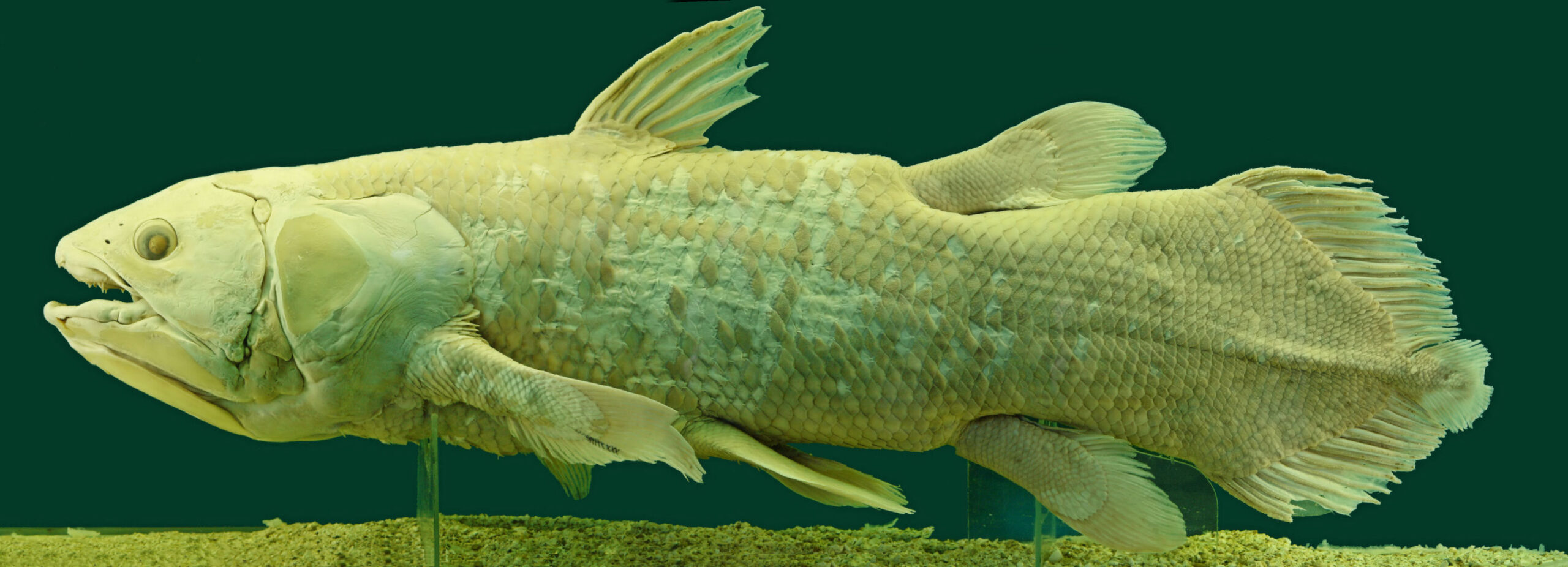 Photo Credit: Alberto Fernandez Fernandez / Wikimedia
In the shadowy depths of the ocean, where sunlight barely penetrates, lives a remarkable fish known as the coelacanth, or Latimeria chalumnae. This ancient creature, often referred to as a “living fossil,” boasts a lineage that stretches back over 400 million years, making it a true marvel of evolution. With its thick, lobed fins that resemble the limbs of land animals, the coelacanth glides gracefully through the cool, dark waters, often seeking refuge in underwater caves and rocky crevices. Its body, which can weigh up to 200 pounds, is adorned with a unique pattern of scales that shimmer like jewels in the dim light, captivating the hearts of scientists and nature enthusiasts alike.
The coelacanth’s fascinating history and distinctive features have made it a subject of intense study and admiration. Once thought to be extinct for millions of years, this fish was rediscovered in 1938 off the coast of South Africa, igniting excitement in the scientific community. Its ability to thrive in deep-sea environments, along with its carnivorous diet of cephalopods and other fish, showcases its adaptability and resilience. As researchers continue to explore the mysteries of the coelacanth, they uncover not only the secrets of this ancient fish but also the intricate web of life it supports in its underwater realm. Join us as we dive deeper into the world of the coelacanth, exploring its behavior, habitat, and the vital role it plays in the ocean’s ecosystem.
The coelacanth is a captivating fish that occupies a special place in the tree of life. Belonging to the class Sarcopterygii, which includes lobe-finned fishes, it is often referred to as a “living fossil.” This term highlights its ancient lineage, as coelacanths have existed for over 400 million years, long before the dinosaurs roamed the Earth. Their unique features, such as their lobed pectoral and pelvic fins, set them apart from most modern fish, making them a key species for understanding the evolution of vertebrates.
| Taxonomic Rank | Scientific Name | Meaning & Significance |
|---|---|---|
| Kingdom | Animalia | This name signifies that coelacanths are part of the animal kingdom, which includes all multicellular organisms that are not plants, fungi, or bacteria. |
| Phylum | Chordata | Chordata means “having a notochord,” a flexible rod that supports the body. This feature is a key characteristic of all vertebrates, including humans. |
| Class | Sarcopterygii | Sarcopterygii translates to “fleshy fins,” referring to the lobe-like fins that are more muscular and bony than the fins of ray-finned fish. This adaptation is significant for the evolution of land vertebrates. |
| Order | Coelacanthiformes | This order name comes from the Greek words “koilos,” meaning hollow, and “akantha,” meaning spine. It refers to the unique hollow structure of their spines. |
| Family | Latimeriidae | Named after Marjorie Courtenay-Latimer, the woman who discovered the first living coelacanth in 1938, this family honors her contribution to science. |
| Genus | Latimeria | This genus name also pays tribute to Marjorie Courtenay-Latimer, emphasizing the importance of her discovery in understanding this ancient lineage. |
The classification of the coelacanth reveals a rich evolutionary history that connects it to both ancient and modern species. Its position in the tree of life illustrates how this fish has survived dramatic changes in the Earth’s environment over millions of years. By studying coelacanths, scientists gain valuable insights into the transition from water to land, as their lobe-finned structure is a precursor to the limbs of terrestrial animals. This remarkable lineage not only enriches our understanding of evolution but also reminds us of the incredible diversity of life that has thrived on our planet.
The evolutionary journey of the coelacanth stretches back over 400 million years, placing it in the depths of the Devonian period. This ancient fish swam alongside the first amphibians and dinosaurs, making it a living link to a time when life was just beginning to explore the land. Coelacanths were once thought to be extinct, vanishing from the fossil record around 66 million years ago, until a remarkable discovery in 1938 off the coast of South Africa revealed that they were still alive, swimming in the depths of the ocean.
The ancestors of coelacanths were among the first fish to develop lobe-fins, which are fleshy, limb-like structures that allowed them to navigate through shallow waters and possibly venture onto land. This adaptation was a significant evolutionary step, as it paved the way for the eventual transition of some fish into amphibians. Over millions of years, coelacanths evolved to thrive in deep-sea environments, developing unique features such as a hinged skull that allows them to open their mouths wide to capture prey. Their distinctive, three-lobed tail fin is another evolutionary trait that helps them maneuver gracefully in the water, showcasing their adaptability to various aquatic habitats.
The adaptations of the coelacanth have been crucial for its survival in the ever-changing ocean environment. With features that enhance their hunting abilities and allow them to thrive in deep waters, these ancient fish have successfully navigated the challenges of their habitat for millions of years. Their evolutionary story is a testament to the resilience of life, showcasing how adaptations can lead to survival across vast stretches of time.
The coelacanth is a stunning fish that captures the imagination with its ancient lineage and striking appearance. With a robust body that can weigh up to 200 pounds, this fish boasts a unique structure that sets it apart from most modern fish. Its most distinctive feature is its lobe-finned appendages, which resemble the limbs of land animals. These fleshy fins give the coelacanth a prehistoric look, as if it has stepped right out of a time capsule. Its skin, covered in tough scales, adds to its rugged charm, making it a true marvel of the ocean depths.
| Feature | Description |
|---|---|
| Weight | Up to 200 lbs |
| Skin Type | Scales |
| Most Distinctive Feature | Lobed fin |
The coelacanth’s impressive weight and sturdy scales provide it with both protection and buoyancy in the deep sea. Its lobe-finned structure is not just for show; these fins allow for agile movements in the water, helping it navigate through rocky crevices and coral reefs. This combination of features not only showcases its evolutionary history but also equips the coelacanth to thrive in its underwater habitat, making it a living testament to the wonders of evolution.
The coelacanth calls the deep, mysterious oceans its home, often dwelling in underwater caves and rocky crevices. These ancient fish prefer the cool, dark waters, typically found at depths ranging from 500 to 2,000 feet. Here, they glide gracefully through the shadows, surrounded by a world of vibrant corals and swaying sea plants. The ocean floor, with its rugged terrain and hidden nooks, provides the perfect sanctuary for this remarkable species.
The coelacanth thrives in environments where the water temperature is relatively stable, usually between 18 to 22 degrees Celsius (64 to 72 degrees Fahrenheit). These fish are also sensitive to changes in salinity, which is the measure of salt in water. They prefer areas with low light and high pressure, conditions that are typical of the deep sea. The unique combination of these factors creates a habitat that is both safe and suitable for their survival.
Over millions of years, the coelacanth has developed fascinating adaptations to its deep-sea environment. Its thick, lobed fins allow it to maneuver skillfully through rocky landscapes, while its ability to detect electrical signals helps it locate prey in the dark waters. This ancient fish has also evolved a unique way of breathing, using a special organ that allows it to extract oxygen from the water efficiently. These adaptations not only help the coelacanth survive but also thrive in the depths of the ocean, where few other creatures dare to venture.
The coelacanth leads a life that is both intriguing and solitary. As a deep-sea dweller, it spends its days navigating the dark, cool waters of the ocean, often resting in underwater caves or rocky crevices. These ancient fish are primarily nocturnal, meaning they are most active during the night. When the sun sets, the coelacanth emerges to hunt for its favorite meals, which include fish and cephalopods, like squid. With its unique lobe-finned structure, it glides gracefully through the water, using its powerful fins to maneuver around obstacles in its environment.
In terms of social behavior, the coelacanth is a solitary creature. Unlike many fish that form schools or groups, coelacanths prefer to live alone. This solitary lifestyle may help them avoid competition for food and reduce the risk of predation. While they do not engage in complex social interactions, they are equipped with keen senses that allow them to detect changes in their surroundings. This heightened awareness is crucial for survival in the deep sea, where visibility is often limited and threats can come from any direction.
| Behavior Type | Description |
|---|---|
| Activity Patterns | Nocturnal foraging, resting in caves during the day |
| Social Structure | Solitary, avoiding group dynamics |
| Communication Methods | Limited; relies on sensory perception rather than vocalizations |
The coelacanth’s solitary behaviors play a vital role in its survival. By avoiding the hustle and bustle of group life, it minimizes competition for food and reduces the chances of attracting predators. Its ability to navigate the dark depths of the ocean with precision allows it to find food and shelter effectively. This ancient fish has thrived for millions of years, and its unique lifestyle is a testament to the adaptability and resilience of life in the deep sea.
The coelacanth is a carnivorous fish, meaning it primarily eats other animals. Its diet mainly consists of cephalopods, like squid and octopus, as well as various fish. This ancient fish has developed specialized hunting techniques that allow it to thrive in the deep, dark waters where it resides. With its keen sense of smell and ability to detect vibrations in the water, the coelacanth can locate its prey even in the murkiest conditions.
| Dietary Aspect | Details |
|---|---|
| Diet Type | Carnivore |
| Favorite Foods | Cephalopods and fish |
| Prey Items | Squid, octopus, and smaller fish |
| Hunting/Foraging Strategies | Uses keen sense of smell and detects vibrations to locate prey |
This diet plays a crucial role in the coelacanth’s ecology and daily routine. By preying on cephalopods and fish, it helps maintain the balance of marine life in its habitat. The coelacanth’s unique feeding behavior not only supports its survival but also influences the populations of its prey, showcasing the interconnectedness of ocean ecosystems. As it glides through the depths, this ancient fish continues to be a vital part of the underwater world, reminding us of the delicate balance that sustains life in our oceans.
The coelacanth’s mating behavior is as mysterious as its ancient lineage. These fish are believed to have a breeding season that coincides with specific environmental cues, such as water temperature and food availability. During this time, males may engage in elaborate courtship displays to attract females. While much about their reproduction remains a puzzle, scientists think that coelacanths may reproduce through a process called ovoviviparity. This means that the eggs develop inside the female’s body, and she gives birth to live young, rather than laying eggs in the open water.
| Reproductive Aspect | Details |
|---|---|
| Gestation Period | Unknown |
| Litter Size | Up to 30 young |
| Age of Maturity | About 10-15 years |
| Name of Young | Fry |
Once the fry are born, they are relatively independent and must quickly learn to navigate their deep-sea environment. The young coelacanths are miniature versions of their parents, equipped with the same remarkable adaptations that help them thrive in the ocean’s depths. While the adults do not provide direct parental care, the fry benefit from the rich habitat where they are born, which offers plenty of hiding spots and food sources. As they grow, these young fish will gradually develop the skills and strength needed to survive in the vast, mysterious ocean, continuing the ancient lineage of the coelacanth.
The coelacanth, a fascinating relic of the deep, occupies a unique position in the ocean’s food web. As a carnivorous fish, it preys on cephalopods and various fish, making it an important predator in its underwater habitat. However, despite its ancient lineage and impressive adaptations, the coelacanth faces several dangers that threaten its survival.
To defend itself against these threats, the coelacanth relies on its remarkable adaptations. Its thick, bony scales provide a tough armor against predators, while its ability to remain hidden in dark caves helps it avoid detection. Additionally, the coelacanth’s slow-moving lifestyle allows it to conserve energy, making it less vulnerable to the dangers of its environment. By utilizing these survival strategies, this ancient fish continues to navigate the challenges of its deep-sea world.
A keystone species is a vital part of an ecosystem, playing a crucial role in maintaining its structure and balance. These species have a disproportionately large impact on their environment compared to their abundance. The coelacanth, an ancient fish that has survived for millions of years, does not fit the traditional definition of a keystone species. While it is an important predator in its deep-sea habitat, its solitary lifestyle and specific ecological niche mean that its absence would not lead to the same dramatic changes seen with true keystone species.
The coelacanth primarily feeds on cephalopods, such as squid and octopus, as well as various fish. By preying on these animals, it helps regulate their populations, ensuring that no single species becomes too dominant. This balance is essential for the health of the ecosystem, as it allows for a diverse range of marine life to thrive. Additionally, the coelacanth’s unique hunting techniques, which include using its lobed fins to maneuver through rocky crevices, contribute to the dynamic interactions within its habitat.
Moreover, the coelacanth serves as an indicator species, meaning its presence can signal the overall health of the marine environment. Because it inhabits deep, often fragile ecosystems, changes in its population can reflect shifts in ocean conditions, such as temperature and pollution levels. This makes the coelacanth a valuable species for scientists studying the impacts of climate change and human activity on marine ecosystems.
If the coelacanth were to disappear, the effects might not be immediately obvious, but they could ripple through the ecosystem over time. Without this ancient predator, populations of its prey could surge, potentially leading to overgrazing of certain species and a decline in biodiversity. This imbalance could disrupt the entire food web, affecting not only the coelacanth’s immediate environment but also the broader marine ecosystem. The loss of such a unique species would also mean a loss of valuable scientific knowledge about evolution and the history of life in our oceans.
The coelacanth plays a fascinating role in its underwater ecosystem, acting as a keystone species that helps maintain the balance of marine life. This ancient fish, which has existed for over 400 million years, thrives in the deep, cool waters of the ocean. By preying on various fish and cephalopods, such as squid and octopus, the coelacanth helps regulate the populations of these species, ensuring that no single group dominates the ecosystem. Its presence is a reminder of the intricate connections that exist beneath the waves.
| Ecosystem Service | Impact |
|---|---|
| Predation | Controls populations of prey species, promoting biodiversity. |
| Habitat Structure | Utilizes underwater caves and rocky crevices, influencing the physical environment. |
| Food Source | Serves as prey for larger marine predators, contributing to the food web. |
| Indicator Species | Reflects the health of deep-sea ecosystems, signaling changes in environmental conditions. |
The coelacanth’s influence extends beyond its role as a predator. By residing in underwater caves and rocky crevices, it helps shape the physical environment of its habitat. These structures provide shelter not only for the coelacanth but also for other marine organisms, creating a complex web of life. Additionally, as a food source for larger predators, the coelacanth contributes to the overall health of the marine food web. Its presence indicates a thriving ecosystem, as it is sensitive to changes in water quality and temperature.
Understanding the coelacanth’s ecological importance highlights the interconnectedness of marine life. As a keystone species, it plays a crucial role in maintaining the balance of its environment. The health of the coelacanth population can signal shifts in the ecosystem, making it an important focus for conservation efforts. Protecting this ancient fish not only preserves its lineage but also supports the diverse array of life that depends on the delicate balance of the ocean’s depths.
In the intricate web of life beneath the ocean’s surface, symbiosis plays a vital role in shaping the relationships between species. Symbiosis refers to the close interactions between different organisms, which can be beneficial, harmful, or neutral. These relationships can take many forms, such as mutualism, where both species gain advantages, parasitism, where one benefits at the other’s expense, and commensalism, where one species benefits while the other is neither helped nor harmed. Understanding these connections helps us appreciate the delicate balance of marine ecosystems, including the life of the coelacanth.
| Species/Type | Relationship Type | Description |
|---|---|---|
| Cleaner Wrasse | Mutualistic | The cleaner wrasse removes parasites and dead skin from the coelacanth, benefiting from a meal while helping the fish stay healthy. |
| Remora Fish | Commensal | Remoras attach themselves to the coelacanth, gaining a free ride and access to food scraps without affecting the coelacanth. |
| Various Parasites | Parasitic | Some parasites may latch onto the coelacanth, feeding on its blood or tissues, which can harm the fish over time. |
These relationships have evolved over millions of years, showcasing the adaptability and interconnectedness of marine life. The coelacanth, with its solitary nature, still engages in these partnerships, highlighting the importance of cooperation in the ocean. Mutualistic relationships, like that with cleaner wrasses, enhance the coelacanth’s health, while commensal relationships with remoras provide benefits without causing harm. Understanding these dynamics not only enriches our knowledge of the coelacanth but also emphasizes the significance of preserving the delicate balance of marine ecosystems.
The coelacanth is a truly extraordinary fish that has captured the imagination of scientists and nature lovers alike. Often called a “living fossil,” this ancient creature has a history that stretches back hundreds of millions of years, making it a remarkable subject of study.
The coelacanth, often dubbed a “living fossil,” has a rich history intertwined with human culture and curiosity. Discovered in 1938 off the coast of South Africa, this ancient fish was thought to have been extinct for over 66 million years. Its reappearance sparked excitement and wonder, leading to a surge of interest in paleontology and marine biology. In various cultures, the coelacanth has been seen as a symbol of resilience and mystery, embodying the idea that life can endure through the ages. Its striking appearance and deep-sea habitat have made it a subject of fascination in art, literature, and scientific inquiry.
Today, the relationship between coelacanths and humanity is marked by both conservation efforts and challenges. As a species that thrives in deep, often inaccessible waters, coelacanths are vulnerable to threats such as overfishing and habitat destruction. Conservationists are working diligently to protect these ancient fish and their habitats, recognizing their importance in maintaining the balance of marine ecosystems. However, conflicts can arise when local fishing communities depend on the same waters for their livelihoods. Striking a balance between protecting the coelacanth and supporting human communities is crucial for the future of both.
As we look to the future, the relationship between coelacanths and humanity holds both promise and responsibility. With ongoing research and conservation initiatives, there is hope that we can protect these ancient fish while fostering a deeper understanding of our oceans. By learning from the coelacanth’s remarkable history, we can inspire future generations to appreciate and safeguard the wonders of marine life. Together, we can ensure that this living link to our planet’s past continues to thrive in the depths of the sea.
The coelacanth is currently classified as Critically Endangered, a status that highlights the urgent need for conservation efforts. With an estimated population size of only hundreds to thousands, this ancient fish faces significant challenges in its survival. The population trend is concerning, as the numbers are not increasing, indicating that the species is still at risk.
| Conservation Factor | Status/Details |
|---|---|
| IUCN Status | Critically Endangered |
| Estimated Population Size | Hundreds or thousands |
| Population Trend | Stable but not increasing |
The main threats to the coelacanth include habitat destruction and fishing practices. As deep-sea environments are disturbed by human activities, such as trawling and pollution, the delicate ecosystems that support coelacanth populations are compromised. Additionally, accidental capture in fishing nets poses a significant risk, as these fish are often caught unintentionally while targeting other species.
Conservation efforts are underway to protect the coelacanth and its habitat. Organizations are working to raise awareness about the importance of this ancient fish and its role in marine ecosystems. Protected areas have been established to safeguard their habitats, and research is ongoing to better understand their biology and behavior. With continued efforts, there is hope that the coelacanth can be preserved for future generations to marvel at this living link to our planet’s distant past.
| Question | Answer |
|---|---|
| Where do Coelacanths live? | Coelacanths are found in the deep oceans, primarily around the coasts of Madagascar and the Comoros Islands. They prefer rocky underwater habitats, often dwelling at depths of 150 to 700 feet, where they can find shelter and food. |
| What do Coelacanths eat? | Coelacanths are carnivores, meaning they primarily eat other animals. Their diet consists of fish and cephalopods, like squid, which they catch using their unique lobe-finned structure to maneuver through the water. |
| How do Coelacanths behave? | Coelacanths are known for their slow, graceful swimming style. They are generally solitary creatures, but they can sometimes be seen resting on the ocean floor or exploring their rocky habitats in search of food. |
| How do Coelacanths reproduce? | Coelacanths have a fascinating reproductive process. They give birth to live young, which is quite rare among fish. The females can carry their young for several years before giving birth, ensuring that the babies are well-developed when they arrive. |
| What threats do Coelacanths face? | Coelacanths are critically endangered, facing threats from habitat destruction and fishing practices. Their deep-sea habitats are often disturbed by human activities, and they can accidentally get caught in fishing nets. |
| What is a unique characteristic of Coelacanths? | One of the most distinctive features of Coelacanths is their lobe-shaped fins, which resemble the limbs of land animals. This unique fin structure is a key reason scientists believe they are closely related to the ancestors of all land vertebrates. |
| Why are Coelacanths considered a "living fossil"? | Coelacanths are often called "living fossils" because they have changed very little over millions of years. They were thought to be extinct for about 66 million years until one was discovered alive in 1938, providing a direct link to ancient fish species. |