Taxonomy & Classification
- Kingdom
- Animalia
- Phylum
- Chordata
- Class
- Actinopterygii
- Order
- Acipenseriformes
- Family
- Polyodontidae
- Genus
- Polyodon
- Species
- Polyodon spathula

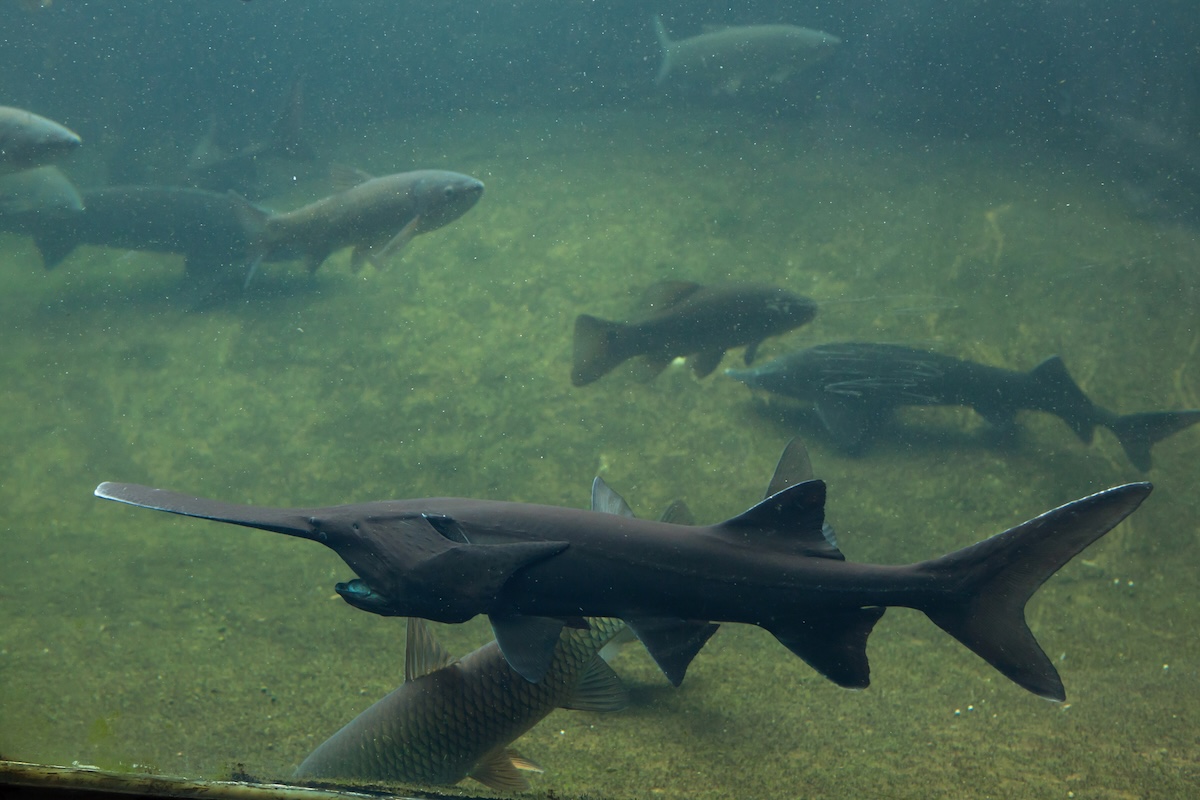 Photo Credit: wrangel on Deposit Photos
In the shimmering waters of the Mississippi River Basin swims the American Paddlefish, known scientifically as Polyodon spathula. This ancient fish, with its long, sleek body and distinctive paddle-shaped snout, glides gracefully through the currents, embodying a living link to a time when dinosaurs roamed the Earth. Imagine standing on the riverbank, watching as this remarkable creature surfaces, its flat snout breaking the water’s surface like a gentle wave, while its gill rakers filter tiny zooplankton from the water, showcasing a feeding style that has remained unchanged for millions of years.
The Paddlefish is not just a sight to behold; it is a marvel of evolution. With a lineage that stretches back over 300 million years, it has adapted to its environment in ways that continue to intrigue scientists and nature lovers alike. Its unique features, such as the electroreceptors along its snout that help it detect prey in murky waters, make it a subject of ongoing research. As we explore the life of the American Paddlefish, we will uncover its vital role in the ecosystem, its fascinating behaviors, and the challenges it faces in a rapidly changing world. Join us on this adventure to learn more about a fish that has not only survived the test of time but also plays a crucial part in the health of its aquatic home.
The American Paddlefish, scientifically known as Polyodon spathula, occupies a distinctive place in the tree of life. This ancient fish is a member of the kingdom Animalia, which includes all animals, and it belongs to the phylum Chordata, characterized by having a backbone. What sets the American Paddlefish apart is its long, flattened snout, resembling a paddle, which is not just for show. This unique feature helps it detect food in the murky waters of rivers and lakes, making it a master of its aquatic environment. Paddlefish are also one of the few surviving members of a lineage that dates back over 200 million years, giving them a fascinating evolutionary story.
| Taxonomic Rank | Scientific Name | Meaning & Significance |
|---|---|---|
| Kingdom | Animalia | This name means “animals” in Latin, highlighting that paddlefish are part of the vast group of living organisms that are multicellular and consume organic material. |
| Phylum | Chordata | Derived from the Greek word “chordē,” meaning “string,” this classification indicates that paddlefish have a notochord, a flexible rod that supports their body during development. |
| Class | Actinopterygii | This term means “ray-finned fishes,” referring to the bony rays that support their fins, a feature that distinguishes them from other fish classes. |
| Order | Acipenseriformes | This name comes from “Acipenser,” the Latin word for sturgeon, indicating a close relationship with these ancient fish, which share similar habitats and features. |
| Family | Polyodontidae | From the Greek “polus,” meaning “many,” and “odous,” meaning “teeth,” this family name reflects the paddlefish’s many small, comb-like teeth used for filtering food from the water. |
| Genus | Polyodon | This name means “many teeth,” which is fitting as paddlefish have numerous small teeth that help them feed on plankton and small organisms. |
| Species | spathula | Derived from the Greek word “spathulē,” meaning “spatula,” this name describes the paddlefish’s distinctive paddle-shaped snout. |
The classification of the American Paddlefish reveals much about its evolutionary journey. As a member of the ancient lineage of ray-finned fishes, it showcases adaptations that have allowed it to thrive in freshwater environments for millions of years. Its unique features, such as the paddle-shaped snout and filter-feeding habits, highlight how this species has evolved to survive in a changing world. Understanding its place in the tree of life not only deepens our appreciation for this fascinating fish but also underscores the importance of conserving its habitats for future generations.
The evolutionary journey of the American Paddlefish stretches back over 300 million years, making it one of the oldest surviving species in North America. This fish has witnessed dramatic changes in the Earth’s climate and geography, adapting to survive in a world that has transformed around it. Its lineage can be traced to ancient relatives that swam in the waters of prehistoric seas, showcasing a remarkable story of resilience and adaptation.
The ancestors of the American Paddlefish were part of a group known as the Chondrichthyes, which includes sharks and rays. Over time, these early fish evolved into bony fish, a significant transition that allowed them to thrive in freshwater environments. The Paddlefish itself emerged around 70 million years ago, during the Late Cretaceous period. This period was marked by the rise of flowering plants and the diversification of many animal groups. The Paddlefish developed a long, flattened snout, or rostrum, which is a defining feature that helps it detect food in murky waters. This adaptation is a result of millions of years of evolution, allowing it to sense vibrations and movements in the water, a skill that is crucial for survival.
The adaptations of the American Paddlefish have been vital for its survival in changing ecosystems. Its ability to sense food in dark or murky waters, combined with its efficient swimming and feeding mechanisms, has allowed it to thrive where many other species have struggled. As rivers and lakes have evolved, so too has the Paddlefish, showcasing the incredible power of evolution to shape life in response to environmental challenges.
The American Paddlefish is a striking sight in the waters it inhabits. With its elongated body and flat, paddle-like snout, it captures attention instantly. This fish can grow quite large, reaching lengths of up to 6 feet, making it one of the biggest freshwater fish in North America. Its sleek, streamlined form allows it to glide effortlessly through rivers and lakes, while its smooth skin glistens in the sunlight, reflecting shades of gray and blue. The paddlefish’s unique shape not only makes it visually captivating but also plays a crucial role in its feeding habits.
| Feature | Description |
|---|---|
| Size | Can grow up to 6 feet long |
| Color | Grayish-blue with a smooth, shiny appearance |
| Skin Type | Smooth, allowing for easy movement through water |
| Snout | Flat and paddle-like, used for sensing food |
The combination of its size, color, and distinctive paddle-shaped snout serves multiple purposes for the American Paddlefish. The smooth skin reduces drag as it swims, enabling it to move swiftly in search of food. Its paddle-like snout is not just for show; it is equipped with electroreceptors that help the fish detect tiny prey like zooplankton in the water. This remarkable adaptation allows the paddlefish to thrive in its aquatic environment, showcasing the incredible ways in which form and function come together in the natural world.
The American Paddlefish thrives in the expansive waters of the Mississippi River Basin, a vast network of rivers, lakes, and wetlands. This habitat is characterized by slow-moving waters, where the fish can glide gracefully through the currents. The riverbanks are often lined with lush vegetation, providing a rich ecosystem that supports a variety of life. The waters are typically murky, filled with nutrients that sustain the paddlefish’s diet of tiny plankton and other microscopic organisms.
The American Paddlefish prefers warm, freshwater environments, typically found in areas where the water temperature ranges from 60 to 80 degrees Fahrenheit. These fish are sensitive to changes in their surroundings, thriving in clean, well-oxygenated waters. They often inhabit deeper pools and areas with gentle currents, which provide the ideal conditions for feeding and breeding. The presence of aquatic plants and a stable substrate, like sand or gravel, also plays a crucial role in their habitat preferences.
Over time, the American Paddlefish has developed several adaptations that help it survive in its specific environment. Its long, paddle-shaped snout is not just for show; it helps the fish detect food in the murky waters by sensing vibrations and electrical signals. This unique feature allows the paddlefish to efficiently locate its microscopic prey. Additionally, its streamlined body enables it to navigate through the water with ease, making it a skilled swimmer in the ever-changing currents of the Mississippi River Basin.
The American Paddlefish leads a life that is both tranquil and dynamic, gliding through the waters of the Mississippi River Basin. Each day, these fish engage in a variety of activities that revolve around feeding, socializing, and navigating their aquatic environment. Paddlefish are filter feeders, using their specialized gill rakers to sift through the water for tiny organisms like zooplankton. This feeding method often involves swimming with their mouths open, allowing them to capture food while they move. As they swim, they can be seen occasionally breaching the surface, a behavior that may help them breathe or communicate with others nearby.
Socially, American Paddlefish are known to be somewhat gregarious, often found in loose groups. These gatherings can vary in size, from small clusters to larger schools, especially during feeding times. Within these groups, paddlefish exhibit interesting dynamics, as they seem to communicate through subtle movements and body language. They may swim in synchronized patterns, which not only helps them find food more efficiently but also strengthens their social bonds. This social behavior is crucial, as it allows them to navigate their environment more effectively and enhances their chances of survival.
| Behavior Type | Description |
|---|---|
| Feeding | Paddlefish filter feed by swimming with their mouths open, capturing tiny organisms like zooplankton using their gill rakers. |
| Social Structure | They often form loose groups or schools, which can vary in size and help them find food and avoid predators. |
| Communication | Subtle movements and synchronized swimming patterns are used to communicate with one another, enhancing group cohesion. |
The behaviors of the American Paddlefish are finely tuned to ensure their survival in a complex ecosystem. By feeding in groups, they maximize their chances of finding food, while their social interactions help them stay alert to potential threats. This combination of feeding strategies and social dynamics not only supports their individual well-being but also strengthens the resilience of the population as a whole. In the ever-changing waters of their habitat, these behaviors are essential for thriving in a world filled with challenges.
The American Paddlefish primarily feeds on zooplankton, tiny drifting animals that float in the water. These fish are filter feeders, meaning they take in water through their mouths and use their gill rakers—special comb-like structures—to trap their food. As they swim with their mouths open, they filter out these minuscule creatures, which are abundant in their riverine habitats. This feeding strategy allows them to consume large quantities of food while moving gracefully through the water.
| Dietary Aspect | Details |
|---|---|
| Diet Type | Filter feeder |
| Favorite Foods | Zooplankton |
| Prey Items | Tiny aquatic animals |
| Hunting/Foraging Strategies | Swimming with mouth open to filter food from water |
The diet of the American Paddlefish plays a crucial role in its ecology and daily routine. By consuming zooplankton, these fish help maintain the balance of their aquatic ecosystem, as they control the population of these tiny organisms. Their feeding habits also influence the distribution of nutrients in the water, which can affect other species. As they glide through their riverine homes, the paddlefish not only sustain themselves but also contribute to the health of their environment, showcasing the interconnectedness of life in freshwater ecosystems.
As spring arrives, the American Paddlefish begins its mating ritual, a captivating dance that takes place in the shallow waters of rivers and lakes. During this time, males become particularly active, swimming vigorously to attract females. The breeding season typically occurs from late March to early June, coinciding with rising water temperatures. Males will often chase females, and once a female is ready to spawn, she releases her eggs into the water, where males fertilize them. This synchronized behavior ensures that the eggs have the best chance of survival.
| Reproductive Aspect | Details |
|---|---|
| Gestation Period | Approximately 5 to 10 days |
| Litter Size | Up to 300,000 eggs |
| Age of Maturity | 3 to 7 years |
| Name of Young | Fry |
After the eggs are fertilized, they drift in the water until they hatch into tiny fry. These young paddlefish are independent from the moment they emerge, relying on their natural instincts to find food and avoid predators. As they grow, they undergo significant changes, developing their distinctive paddle-like snouts and adapting to their aquatic environment. While the American Paddlefish does not provide parental care, the sheer number of eggs laid increases the chances that some will survive to adulthood. With time, these fry will mature into the majestic paddlefish that glide through the waters of North America, continuing the cycle of life in their riverine habitats.
The American Paddlefish plays a vital role in its aquatic ecosystem, serving as both a filter feeder and a prey species. Positioned in the food web, it helps maintain the balance of zooplankton populations while also being a target for various predators. This ancient fish, with its unique paddle-like snout, is an important part of the Mississippi River Basin’s biodiversity, but it faces several dangers that threaten its survival.
To defend against these threats, the American Paddlefish has developed several survival strategies. Its size and speed can help it evade predators, while its ability to filter feed allows it to thrive even in less-than-ideal conditions. Additionally, paddlefish often inhabit deeper waters where they are less visible to potential threats. By adapting to their environment and utilizing their unique physical traits, these ancient fish continue to navigate the challenges they face in the wild.
A keystone species is an organism that has a disproportionately large impact on its environment relative to its abundance. In the case of the American Paddlefish, or Polyodon spathula, it does indeed play a keystone role in its ecosystem. This ancient fish is not just a fascinating inhabitant of the Mississippi River Basin; it helps maintain the balance of its aquatic environment in significant ways.
The American Paddlefish primarily feeds on zooplankton, tiny organisms that drift in the water. By filtering these small creatures from the water, paddlefish help control their populations. This feeding behavior is crucial because zooplankton are a key food source for many other aquatic animals, including fish and invertebrates. If paddlefish numbers decline, zooplankton could multiply unchecked, leading to imbalances that might harm other species in the ecosystem.
Moreover, paddlefish serve as a food source for larger predators, such as birds and larger fish. Their presence supports a diverse food web, ensuring that various species can thrive. Additionally, as they move through their habitat, paddlefish stir up sediments, which can help distribute nutrients in the water. This process supports the growth of aquatic plants, which are vital for oxygen production and provide shelter for many other organisms.
If the American Paddlefish were to disappear, the consequences could be dire. Without these fish, zooplankton populations could explode, leading to a decline in water quality and a reduction in food availability for other species. This imbalance could ripple through the ecosystem, affecting everything from small fish to larger predators. The loss of paddlefish would not only disrupt the food web but could also lead to a decline in biodiversity, making the Mississippi River Basin a less vibrant and healthy environment.
The American Paddlefish, known scientifically as Polyodon spathula, plays a crucial role in its ecosystem, particularly within the Mississippi River Basin. As a filter feeder, it helps regulate the populations of tiny organisms called zooplankton, which float in the water. By consuming these microscopic creatures, the paddlefish not only sustains itself but also contributes to the overall health of its aquatic environment. This balance is essential for maintaining water quality and supporting other species that share its habitat.
| Ecosystem Service | Impact |
|---|---|
| Filter Feeding | Controls zooplankton populations, improving water clarity and quality. |
| Prey for Larger Species | Serves as a food source for larger fish and birds, supporting the food web. |
| Nutrient Cycling | Contributes to the cycling of nutrients in the ecosystem through its feeding habits. |
| Habitat Structure | Influences the physical environment by interacting with sediment and water flow. |
The influence of the American Paddlefish extends beyond its immediate feeding habits. For instance, by consuming large amounts of zooplankton, it helps keep these populations in check, which in turn allows for a diverse range of aquatic plants to thrive. Healthy plant life is vital for oxygen production and provides shelter for various fish and invertebrate species. Additionally, paddlefish are prey for larger predators, such as eagles and larger fish, creating a link in the food web that supports a variety of wildlife.
The broader ecological importance of the American Paddlefish cannot be overstated. As a keystone species, its presence helps maintain the balance of the Mississippi River Basin’s ecosystem. When paddlefish populations are healthy, they contribute to a thriving aquatic community, which benefits not only other species but also the overall health of the river system. Protecting this ancient fish is essential for preserving the intricate web of life that depends on clean, clear waters and a balanced ecosystem.
In the intricate web of life, symbiosis refers to the close interactions between different species, which can take on various forms. These relationships can be mutualistic, where both species benefit, parasitic, where one benefits at the expense of the other, or commensal, where one benefits while the other is neither helped nor harmed. The American Paddlefish, a fascinating inhabitant of the Mississippi River Basin, engages in several ecological partnerships that highlight the interconnectedness of aquatic life.
| Species/Type | Relationship Type | Description |
|---|---|---|
| Zooplankton | Mutualistic | The American Paddlefish feeds on zooplankton, which helps control their populations while providing the fish with essential nutrients. |
| Fish Lice (Argulus spp.) | Parasitic | These small crustaceans attach to the paddlefish, feeding on its blood and tissues, which can weaken the fish over time. |
| Algae | Commensal | Algae can grow on the paddlefish’s skin, benefiting from the movement through water while the fish remains unaffected. |
The evolution of these relationships showcases the adaptability of the American Paddlefish and its environment. Over time, these interactions have shaped the behaviors and survival strategies of the species involved. For instance, the paddlefish’s role as a filter feeder not only aids in its own nourishment but also helps maintain the balance of zooplankton populations, demonstrating a beautiful example of mutual benefit. Understanding these connections deepens our appreciation for the delicate balance of ecosystems and the importance of every species within them.
The American Paddlefish is a captivating species that has been swimming in North American waters for millions of years. With its unique features and fascinating behaviors, this ancient fish continues to intrigue scientists and nature lovers alike.
The American Paddlefish, known scientifically as Polyodon spathula, has a rich history intertwined with human culture. Native American tribes revered this ancient fish, often incorporating it into their diets and spiritual practices. The paddlefish’s unique paddle-shaped snout and impressive size made it a symbol of strength and resilience. Early European settlers also recognized its value, leading to fishing practices that have persisted for centuries. This historical connection highlights the paddlefish’s significance not just as a food source, but as a part of the cultural fabric of the regions it inhabits.
Today, the relationship between the American Paddlefish and humanity is complex and multifaceted. Conservation efforts are underway to protect this species, which has faced threats from habitat loss, pollution, and overfishing. Organizations and researchers are working to restore paddlefish populations and their habitats, recognizing their role as a keystone species in aquatic ecosystems. However, conflicts arise as human activities, such as dam construction and industrial development, continue to impact their natural environments. Some innovative approaches, like aquaculture, aim to domesticate paddlefish for sustainable farming, providing a balance between human needs and ecological preservation.
The future of the American Paddlefish and its relationship with humanity hinges on our ability to balance ecological health with human interests. As awareness grows about the importance of preserving this ancient species, collaborative efforts between scientists, conservationists, and local communities will be essential. By fostering a deeper understanding of the paddlefish’s role in the ecosystem, we can ensure that future generations will continue to appreciate and protect this remarkable fish. Together, we can create a sustainable future where both paddlefish and people thrive.
The American Paddlefish, a fascinating species that has roamed North American waters for millions of years, currently faces a conservation status of Vulnerable. This means that while the species is not yet endangered, it is at risk of becoming so if current trends continue. Population estimates suggest that numbers have declined significantly due to various environmental pressures, leading to concerns about their long-term survival.
| Conservation Factor | Status/Details |
|---|---|
| IUCN Status | Vulnerable |
| Population Estimates | Decreasing, specific numbers vary by region |
| Trend Direction | Declining |
One of the main threats to the American Paddlefish is habitat loss. As rivers are dammed and altered for human use, the natural flow and quality of their habitats are disrupted. Pollution from agricultural runoff and industrial waste also poses a significant risk, affecting the water quality that these fish depend on for survival. Additionally, overfishing and illegal harvesting for their roe, which is used to make caviar, further threaten their populations.
Conservation efforts are underway to help protect the American Paddlefish and its habitat. Organizations are working to restore river ecosystems and improve water quality, while regulations are being enforced to limit fishing and harvesting. Public awareness campaigns aim to educate communities about the importance of this ancient fish. With continued efforts and support, there is hope that the American Paddlefish can rebound and thrive once again in its native waters.
| Question | Answer |
|---|---|
| Where do American Paddlefish live? | American Paddlefish are primarily found in the Mississippi River Basin. This includes rivers and lakes in states like Mississippi, Louisiana, and Arkansas, where they prefer large, slow-moving waters. |
| What do American Paddlefish eat? | These fascinating fish primarily feed on zooplankton, which are tiny organisms that drift in the water. They use their specialized gill rakers, which act like a filter, to capture these small creatures as they swim through the water. |
| How do American Paddlefish behave? | American Paddlefish are known for their unique swimming style, gliding gracefully through the water. They are often seen swimming near the surface, where they can easily catch their food, and they tend to be more active during the warmer months. |
| How do American Paddlefish reproduce? | During the spawning season, which typically occurs in spring, female Paddlefish release their eggs into the water, where males fertilize them. This process usually takes place in shallow areas of rivers, where the eggs can settle and develop safely. |
| What threats do American Paddlefish face? | American Paddlefish are currently classified as vulnerable, facing threats from habitat loss and pollution. Dams and other human activities can disrupt their natural spawning grounds, making it harder for them to reproduce successfully. |
| What are some interesting characteristics of American Paddlefish? | One of the most striking features of the American Paddlefish is its long, paddle-shaped snout, which can be nearly one-third of its body length. This unique snout helps them detect food in the water using electroreception, a special ability to sense electrical signals from other organisms. |
| How long can American Paddlefish live? | American Paddlefish can live for several decades, with some individuals reaching ages of 30 years or more. Their long lifespan allows them to grow quite large, with some weighing over 100 pounds! |