Taxonomy & Classification
- Kingdom
- Animalia
- Phylum
- Chordata
- Class
- Mammalia
- Order
- Primates
- Family
- Palaeopropithecidae
- Genus
- Archaeoindris
- Species
- Archaeoindris Fontoynontii

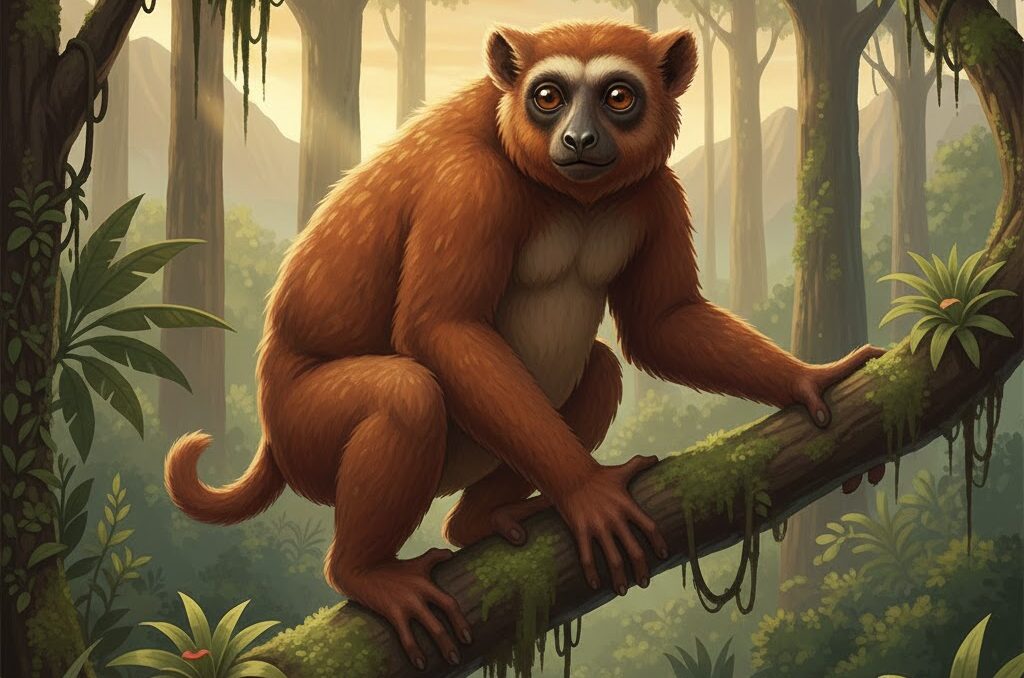 Photo Credit: AnimalsDiscovered
In the heart of Madagascar’s vibrant forests, a giant primate known as Archaeoindris, or the “giant sloth lemur,” once roamed the lush canopies and sun-dappled undergrowth. Imagine a creature so large that it could rival a modern-day gorilla, with a robust body and long limbs perfectly adapted for life among the trees. With its distinctive features, including a broad, flat face and powerful jaws, Archaeoindris was a sight to behold, captivating the imaginations of scientists and nature enthusiasts alike. This remarkable animal, which lived during the late Pleistocene epoch, around 1 million to 500,000 years ago, offers a fascinating glimpse into a world where extraordinary life flourished.
As you wander through the dense foliage of Madagascar, you can almost picture Archaeoindris swinging gracefully from branch to branch, foraging for leaves and fruits that made up its herbivorous diet. The forests, filled with towering trees and a symphony of sounds from other wildlife, provided a rich habitat for this massive primate. Its existence is a reminder of the incredible diversity that once thrived on our planet, and the mysteries that still lie hidden in the past. The story of Archaeoindris not only highlights the unique adaptations of this extinct species but also raises important questions about the delicate balance of ecosystems and the impact of extinction on biodiversity.
Archaeoindris is a captivating member of the animal kingdom, nestled within the tree of life as a remarkable example of prehistoric primates. This extinct genus belongs to the family Palaeopropithecidae, which includes some of the largest known lemurs. What sets Archaeoindris apart is its impressive size, comparable to that of a modern gorilla, and its unique adaptations for a life spent in the trees of Madagascar. These adaptations hint at a fascinating evolutionary journey, showcasing how species can evolve in isolation to fill specific ecological niches.
| Taxonomic Rank | Scientific Name | Meaning & Significance |
|---|---|---|
| Kingdom | Animalia | This name signifies that Archaeoindris is part of the vast group of multicellular organisms known as animals, which are characterized by their ability to move and respond to their environment. |
| Phylum | Chordata | Chordata means “having a notochord,” a flexible rod that supports the body. This group includes all animals with a backbone, highlighting Archaeoindris’s place among vertebrates. |
| Class | Mammalia | Mammalia refers to mammals, animals that possess mammary glands to nurse their young. Archaeoindris, like all mammals, would have had fur and likely gave birth to live young. |
| Order | Primates | Primates are known for their complex behaviors and large brains. This order includes humans, monkeys, and lemurs, showcasing Archaeoindris’s close evolutionary ties to these intelligent animals. |
| Family | Palaeopropithecidae | This family name means “ancient propithecids,” referring to a group of large, tree-dwelling lemurs. It highlights Archaeoindris’s adaptations for life in the treetops of Madagascar. |
| Genus | Archaeoindris | The name Archaeoindris translates to “ancient man-like,” reflecting its size and some physical traits that may have resembled those of modern primates, emphasizing its unique evolutionary path. |
The classification of Archaeoindris reveals much about its evolutionary history and the environment it inhabited. As a member of the Palaeopropithecidae family, it thrived in Madagascar’s lush forests, where it adapted to a life high in the trees. This isolation on the island led to unique evolutionary traits, showcasing how species can diverge and develop distinct characteristics over time. Understanding where Archaeoindris fits in the tree of life not only highlights its fascinating adaptations but also provides insight into the broader story of primate evolution and the ecological dynamics of Madagascar.
The story of Archaeoindris unfolds in the lush landscapes of Madagascar, where this extraordinary primate roamed during the late Pleistocene epoch, around 1 million to 500,000 years ago. This time period was marked by significant climatic changes and the evolution of diverse species, making Madagascar a unique hotspot for biodiversity. Archaeoindris, a member of the family Palaeopropithecidae, is a fascinating glimpse into the past, showcasing how life adapted to the island’s distinct environment.
Archaeoindris is believed to have evolved from earlier primate ancestors that adapted to the unique conditions of Madagascar. These ancestral forms were likely smaller and more agile, but as they evolved, they developed larger bodies and specialized traits. This transition allowed them to thrive in the island’s forests, where they became herbivorous, primarily feeding on leaves and fruits. Their adaptations included a more robust skeletal structure, which supported their larger size, and changes in their teeth that enabled them to process tough plant material more efficiently.
These adaptations were crucial for Archaeoindris’s survival in the competitive and changing environment of Madagascar. By growing larger, developing specialized teeth, and enhancing their climbing abilities, they could access a variety of food sources while avoiding many predators. Their potential social structures may have further bolstered their chances of thriving in a world filled with challenges. The evolutionary journey of Archaeoindris not only highlights the wonders of adaptation but also serves as a reminder of the delicate balance of life on our planet.
Archaeoindris presents an awe-inspiring silhouette that captures the imagination. This massive primate, once a resident of Madagascar, boasted a robust body structure that could rival that of a modern-day gorilla. With a weight of around 160 kilograms, or 350 pounds, it was one of the largest lemurs to ever exist. Its limbs were strong and muscular, designed for climbing and navigating the dense forests of its island home. The overall impression of Archaeoindris is one of power and grace, a gentle giant that moved through the trees with surprising agility.
| Feature | Description |
|---|---|
| Size | Approximately 1.5 meters (5 feet) tall when standing upright. |
| Weight | 160 kg (350 lb), making it one of the largest lemurs. |
| Color | Fur likely ranged from light brown to gray, providing camouflage in the forest. |
| Skin Type | Covered in thick fur, which helped insulate and protect it from the elements. |
| Limbs | Strong, muscular arms and legs adapted for climbing and swinging through trees. |
The features of Archaeoindris worked together beautifully to support its survival in a challenging environment. Its impressive size and weight provided a sense of security against predators, while its strong limbs allowed it to traverse the treetops with ease. The thick fur not only offered protection from the elements but also helped it blend into the dappled light of the forest, making it less visible to potential threats. In this way, Archaeoindris was perfectly adapted to thrive in the lush, vibrant world of Madagascar, a true testament to the wonders of evolution.
Archaeoindris once called the vibrant forests of Madagascar its home, a place where towering trees and dense foliage created a lush, green paradise. Imagine walking through a sun-dappled canopy, where the air is filled with the sounds of chirping birds and rustling leaves. This ancient giant lemur thrived in the rich biodiversity of Madagascar, surrounded by a variety of plants and animals that made this island unique. The forests provided not just shelter but also a smorgasbord of food, allowing Archaeoindris to flourish in its environment.
To thrive, Archaeoindris required a warm and humid climate, typical of Madagascar’s tropical environment. The island experiences a wet season, where heavy rains nourish the lush vegetation, and a dry season, which still maintains a mild temperature. These conditions are essential for the growth of the diverse plant life that Archaeoindris depended on for food. The combination of rich soil and ample sunlight allowed for a variety of trees and shrubs to flourish, creating a perfect habitat for this massive primate.
Adapting to its environment, Archaeoindris developed features that suited its forested home. Its strong limbs and grasping hands were perfect for climbing and swinging through the trees, allowing it to navigate the dense canopy with ease. This adaptation not only helped it find food but also provided safety from predators lurking below. The ability to thrive in such a specialized habitat showcases the incredible ways in which life can evolve to fit the unique challenges of its surroundings.
Archaeoindris led a life that revolved around the vibrant forests of Madagascar, where it spent its days foraging for food and navigating the treetops. As a diurnal creature, it was active during daylight hours, using its keen senses to search for leaves, fruits, and flowers. This massive primate was well-adapted to its arboreal lifestyle, moving gracefully among the branches, often using its strong limbs to swing and climb. Each day was a blend of exploration and feeding, as Archaeoindris sought out the best spots to munch on its favorite snacks.
While Archaeoindris was primarily solitary, it did not completely shun social interactions. These primates had their own ways of communicating, using a mix of vocalizations and body language to express themselves. When they did encounter one another, it was often a brief meeting, with each individual maintaining its own territory. This solitary behavior allowed them to minimize competition for food and resources, ensuring that they could thrive in their lush environment.
| Behavior Type | Description |
|---|---|
| Activity Patterns | Active during the day, foraging for leaves, fruits, and flowers in the treetops. |
| Social Structure | Primarily solitary, with occasional interactions between individuals. |
| Communication Methods | Utilized vocalizations and body language to convey messages and establish territory. |
The behaviors of Archaeoindris were finely tuned to ensure its survival in the rich ecosystems of Madagascar. By being diurnal, it capitalized on the abundance of food available during the day, while its solitary nature reduced competition for resources. This combination of traits allowed Archaeoindris to thrive in its environment, showcasing the intricate balance of life in the ancient forests it called home.
Archaeoindris was a herbivore, meaning it primarily fed on plant material. This massive primate had a diet that revolved around the abundant vegetation found in its forested habitat. With its strong teeth and jaws, Archaeoindris was well-equipped to munch on tough leaves, fruits, and possibly even bark. Its feeding behavior likely involved foraging through the treetops, where it could reach a variety of plant life, ensuring it had a steady supply of food throughout the day.
| Dietary Aspect | Details |
|---|---|
| Diet Type | Herbivore |
| Favorite Foods | Leaves, fruits, and possibly bark |
| Prey Items | N/A (as a herbivore, it did not hunt) |
| Hunting/Foraging Strategies | Foraged in trees, using strong teeth to consume tough plant material |
The diet of Archaeoindris played a crucial role in shaping its ecology and daily routine. By feeding on a variety of plant materials, it helped maintain the health of its forest environment, promoting growth and diversity among the flora. Its foraging habits likely influenced the structure of the forest, as the primate moved through the trees, creating pathways and openings. This interaction with its habitat not only supported its own survival but also contributed to the intricate web of life in Madagascar’s ecosystems.
Mating behavior in Archaeoindris likely revolved around the lush environment of Madagascar, where these massive primates would have engaged in courtship displays to attract mates. During the breeding season, which may have coincided with the availability of food resources, males would have showcased their strength and agility to impress potential partners. This season was crucial for ensuring the survival of their young, as a healthy environment would provide the necessary nutrients for both the mother and her offspring.
| Reproductive Aspect | Details |
|---|---|
| Gestation Period | Approximately 6 to 7 months |
| Litter Size | Usually one young |
| Age of Maturity | About 3 to 4 years |
| Name of Young | Infant |
Parental care in Archaeoindris was likely a vital aspect of their reproductive strategy. Mothers would have devoted significant time and energy to nurturing their infants, carrying them on their backs as they foraged for food. This close bond allowed the young to learn essential survival skills, such as finding food and navigating their forest home. As the infants grew, they would gradually gain independence, maturing into adults around the age of three to four years. This careful upbringing ensured that the next generation of Archaeoindris was well-equipped to thrive in the vibrant ecosystems of Madagascar.
Archaeoindris, a giant primate from Madagascar, held a unique position in its ecosystem. As a herbivore, it primarily fed on the abundant leaves and fruits found in the dense forests. While it was not a predator, it played a crucial role in the food web by helping to maintain the health of its habitat through seed dispersal. However, like all creatures, it faced various dangers that threatened its survival.
To defend itself against these threats, Archaeoindris likely relied on its size and strength. Being a massive primate, it could have used its bulk to intimidate potential predators. Additionally, its arboreal lifestyle—spending most of its time in trees—offered a strategic advantage, allowing it to escape danger by climbing higher into the canopy. By staying alert and using its environment wisely, Archaeoindris would have developed survival strategies to navigate the challenges of its prehistoric world.
A keystone species is a vital part of its ecosystem, playing a crucial role in maintaining the structure and balance of that environment. These species have a disproportionately large impact on their surroundings compared to their abundance. Archaeoindris, an extinct giant lemur from Madagascar, qualifies as a keystone species due to its significant influence on the forest ecosystem where it lived. By understanding its role, we can appreciate how its presence shaped the environment and the other species that thrived alongside it.
Archaeoindris was a herbivore, primarily feeding on leaves and fruits found in the dense forests of Madagascar. Its feeding habits would have helped control plant growth, preventing any one species from dominating the landscape. This grazing behavior promotes biodiversity, allowing various plants to flourish and providing habitats for other animals. Additionally, as Archaeoindris foraged, it likely contributed to seed dispersal. By eating fruits and excreting the seeds elsewhere, it would have helped new plants grow in different areas, further enriching the forest ecosystem.
Moreover, the presence of Archaeoindris would have influenced the behavior of other species. For instance, smaller animals might have relied on the pathways created by this giant lemur as it moved through the trees. These trails would have made it easier for other creatures to navigate the forest, promoting interactions among various species. The loss of such a significant herbivore could have led to a decline in plant diversity and altered the dynamics of the entire ecosystem.
If Archaeoindris had disappeared from its ecosystem, the consequences would have been profound. Without this giant lemur, plant species that relied on its grazing and seed dispersal would have struggled to thrive. Over time, this could lead to a decline in plant diversity, which would ripple through the food web, affecting everything from insects to larger mammals. The intricate balance of the forest would be disrupted, showcasing just how essential Archaeoindris was to the health and vitality of its environment.
No response
In the intricate web of life, symbiosis refers to the close and often long-term interactions between different species. These relationships can take many forms, including mutualism, where both species benefit, parasitism, where one benefits at the expense of the other, and commensalism, where one benefits while the other is neither helped nor harmed. Understanding these connections helps us appreciate how species like Archaeoindris, an extinct giant lemur from Madagascar, interacted with their environment and other organisms.
| Species/Type | Relationship Type | Description |
|---|---|---|
| Fruits and Leaves | Mutualistic | Archaeoindris likely played a role in seed dispersal by consuming fruits and leaves, helping plants reproduce while gaining nourishment. |
| Insects | Parasitic | Like many large mammals, Archaeoindris may have hosted parasites such as ticks or mites, which benefited from feeding on its blood. |
| Tree Canopy | Commensal | The trees in its habitat provided shelter and food for Archaeoindris, while the trees themselves were unaffected by its presence. |
The relationships that Archaeoindris formed with other species were likely shaped by millions of years of evolution. As this giant lemur adapted to its environment, it developed behaviors that not only supported its survival but also contributed to the health of its ecosystem. By dispersing seeds through its diet, Archaeoindris helped maintain the lush forests of Madagascar, showcasing how interconnected life can be. These partnerships highlight the delicate balance of nature, where every species plays a role in the grand tapestry of life.
Archaeoindris, a fascinating giant primate from Madagascar, offers a glimpse into a world that once thrived with extraordinary life. This remarkable creature, now extinct, has left behind a legacy that continues to intrigue scientists and nature enthusiasts alike.
The relationship between Archaeoindris and humanity is steeped in history and cultural significance. This giant primate, which roamed Madagascar during the late Pleistocene, has captured the imagination of researchers and enthusiasts alike. While Archaeoindris itself is long extinct, its legacy lives on in the stories and folklore of the Malagasy people. Ancient encounters with this massive creature likely influenced local myths and traditions, as the awe-inspiring size and unique features of Archaeoindris would have left a lasting impression on those who lived alongside it.
Today, the interactions between humans and the remnants of Archaeoindris are primarily focused on conservation and education. As Madagascar faces significant environmental challenges, including deforestation and habitat loss, understanding the role of extinct species like Archaeoindris can help inform conservation efforts. While there is no direct conflict with this extinct species, the ongoing struggle to protect Madagascar’s unique biodiversity highlights the importance of preserving the ecosystems that once supported such incredible wildlife. Additionally, the study of Archaeoindris can inspire a deeper appreciation for the living primates of Madagascar, many of which are endangered and face similar threats.
As we look to the future, the relationship between humanity and the legacy of Archaeoindris can serve as a powerful reminder of our responsibility to protect the natural world. By learning from the past, we can foster a greater understanding of the delicate balance within ecosystems and the importance of every species, living or extinct. The story of Archaeoindris encourages us to cherish the biodiversity that remains and to take action to ensure that future generations can experience the wonders of Madagascar’s wildlife.
Archaeoindris, a giant primate that once roamed the lush forests of Madagascar, is classified as extinct. This means that there are no living individuals of this species left on Earth. The extinction of Archaeoindris marks a significant loss in biodiversity, as it was a unique part of Madagascar’s rich prehistoric ecosystem. Understanding the reasons behind its disappearance can help us learn valuable lessons about conservation today.
| Conservation Factor | Status/Details |
|---|---|
| IUCN Status | Extinct |
| Population Estimates | None (species is extinct) |
| Trend Direction | Declining (leading to extinction) |
The main threats that led to the extinction of Archaeoindris were likely habitat loss and hunting. As human populations grew, Madagascar’s forests were cleared for agriculture and development, shrinking the natural habitat of many species. Additionally, hunting pressures from early human settlers may have contributed to the decline of this giant primate. These factors combined created an unsustainable environment for Archaeoindris, ultimately leading to its disappearance.
Despite the extinction of Archaeoindris, conservation efforts in Madagascar today focus on protecting the island’s unique biodiversity. Organizations are working to preserve the remaining forests and the species that inhabit them. By raising awareness and promoting sustainable practices, there is hope that future extinctions can be prevented. The story of Archaeoindris serves as a reminder of the importance of protecting our planet’s incredible wildlife and the delicate ecosystems they inhabit.
| Question | Answer |
|---|---|
| What is Archaeoindris? | Archaeoindris is an extinct genus of giant lemurs that lived on the island of Madagascar. These fascinating creatures were among the largest primates to ever exist, showcasing unique adaptations to their environment. |
| What was the habitat of Archaeoindris? | Archaeoindris inhabited the lush forests of Madagascar. These forests provided a rich environment filled with trees and plants, which were essential for their diet and lifestyle. |
| What did Archaeoindris eat? | As herbivores, Archaeoindris primarily fed on leaves, fruits, and other plant materials. Their large size allowed them to reach high branches and consume a variety of vegetation that smaller animals could not. |
| What was the behavior of Archaeoindris? | While specific behaviors are hard to determine due to their extinction, it is believed that Archaeoindris lived in social groups. They likely used vocalizations and body language to communicate with one another, similar to modern lemurs. |
| How did Archaeoindris reproduce? | Like other primates, Archaeoindris would have had a reproductive cycle involving mating and raising young. Female lemurs typically give birth to a single offspring after a gestation period, which is the time they carry the baby in their womb. |
| What were the threats to Archaeoindris? | The primary threats to Archaeoindris were likely habitat loss and hunting by early humans. As forests were cleared for agriculture and other uses, their living space shrank, making survival increasingly difficult. |
| What are some interesting characteristics of Archaeoindris? | One of the most intriguing features of Archaeoindris is its size, which could reach up to 1.5 meters (about 5 feet) in length. Additionally, their teeth were adapted for a herbivorous diet, with large molars designed for grinding tough plant material. |