Taxonomy & Classification
- Kingdom
- Animalia
- Phylum
- Chordata
- Class
- Amphibia
- Order
- Caudata
- Family
- Ambystomatidae
- Genus
- Ambystoma
- Species
- Ambystoma mexicanum

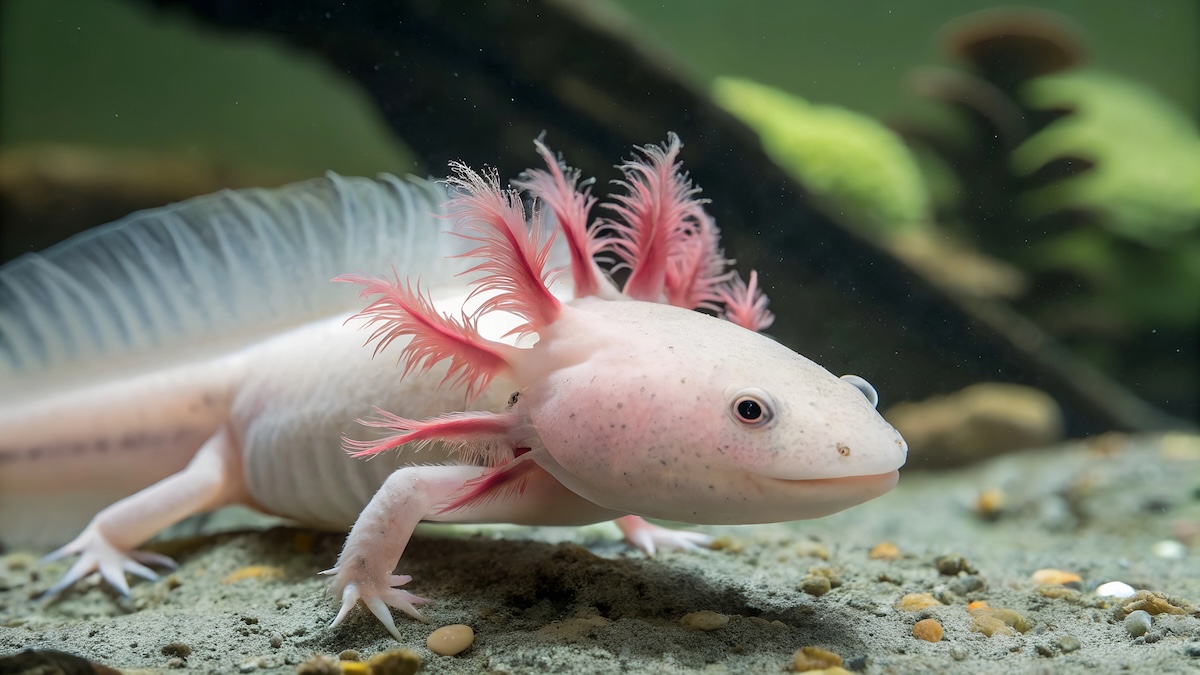 Photo Credit: PhotoAlchemyStudio at Deposit Photos
In the shimmering waters of Mexico’s high-altitude lakes, the axolotl, scientifically known as Ambystoma mexicanum, glides gracefully through its aquatic realm. With its feathery gills fanning out like delicate pink plumes, this enchanting amphibian captivates all who encounter it. Its wide smile and curious eyes give it a whimsical charm, making it a favorite among nature lovers and scientists alike. But what truly sets the axolotl apart is its extraordinary ability to regenerate lost limbs and even parts of its heart and brain, a phenomenon that has sparked intense interest in the fields of biology and medicine.
Imagine a tranquil lake surrounded by lush greenery, where the sun filters through the leaves, casting dappled light on the water’s surface. Here, the axolotl thrives, exploring its habitat with a blend of curiosity and grace. As it navigates through the underwater plants, it hunts for small worms and insects, showcasing its role as both predator and prey in this delicate ecosystem. The axolotl’s unique adaptations and behaviors not only make it a fascinating subject for study but also highlight the importance of preserving its natural habitat, as this remarkable creature faces threats from habitat loss and pollution. Join us as we dive deeper into the world of the axolotl, uncovering the secrets of its life and the vital role it plays in its environment.
The axolotl, a captivating amphibian, holds a special place in the tree of life. It belongs to the kingdom Animalia, which includes all animals, and is classified under the phylum Chordata, meaning it has a backbone. What sets the axolotl apart is its ability to regenerate lost body parts, a skill that has fascinated scientists and nature lovers alike. This remarkable creature remains in its larval form throughout its life, a phenomenon known as neoteny. This means it retains its juvenile features, like external gills, even as it reaches adulthood, making it a true marvel of the animal kingdom.
| Taxonomic Rank | Scientific Name | Meaning & Significance |
|---|---|---|
| Kingdom | Animalia | The kingdom of all animals, highlighting the axolotl’s status as a living organism. |
| Phylum | Chordata | From the Latin “chorda,” meaning “string,” referring to the notochord, a flexible rod that supports the body. |
| Class | Amphibia | Derived from the Greek word “amphibios,” meaning “both lives,” indicating its dual life in water and on land. |
| Order | Caudata | From the Latin “cauda,” meaning “tail,” which is a prominent feature of this group of salamanders. |
| Family | Ambystomatidae | Named after the genus Ambystoma, which means “both kinds of mouths,” referring to the varied feeding habits of its members. |
| Genus | Ambystoma | From the Greek “ambystoma,” meaning “both mouth,” highlighting the axolotl’s unique feeding adaptations. |
| Species | Ambystoma mexicanum | Named for its origin in Mexico, emphasizing its geographical significance and conservation status. |
The classification of the axolotl reveals much about its evolutionary journey. As a member of the amphibians, it shares a common ancestor with frogs and toads, but its unique traits, like neoteny and regenerative abilities, set it apart from its relatives. This fascinating lineage not only showcases the diversity of life on Earth but also highlights the importance of preserving such extraordinary species, as they hold keys to understanding evolution and regeneration in the animal kingdom.
The evolutionary journey of the axolotl is a tale that stretches back millions of years, rooted in the rich tapestry of amphibian history. This extraordinary creature, scientifically known as Ambystoma mexicanum, is a member of the Ambystomatidae family and has a lineage that can be traced to the early ancestors of modern amphibians. These ancestors emerged during the Devonian period, around 400 million years ago, when the first vertebrates began to venture onto land.
As amphibians evolved, they underwent significant changes to adapt to their environments. The axolotl’s story is particularly intriguing because it showcases a phenomenon called neoteny. This means that instead of undergoing the typical metamorphosis from a larval stage to a terrestrial adult, axolotls retain their juvenile features throughout their lives. This adaptation allows them to thrive in aquatic habitats, where they can continue to grow and reproduce without leaving the water.
These adaptations have been vital for the axolotl’s survival in its native habitat, the lakes of Mexico City. By retaining their juvenile characteristics, they can exploit aquatic resources effectively, while their remarkable regenerative abilities offer a significant advantage in a world where injuries can be common. The combination of these traits not only enhances their resilience but also makes them a fascinating subject for researchers studying evolution and regeneration. The axolotl’s evolutionary story is a testament to the wonders of nature and the incredible ways life can adapt and thrive.
The axolotl is a mesmerizing amphibian that captures the imagination with its whimsical appearance. With a body that can reach lengths of up to a foot, this aquatic wonder is often recognized for its striking features. Its smooth, permeable skin glistens in shades of pink, white, or even a deep, rich brown, making it look like a living piece of art. The axolotl’s most enchanting characteristic is its feathery gills, which sprout from the sides of its head like delicate, colorful plumes. These gills not only add to its charm but also play a crucial role in its survival.
| Feature | Description |
|---|---|
| Weight | 60g – 200g (2oz – 7oz) |
| Skin Type | Permeable, allowing for gas exchange and moisture retention |
The combination of the axolotl’s lightweight body and permeable skin is a clever adaptation for life in water. Its ability to absorb oxygen through its skin helps it thrive in environments where oxygen levels may fluctuate. The vibrant gills not only enhance its beauty but also increase the surface area for breathing, making it easier for the axolotl to take in the air it needs. Together, these features create a creature that is not only visually stunning but also perfectly equipped for its aquatic habitat.
The axolotl calls the high-altitude freshwater lakes of Mexico its home. These enchanting bodies of water are often surrounded by lush vegetation and rocky landscapes, creating a serene environment. The lakes are typically cool and clear, providing a perfect setting for the axolotl’s aquatic lifestyle. Imagine gliding through these tranquil waters, where sunlight dances on the surface and the gentle sounds of nature fill the air.
The climate in these regions is quite specific. The lakes are situated at elevations of over 7,000 feet, where temperatures can vary but generally remain cool. The water is often rich in nutrients, supporting a variety of plant life that provides shelter and food for the axolotl. These amphibians thrive in environments that are not only cool but also have a stable pH level, which is essential for their health and well-being.
To survive in these unique habitats, axolotls have developed several fascinating adaptations. Their gills, which resemble feathery plumes, allow them to extract oxygen from the water efficiently, making them well-suited for life in freshwater. Additionally, their ability to regenerate lost limbs and other body parts is a remarkable trait that helps them thrive in environments where they may face predators or injuries. This combination of features ensures that the axolotl remains a resilient inhabitant of its high-altitude lakes.
The daily life of an axolotl is a blend of tranquility and curiosity. These fascinating amphibians spend most of their time gliding gracefully through the water, exploring their surroundings with a gentle swish of their gills. They are primarily nocturnal, meaning they are most active during the night. As the sun sets, axolotls emerge from their hiding spots among rocks and plants, searching for food. Their diet mainly consists of small insects, worms, and other tiny aquatic creatures, which they hunt with a slow, deliberate approach.
While axolotls are solitary animals, they do exhibit interesting behaviors when it comes to their environment. They are not known for forming social groups, but they can sometimes be found in close proximity to one another, especially in areas rich in food. When they encounter another axolotl, they may engage in a brief display of curiosity, often swimming around each other before going their separate ways. Communication among axolotls is subtle; they rely on body language and chemical signals in the water to convey their presence and intentions.
| Behavior Type | Description |
|---|---|
| Activity Patterns | Axolotls are primarily nocturnal, becoming active at night to hunt for food and explore their surroundings. |
| Social Structure | These amphibians are solitary and do not form social groups, although they may be found near one another in food-rich areas. |
| Communication Methods | Axolotls communicate through body language and chemical signals in the water, allowing them to sense each other’s presence. |
The behaviors of axolotls are finely tuned to ensure their survival in the wild. By being active at night, they avoid many predators that hunt during the day. Their solitary nature allows them to minimize competition for food, while their keen senses help them locate prey efficiently. This combination of traits not only supports their individual needs but also plays a crucial role in maintaining the delicate balance of their aquatic ecosystem.
The axolotl is a carnivore, which means it primarily eats meat. This aquatic amphibian has a diet that consists mainly of worms, insects, and mollusks. With its keen sense of smell and excellent vision, the axolotl is well-equipped to hunt for its food in the murky waters of its lake habitat. It uses a method called suction feeding, where it quickly opens its mouth to create a vacuum that pulls in its prey. This clever technique allows the axolotl to capture its meals with impressive speed and efficiency.
| Dietary Aspect | Details |
|---|---|
| Diet Type | Carnivore |
| Favorite Foods | Worms, insects, and mollusks |
| Prey Items | Small aquatic creatures |
| Hunting/Foraging Strategies | Suction feeding to capture prey |
The axolotl’s diet plays a crucial role in its ecology and daily routine. By feeding on various small animals, it helps maintain the balance of its aquatic ecosystem. This not only keeps the population of its prey in check but also ensures that the axolotl receives the nutrients it needs to thrive. As it hunts and forages, the axolotl contributes to the health of its environment, showcasing the interconnectedness of life in its watery world.
When it comes to reproduction, axolotls have a captivating courtship ritual that takes place during the breeding season, typically in the spring. Males perform a dance, wiggling and swimming around females to attract their attention. This display is not just for show; it helps the female choose a suitable mate. Once a female is ready to breed, she lays her eggs, which the male fertilizes externally. This means that the male releases sperm into the water, where it meets the eggs.
| Reproductive Aspect | Details |
|---|---|
| Gestation Period | 2 to 3 weeks |
| Litter Size | Average of 500 eggs |
| Age of Maturity | 6 to 12 months |
| Name of Young | Larvae |
After the eggs hatch, the young axolotls, known as larvae, begin their journey in the water. They are born with external gills, which look like feathery structures on the sides of their heads, allowing them to breathe underwater. Interestingly, axolotls do not receive parental care after the eggs are laid. Instead, the larvae must fend for themselves, feeding on tiny aquatic creatures. As they grow, they undergo a process called metamorphosis, where they gradually develop into adults, losing their gills and gaining lungs. This transformation can take several months, and if conditions are right, they can live for many years, continuing the cycle of life in their enchanting aquatic world.
The axolotl occupies a fascinating niche in the food web of its native habitat, the lakes of Mexico. As a carnivorous amphibian, it plays the role of both predator and prey. While it hunts small invertebrates like worms and insects, it also faces threats from various predators that seek to make it their meal. This delicate balance is crucial for maintaining the ecosystem, but it also means that the axolotl must be vigilant to survive.
To defend itself against these dangers, the axolotl has developed some clever survival strategies. One of its most remarkable features is its ability to regenerate lost body parts, which can be a lifesaver if it gets injured during an attack. Additionally, axolotls often rely on their camouflage, blending into the murky waters and hiding among plants to avoid detection. When threatened, they can also become quite still, making it harder for predators to spot them. These adaptations help the axolotl navigate the challenges of its environment, ensuring its continued existence in the wild.
A keystone species is a vital part of its ecosystem, meaning its presence and activities significantly influence the environment and other organisms within it. The axolotl, with its unique role in the high-altitude freshwater lakes of Mexico, qualifies as a keystone species. This amphibian not only contributes to the balance of its habitat but also supports the health of the ecosystem in various ways.
The axolotl is a carnivore, primarily feeding on worms, insects, and mollusks. By preying on these smaller organisms, it helps regulate their populations, preventing any one species from overwhelming the ecosystem. This predatory behavior maintains a balance, ensuring that the aquatic environment remains diverse and healthy. Additionally, axolotls are known for their remarkable regenerative abilities, which can inspire scientific research into healing and regeneration in other species, including humans. Their presence in the ecosystem can also attract other species, creating a more vibrant community of life.
Moreover, axolotls play a role in nutrient cycling within their habitat. As they consume prey and produce waste, they contribute organic matter to the water, which can enhance the growth of aquatic plants. These plants, in turn, provide oxygen and habitat for other aquatic life, creating a thriving ecosystem. The axolotl’s interactions with its environment demonstrate how interconnected life can be, with each species playing a part in the larger picture.
If axolotls were to disappear from their lakes, the consequences could be severe. Without this keystone species, the populations of their prey could explode, leading to overgrazing of aquatic plants. This imbalance would not only reduce plant diversity but also affect the oxygen levels in the water, harming other aquatic life. The loss of axolotls would ripple through the ecosystem, demonstrating just how crucial they are to maintaining the health and stability of their environment.
The axolotl, a captivating amphibian native to the high-altitude freshwater lakes of Mexico, plays a crucial role in its ecosystem. As a keystone species, it helps maintain the balance of its aquatic environment. This means that the presence of axolotls is essential for the health of their habitat, influencing the populations of other organisms and the overall dynamics of the ecosystem. Their unique adaptations and behaviors allow them to thrive in these specific environments, making them vital players in the ecological community.
| Ecosystem Service | Impact |
|---|---|
| Predation | Controls populations of small invertebrates, helping to maintain balance in the food web. |
| Nutrient Cycling | Contributes to the breakdown of organic matter, enriching the water and supporting plant life. |
| Habitat Structure | Creates microhabitats by interacting with aquatic plants and substrates, providing shelter for other species. |
| Research and Education | Serves as a model organism in scientific studies, enhancing our understanding of regeneration and evolution. |
The axolotl’s influence extends beyond its own survival. By preying on small invertebrates, it helps regulate their populations, preventing overgrowth that could disrupt the ecosystem. Additionally, as axolotls consume organic matter, they contribute to nutrient cycling, which enriches the water and supports the growth of aquatic plants. These plants, in turn, provide oxygen and habitat for various other organisms, creating a thriving community. The axolotl’s interactions with its environment also help shape the physical structure of its habitat, offering shelter and resources for other aquatic life.
The broader ecological importance of the axolotl cannot be overstated. As a keystone species, its presence is vital for the health of its ecosystem. The loss of axolotls could lead to imbalances that affect not only their immediate surroundings but also the entire aquatic community. Furthermore, their unique ability to regenerate lost body parts makes them a subject of great interest in scientific research, offering insights that could benefit medicine and conservation efforts. By understanding and protecting the axolotl, we also safeguard the intricate web of life that depends on this remarkable amphibian.
In the intricate web of life, symbiosis refers to the close and often long-term interactions between different species. These relationships can take many forms, including mutualism, where both species benefit, parasitism, where one benefits at the expense of the other, and commensalism, where one benefits while the other is neither helped nor harmed. The axolotl, a fascinating amphibian, engages in various ecological relationships that highlight the interconnectedness of life in its high-altitude freshwater lakes.
| Species/Type | Relationship Type | Description |
|---|---|---|
| Water Mites | Commensal | Water mites often hitch a ride on axolotls, benefiting from the movement of their host while the axolotl remains unaffected. |
| Algae | Mutualistic | Algae can grow on the axolotl’s skin, providing camouflage and protection while the axolotl offers a stable environment for the algae. |
| Leeches | Parasitic | Leeches attach to axolotls to feed on their blood, which can weaken the axolotl if the infestation is severe. |
These relationships have evolved over time, shaped by the needs and adaptations of the species involved. The axolotl’s interactions with water mites and algae demonstrate how species can coexist and even thrive together, while the presence of leeches highlights the challenges of parasitism. Understanding these connections not only enriches our knowledge of the axolotl but also emphasizes the delicate balance of ecosystems, where every species plays a role in the grand tapestry of life.
The axolotl is a truly enchanting amphibian that has captured the hearts of nature enthusiasts around the world. Known for its unique ability to regenerate limbs and its charming appearance, this creature is full of surprises that reveal the wonders of evolution and adaptation.
The axolotl, a captivating amphibian native to the lakes of Mexico, has a rich history intertwined with human culture. Historically, the axolotl has been a part of local folklore and mythology, often celebrated in Aztec traditions. The name “axolotl” itself comes from the Nahuatl language, meaning “water monster.” This enchanting creature has not only inspired stories but has also been a source of curiosity and admiration for scientists and nature lovers alike. Its unique features and behaviors have made it a symbol of biodiversity and a subject of study for understanding evolution and regeneration.
In modern times, the relationship between axolotls and humans has evolved significantly. As urbanization and pollution threaten their natural habitats, conservation efforts have become crucial. Organizations are working tirelessly to protect the remaining wild populations and restore their ecosystems. Additionally, axolotls have found a place in laboratories and homes around the world, where they are studied for their remarkable regenerative abilities. However, this domestication has led to challenges, including the risk of genetic dilution and the potential for disease spread among wild populations.
Looking ahead, the future of the axolotl and humanity’s relationship holds both promise and challenges. As awareness of environmental issues grows, more people are becoming advocates for the protection of this extraordinary species. By fostering a deeper understanding of the axolotl’s role in its ecosystem, we can inspire future generations to appreciate and protect the natural world. With continued efforts in conservation and education, the axolotl may thrive, serving as a reminder of the delicate balance between humans and the creatures that share our planet.
The axolotl, a fascinating amphibian native to the lakes of Mexico, is currently classified as endangered. This means that its population is at risk of disappearing from the wild. Once abundant in its natural habitat, the axolotl has seen a significant decline in numbers over the years. Factors such as habitat loss and pollution have contributed to this worrying trend, making conservation efforts more crucial than ever.
| Conservation Factor | Status/Details |
|---|---|
| IUCN Status | Endangered |
| Population Estimates | Less than 50 individuals in the wild |
| Trend Direction | Decreasing |
The main threats to the axolotl are primarily linked to human activities. Urbanization has led to the destruction of its natural habitat, as cities expand and pollution increases. Additionally, the introduction of invasive species, such as non-native fish, has further complicated the axolotl’s survival. These fish often prey on young axolotls or compete for food, making it even harder for this unique amphibian to thrive.
Despite these challenges, there is hope for the axolotl’s future. Conservation efforts are underway, focusing on habitat restoration and breeding programs. Organizations are working to raise awareness about the importance of protecting this species and its environment. With continued support and dedication, there is a chance that the axolotl can rebound and once again flourish in its native lakes, captivating the hearts of future generations.
| Question | Answer |
|---|---|
| What is the natural habitat of the Axolotl? | Axolotls are found in high altitude freshwater lakes, particularly in the ancient lake complex of Xochimilco near Mexico City. These lakes provide a unique environment with cool, clear waters that are essential for their survival. |
| What do Axolotls eat? | As carnivores, Axolotls primarily feed on small prey such as worms, insects, and small fish. They use their keen sense of smell to hunt and can even consume prey larger than their own head! |
| How do Axolotls behave in the wild? | Axolotls are generally solitary creatures, preferring to live alone rather than in groups. They are known for their curious nature and can often be seen exploring their surroundings in search of food. |
| How do Axolotls reproduce? | During mating, male Axolotls perform a dance to attract females, which involves releasing a packet of sperm. The female then picks up the sperm to fertilize her eggs, which she lays in clusters in the water. |
| What are the main threats to Axolotls? | Axolotls face several threats, including habitat loss due to urbanization and pollution. Invasive species, such as tilapia and carp, also compete for resources and can harm their populations. |
| What are some interesting characteristics of Axolotls? | One of the most fascinating features of Axolotls is their ability to regenerate lost body parts, including limbs and even parts of their heart and brain. They also retain their juvenile features throughout their lives, a trait known as neoteny. |
| Are Axolotls endangered? | Yes, Axolotls are classified as endangered due to their declining population in the wild. Conservation efforts are underway to protect their natural habitat and raise awareness about their plight. |