Taxonomy & Classification
- Kingdom
- Animalia
- Phylum
- Chordata
- Class
- Reptilia
- Order
- Squamata
- Family
- Colubridae
- Genus
- Leptodeira
- Species
- Leptodeira annulata

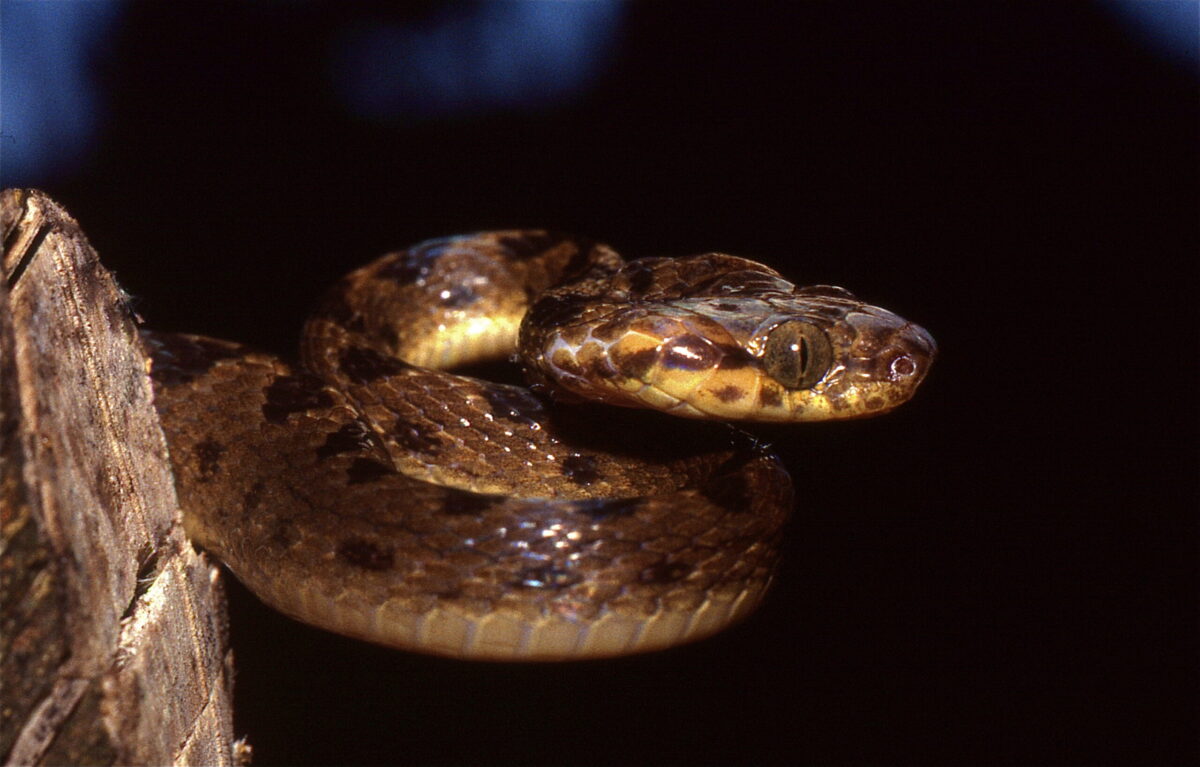 "Northern Cat-eyed Snake (Leptodeira septentrionalis) (36881496461)" by Bernard DUPONT from FRANCE is licensed under CC BY-SA 2.0
In the twilight hours of a warm evening, the Cat-Eyed Snake, or Leptodeira, emerges from its hiding place, ready to explore the world around it. With its slender body and strikingly large, cat-like eyes, this nocturnal reptile glides silently through the underbrush of grasslands and scrublands, where shadows dance and the air is filled with the sounds of chirping insects. The Cat-Eyed Snake is not just a beautiful sight; its unique adaptations make it a subject of fascination for scientists and nature lovers alike. Its eyes, which reflect light in a way that enhances its night vision, allow it to hunt effectively in the dark, making it a skilled predator of frogs, lizards, and other small creatures.
As it navigates its habitat, the Cat-Eyed Snake showcases its remarkable ability to blend into its surroundings, a skill that helps it avoid predators while stalking its prey. This snake plays a vital role in its ecosystem, helping to maintain the balance of populations in the food web. With a diet that includes a variety of small animals, it contributes to the health of its environment. The Cat-Eyed Snake’s intriguing behaviors and adaptations not only highlight the wonders of evolution but also remind us of the delicate connections that exist in nature. Join us as we delve deeper into the life of this captivating reptile, exploring its habits, habitats, and the important role it plays in the wild.
The Cat-Eyed Snake, scientifically known as Leptodeira, occupies a fascinating niche in the tree of life. This slender, nocturnal snake is part of the family Colubridae, which includes many non-venomous snakes. What sets the Cat-Eyed Snake apart is its distinctive vertical pupils, reminiscent of a cat’s eye, which enhance its ability to see in low light. This adaptation is particularly useful for hunting at night, allowing it to thrive in its tropical and subtropical habitats across Central and South America.
| Taxonomic Rank | Scientific Name | Meaning & Significance |
|---|---|---|
| Kingdom | Animalia | This term means “animals” and includes all multicellular organisms that are heterotrophic, meaning they consume organic material for energy. |
| Phylum | Chordata | Chordata refers to animals with a notochord, a flexible rod that supports the body, which in most vertebrates becomes the spine. |
| Class | Reptilia | Reptilia includes reptiles, characterized by their scaly skin and typically laying eggs on land, adapting well to various environments. |
| Order | Squamata | Squamata is the order of reptiles that includes snakes and lizards, known for their ability to shed their skin and their diverse range of habitats. |
| Family | Colubridae | This family consists of a wide variety of snakes, many of which are harmless to humans, showcasing a range of adaptations for survival. |
| Genus | Leptodeira | The name Leptodeira comes from Greek roots meaning “slender” and “to go,” reflecting the snake’s long, agile body that aids in its movement through foliage. |
Understanding the Cat-Eyed Snake’s classification reveals much about its evolutionary journey. As a member of the Colubridae family, it shares a common ancestry with many other snakes, showcasing the incredible adaptability of reptiles. Its unique adaptations, like the specialized eyes for nocturnal hunting, highlight how evolution shapes species to thrive in their environments. The Cat-Eyed Snake is not just a fascinating animal; it is a living testament to the intricate web of life that connects all creatures on our planet.
The evolutionary journey of the Cat-Eyed Snake, belonging to the genus Leptodeira, stretches back millions of years, intertwining with the history of the Colubridae family. This family, which includes a diverse array of non-venomous snakes, has adapted to various environments across the globe. The Cat-Eyed Snake’s ancestors emerged during the late Cretaceous period, around 100 million years ago, when the world was a very different place, filled with dinosaurs and lush vegetation.
The early ancestors of the Cat-Eyed Snake were likely similar to other primitive snakes, possessing basic adaptations for survival. Over time, these snakes underwent significant changes, particularly in their hunting and camouflage strategies. As they evolved, they developed specialized features that allowed them to thrive in their environments, such as enhanced vision for nocturnal hunting and a slender body shape for navigating through dense foliage. These adaptations were crucial as they transitioned from a more generalized lifestyle to one that required specific skills for hunting and evading predators.
The adaptations of the Cat-Eyed Snake have been vital for its survival in diverse habitats, from tropical forests to arid regions. Its keen eyesight and ability to blend into its surroundings make it a skilled hunter, while its slender form allows for agile movement. By evolving to be nocturnal, it has carved out a niche that minimizes competition and maximizes its chances of thriving in a world filled with challenges. Each of these traits tells a story of resilience and ingenuity, showcasing how life adapts to the ever-changing tapestry of nature.
The Cat-Eyed Snake is a striking sight, captivating anyone lucky enough to encounter it. With its slender body, this snake glides gracefully through its environment, often blending seamlessly into the foliage. Its most eye-catching feature is its large, expressive eyes, which are reminiscent of a cat’s, complete with vertical pupils that give it an air of mystery. This nocturnal hunter is designed for stealth, with a streamlined form that allows it to navigate through dense vegetation with ease.
| Feature | Description |
|---|---|
| Size | Typically ranges from 2 to 4 feet in length |
| Color | Often displays a mix of browns, greens, and yellows, providing excellent camouflage |
| Skin Type | Covered in smooth, shiny scales that help it glide through its habitat |
| Eyes | Large, cat-like eyes with vertical pupils, enhancing night vision |
These features work together to create a highly effective predator. The Cat-Eyed Snake’s large eyes are not just for show; they allow it to see well in low light, making it an adept hunter during the night. Its coloration helps it blend into the leaves and branches, providing a perfect disguise against both prey and potential threats. With its sleek body and smooth scales, it can move silently, making it a master of stealth in the wild. Each characteristic plays a vital role in its survival, showcasing the beauty and efficiency of nature’s designs.
The Cat-Eyed Snake thrives in a variety of habitats that paint a vivid picture of its life in the wild. Imagine sun-drenched grasslands where the tall grasses sway gently in the breeze, or scrublands dotted with resilient shrubs and vibrant wildflowers. This snake also finds a home in lush rainforests, where the air is thick with humidity and the sounds of chirping insects fill the atmosphere. Each of these environments offers a unique blend of shelter and hunting grounds, making them ideal for this agile reptile.
The Cat-Eyed Snake prefers warm climates, often found in areas where temperatures are mild to hot. It enjoys environments that provide a mix of open spaces and cover, allowing it to hunt effectively while also hiding from potential predators. The humidity levels in rainforests are particularly important, as they help maintain the moisture that this snake needs to thrive. These conditions create a perfect balance for the Cat-Eyed Snake, enabling it to be active during the night when it hunts for its favorite prey.
Adaptation is key to the Cat-Eyed Snake’s success in these diverse habitats. Its slender body allows it to navigate through thick underbrush and grass with ease, while its coloration helps it blend into the surroundings, making it less visible to both prey and predators. The Cat-Eyed Snake has also developed a nocturnal lifestyle, which means it is most active at night. This adaptation not only helps it avoid daytime predators but also allows it to hunt for small animals like frogs and lizards when they are most active. By fitting seamlessly into its environment, the Cat-Eyed Snake showcases the incredible ways animals adapt to their homes.
As the sun sets and darkness blankets the landscape, the Cat-Eyed Snake begins its daily activities. This slender, nocturnal reptile is most active during the night, hunting for food and exploring its surroundings. With its keen eyesight, adapted for low-light conditions, it slithers through grasslands and scrublands, searching for small prey like frogs and lizards. The Cat-Eyed Snake uses its agility to navigate through the underbrush, often pausing to listen and watch for any signs of movement. This stealthy approach allows it to be an effective hunter, relying on both sight and the ability to sense vibrations in the ground.
In terms of social behavior, the Cat-Eyed Snake is generally solitary, preferring to hunt and live alone. However, during the breeding season, males may engage in competitive displays to attract females. These displays can include body posturing and subtle movements, showcasing their strength and fitness. While they do not form tight-knit groups, they may be found in close proximity to one another in areas rich in food resources. Communication among these snakes is primarily visual and involves body language, as they rely on their keen eyesight to interpret the signals of others.
| Behavior Type | Description |
|---|---|
| Activity Patterns | Nocturnal foraging, primarily hunting at night for small prey like frogs and lizards. |
| Social Structure | Generally solitary, with males competing for females during the breeding season. |
| Communication Methods | Visual signals and body language, using movements to convey strength and fitness. |
The behaviors of the Cat-Eyed Snake are finely tuned to ensure its survival in the wild. By being nocturnal, it avoids many daytime predators and takes advantage of the abundance of prey that comes alive at night. Its solitary nature allows it to minimize competition for food, while its keen eyesight and agility make it a skilled hunter. These adaptations not only help the Cat-Eyed Snake thrive in its environment but also contribute to the delicate balance of the ecosystems it inhabits.
The Cat-Eyed Snake is a carnivore, which means it primarily eats meat. This agile predator has a diverse diet that includes frogs, lizards, salamanders, fish, and even small rodents. With its keen eyesight, especially in low light, the Cat-Eyed Snake is well-equipped to hunt at night. It uses a combination of stealth and speed to catch its prey, often waiting patiently for the perfect moment to strike.
| Dietary Aspect | Details |
|---|---|
| Diet Type | Carnivore |
| Favorite Foods | Frogs, lizards, salamanders, fish, and rodents |
| Prey Items | Small amphibians and reptiles, as well as small mammals |
| Hunting/Foraging Strategies | Uses keen eyesight and stealth to ambush prey at night |
The diet of the Cat-Eyed Snake plays a crucial role in its ecological niche. By preying on various small animals, it helps control their populations, contributing to a balanced ecosystem. Its nocturnal hunting habits also mean that it is active when many other predators are resting, allowing it to thrive in its environment. This adaptability not only shapes its daily routine but also influences the dynamics of the habitats it occupies.
When it comes to reproduction, the Cat-Eyed Snake has some intriguing behaviors. Mating typically occurs during the warmer months, often coinciding with the rainy season. This is a time when food is plentiful, making it easier for the snakes to find the energy they need for reproduction. Males engage in a fascinating courtship ritual, which may include displays of their vibrant colors and gentle movements to attract females. Once a female is receptive, she will mate with a male, and the process is both quick and efficient.
| Reproductive Aspect | Details |
|---|---|
| Gestation Period | Approximately 60 to 70 days |
| Litter Size | 4 to 12 eggs |
| Age of Maturity | About 2 years |
| Name of Young | Hatchlings |
After the eggs are laid, the female Cat-Eyed Snake provides no further parental care. Instead, she leaves the eggs to develop on their own. The hatchlings emerge after a couple of months, fully formed and ready to face the world. These young snakes are independent from the moment they break free from their eggs, relying on their instincts to hunt and survive. As they grow, they will shed their skin several times, a process known as molting, which helps them grow and adapt to their environment. With time, they will mature into adults, continuing the cycle of life in their vibrant habitats.
The Cat-Eyed Snake plays a vital role in its ecosystem, serving as both predator and prey. Positioned in the food web, it helps control populations of small animals like frogs and lizards, while also being a target for larger predators. This delicate balance is crucial for maintaining the health of its habitat, but it also exposes the snake to various dangers.
To survive these threats, the Cat-Eyed Snake has developed several clever defensive behaviors. When faced with danger, it often relies on its ability to blend into its surroundings, using camouflage to avoid detection. Additionally, it may freeze in place, becoming nearly invisible among the leaves and grasses. If threatened further, it can also deliver a quick bite, though it is not venomous. These strategies help the Cat-Eyed Snake navigate the challenges of its environment, ensuring its survival in a world full of predators.
A keystone species is an organism that has a disproportionately large impact on its environment relative to its abundance. These species play critical roles in maintaining the structure of an ecosystem. The Cat-Eyed Snake, known scientifically as Leptodeira, qualifies as a keystone species due to its significant influence on the populations of various small animals in its habitat, which includes grasslands, scrublands, and rainforests throughout the Americas.
The Cat-Eyed Snake is a skilled predator, primarily feeding on frogs, lizards, and small rodents. By keeping these populations in check, it helps maintain a balance in the ecosystem. For instance, if the snake preys on frogs, it prevents their numbers from exploding, which could lead to overgrazing of vegetation in wetland areas. This balance is crucial because too many frogs can deplete plant life, affecting other species that rely on those plants for food and shelter.
Moreover, the Cat-Eyed Snake itself serves as prey for larger predators, such as birds of prey and some mammals. This dual role as both predator and prey creates a dynamic food web, where energy flows through various levels of the ecosystem. The presence of the Cat-Eyed Snake supports not only its own survival but also the health of the entire community of organisms that share its habitat.
If the Cat-Eyed Snake were to disappear from its ecosystem, the consequences could be severe. Without this snake, populations of its prey, like frogs and lizards, could surge uncontrollably. This overpopulation would lead to increased competition for food and habitat, ultimately harming plant life and other animal species that depend on those plants. The ripple effects could destabilize the entire ecosystem, demonstrating just how vital the Cat-Eyed Snake is to the health and balance of its environment.
The Cat-Eyed Snake, known scientifically as Leptodeira, plays a vital role in shaping its ecosystem across various habitats, including grasslands, scrublands, and rainforests throughout the Americas. As a nocturnal predator, it occupies a unique ecological niche, hunting primarily at night. This behavior not only helps control populations of its prey but also influences the dynamics of the entire food web. By maintaining balance among small animal populations, the Cat-Eyed Snake ensures that no single species overwhelms the ecosystem, allowing for a diverse and thriving environment.
| Ecosystem Service | Impact |
|---|---|
| Prey Control | Regulates populations of frogs, lizards, and small rodents. |
| Food Source | Serves as prey for larger predators, contributing to the food web. |
| Soil Health | Indirectly supports soil health by controlling insect populations. |
| Habitat Maintenance | Encourages biodiversity by influencing the distribution of prey species. |
The influence of the Cat-Eyed Snake extends beyond its immediate hunting habits. For instance, by preying on frogs and lizards, it helps keep these populations in check, which in turn affects the insects these animals consume. This predator-prey relationship is crucial for maintaining a balanced ecosystem. Additionally, as the Cat-Eyed Snake itself becomes prey for larger animals, it contributes to the energy flow within the food web, supporting a variety of species that rely on it for sustenance.
The broader ecological importance of the Cat-Eyed Snake cannot be overstated. As a keystone species, its presence is essential for maintaining the structure and health of its environment. By regulating prey populations and serving as a food source for larger predators, the Cat-Eyed Snake helps ensure that ecosystems remain diverse and resilient. This delicate balance is vital for the survival of many species, highlighting the interconnectedness of life in the natural world.
In the intricate web of life, symbiosis refers to the close interactions between different species, which can take on various forms. These relationships can be mutualistic, where both species benefit; parasitic, where one benefits at the expense of the other; or commensal, where one benefits while the other is neither helped nor harmed. The Cat-Eyed Snake, known for its striking appearance and nocturnal habits, engages in several fascinating ecological relationships that highlight the interconnectedness of nature.
| Species/Type | Relationship Type | Description |
|---|---|---|
| Frogs | Mutualistic | The Cat-Eyed Snake preys on frogs, helping to control their populations, while the frogs benefit from the snake’s presence by keeping other predators at bay. |
| Birds | Commensal | Some birds may follow the Cat-Eyed Snake, benefiting from the disturbances it causes in the underbrush, which can flush out insects for the birds to eat. |
| Parasites (like ticks) | Parasitic | Ticks and other parasites may latch onto the Cat-Eyed Snake, feeding on its blood, which can weaken the snake but does not provide any benefit to it. |
The evolution of these relationships showcases the dynamic nature of ecosystems. Over time, species like the Cat-Eyed Snake have adapted to interact with others in ways that enhance their survival and reproductive success. These partnerships not only help maintain balance within their habitats but also illustrate the delicate dance of life where every creature plays a role. Understanding these connections deepens our appreciation for the natural world and the myriad ways species rely on one another.
The Cat-Eyed Snake, known for its striking appearance and intriguing behaviors, is a captivating reptile that often surprises those who take the time to learn about it. With its large, cat-like eyes and nocturnal habits, this snake has some remarkable traits that set it apart in the animal kingdom.
The Cat-Eyed Snake, or Leptodeira, has long captured the imagination of people across various cultures. Historical encounters with this snake often evoke a sense of mystery and intrigue. In many regions of Central and South America, local folklore features the Cat-Eyed Snake as a symbol of transformation and adaptability. Its striking appearance, particularly its large, cat-like eyes, has led to various interpretations in art and storytelling, where it is sometimes seen as a guardian of the night. These cultural significances highlight humanity’s fascination with the natural world and the stories we weave around its inhabitants.
Today, the relationship between humans and the Cat-Eyed Snake is complex and multifaceted. While some people admire this snake for its beauty and ecological role, others may view it with fear or misunderstanding. In many areas, habitat destruction poses a significant threat to the Cat-Eyed Snake, as urban development and agriculture encroach on its natural environments. Conservation efforts are underway to protect these habitats and educate communities about the importance of this species in maintaining ecological balance. However, conflicts can arise when snakes venture into human-populated areas, leading to negative encounters. Understanding and respecting these creatures is crucial for fostering a harmonious coexistence.
As we look to the future, the relationship between humans and the Cat-Eyed Snake holds both challenges and opportunities. With increasing awareness of environmental issues, there is hope that more people will recognize the value of preserving this species and its habitat. By fostering a sense of curiosity and respect for the natural world, we can work towards a future where the Cat-Eyed Snake continues to thrive alongside humanity. Together, we can ensure that this captivating reptile remains a part of our shared ecosystem for generations to come.
The Cat-Eyed Snake, scientifically known as Leptodeira, currently holds a conservation status of “Least Concern” according to the International Union for Conservation of Nature (IUCN). This means that, at present, the species is not facing an immediate threat of extinction. However, specific population estimates remain unknown, making it difficult to assess trends in their numbers. While they are not currently endangered, ongoing monitoring is essential to ensure their populations remain stable.
| Conservation Factor | Status/Details |
|---|---|
| IUCN Status | Least Concern |
| Estimated Population Size | Unknown |
| Population Trend | Stable |
The main threats to the Cat-Eyed Snake include habitat loss and degradation, primarily due to human activities such as agriculture and urban development. As their natural environments are altered or destroyed, these snakes may find it increasingly difficult to hunt for food and reproduce. Additionally, pollution and climate change can further impact their habitats, leading to potential declines in their populations over time.
Conservation efforts for the Cat-Eyed Snake focus on habitat protection and restoration. By preserving the ecosystems where these snakes thrive, we can help ensure their survival for future generations. Education and awareness programs also play a crucial role in promoting coexistence between humans and wildlife. With continued efforts, the outlook for the Cat-Eyed Snake remains positive, as it adapts to changing environments while maintaining its important role in the ecosystem.
| Question | Answer |
|---|---|
| What is the habitat of the Cat-Eyed Snake? | Cat-Eyed Snakes are found in a variety of habitats, including grasslands, scrublands, and rainforests throughout the Americas. They thrive in warm environments where they can easily hunt for food and find shelter. |
| What do Cat-Eyed Snakes eat? | These snakes are carnivores, meaning they primarily eat other animals. Their diet mainly consists of small mammals, birds, and lizards, which they hunt using their keen eyesight and quick reflexes. |
| How do Cat-Eyed Snakes behave? | Cat-Eyed Snakes are mostly nocturnal, which means they are active at night. They are known for their calm demeanor, but they can be quick and agile when hunting or feeling threatened. |
| How do Cat-Eyed Snakes reproduce? | These snakes are oviparous, which means they lay eggs. After mating, a female Cat-Eyed Snake will lay a clutch of eggs in a safe, hidden location, where they will incubate until they hatch. |
| What threats do Cat-Eyed Snakes face? | While Cat-Eyed Snakes are currently listed as Least Concern, they still face threats from habitat destruction and climate change. Human activities, such as deforestation and urban development, can reduce their natural habitats. |
| What is an interesting characteristic of the Cat-Eyed Snake? | One of the most distinctive features of the Cat-Eyed Snake is its large eyes, which have vertical pupils that resemble those of a cat. This unique adaptation helps them see well in low light, making them effective hunters at night. |
| Are Cat-Eyed Snakes dangerous to humans? | Cat-Eyed Snakes are not considered dangerous to humans. They are non-venomous and tend to avoid confrontation, preferring to escape rather than attack when threatened. |