Taxonomy & Classification
- Kingdom
- Animalia
- Phylum
- Chordata
- Class
- Mammalia
- Order
- Artiodactyla
- Family
- Bovidae
- Genus
- Taurotragus
- Species
- Taurotragus oryx

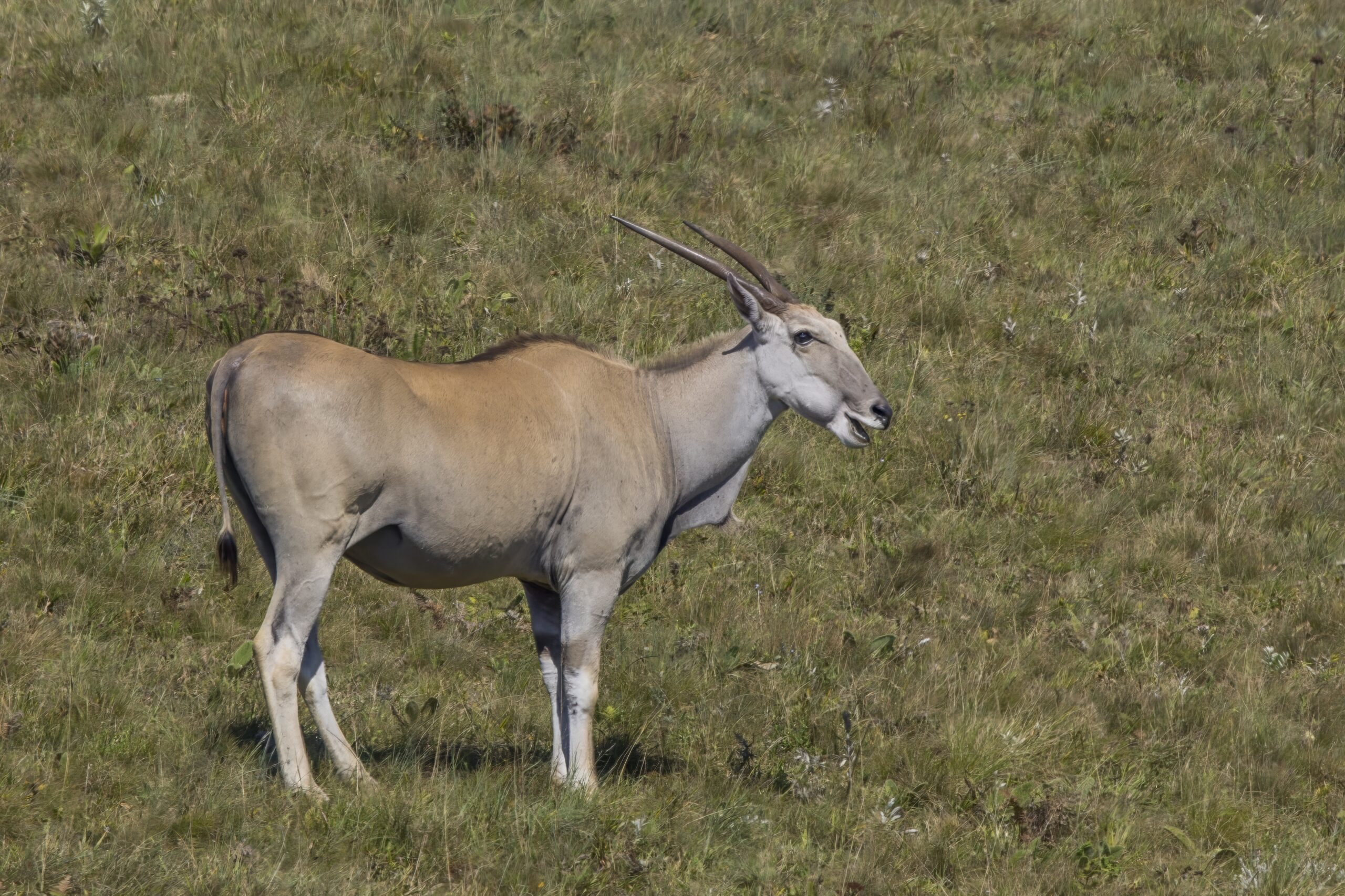 Photo Credit: Charlesjsharp / Wikimedia Commons
In the heart of Africa’s sprawling savannas, the eland, scientifically known as Taurotragus oryx, roams gracefully across the golden grasslands. With its impressive stature, the eland stands as one of the largest antelopes in the world, reaching heights of up to 9.5 feet. Its striking appearance is marked by a robust body, long legs, and a pair of spiraled horns that can twist up to 3 feet in length. These magnificent features not only make the eland a sight to behold but also a subject of fascination for scientists and nature lovers alike.
Imagine a warm afternoon, where the sun casts a golden hue over the landscape, and a herd of elands grazes peacefully, their large, soulful eyes scanning the horizon for any signs of danger. These gentle giants are herbivores, primarily munching on grasses, leaves, and shoots, which they skillfully reach with their long necks. As they move through their habitat, they play a crucial role in maintaining the balance of their ecosystem, influencing plant growth and providing sustenance for predators. The eland’s unique behaviors, social structures, and adaptability to various environments make it a captivating creature to study, revealing the intricate connections that bind all life in the African wilderness.
The eland, a majestic antelope found in the savannas and grasslands of Africa, holds a special place in the animal kingdom. Taxonomically, it belongs to the Kingdom Animalia, Phylum Chordata, Class Mammalia, Order Artiodactyla, Family Bovidae, and Genus Taurotragus. What sets the eland apart is its impressive size and unique adaptations, such as its long, spiraled horns and the ability to thrive in diverse habitats. These gentle giants are not just another antelope; they are the largest of their kind, showcasing a blend of grace and strength that captivates wildlife enthusiasts and researchers alike.
| Taxonomic Rank | Scientific Name | Meaning & Significance |
|---|---|---|
| Kingdom | Animalia | This name comes from the Latin word for “animal,” highlighting that elands are part of the vast group of living organisms that are multicellular and capable of movement. |
| Phylum | Chordata | Derived from the Greek word “chordē,” meaning “string,” this classification indicates that elands have a notochord, a flexible rod that supports their bodies during development. |
| Class | Mammalia | This term comes from the Latin “mamma,” meaning “breast,” referring to the fact that female elands nurse their young with milk, a defining characteristic of mammals. |
| Order | Artiodactyla | From the Greek words “artios,” meaning “even,” and “daktulos,” meaning “finger,” this order includes animals with an even number of toes, like the eland, which has two main weight-bearing toes on each foot. |
| Family | Bovidae | This name is derived from “bos,” the Latin word for “cow,” indicating that elands are part of the group that includes cattle, goats, and sheep, all of which share similar traits. |
| Genus | Taurotragus | Combining the Greek words “tauros,” meaning “bull,” and “tragos,” meaning “goat,” this name reflects the eland’s robust build and its classification among the larger antelopes. |
The classification of the eland reveals much about its evolutionary journey. As a member of the Bovidae family, it shares a common ancestry with other hoofed mammals, showcasing adaptations that have allowed it to thrive in various environments. The eland’s size and social behavior, such as living in herds, are traits that have evolved to enhance survival in the wild. Understanding where the eland fits in the tree of life not only highlights its biological significance but also emphasizes the intricate connections between species and their environments throughout history.
The evolutionary journey of the eland, a large and graceful antelope, stretches back millions of years. This fascinating story begins in the late Miocene epoch, around 10 million years ago, when the ancestors of modern antelopes roamed the Earth. As the climate changed and grasslands expanded, these early ungulates adapted to new environments, leading to the diverse family of Bovidae, which includes the eland.
The eland’s ancestors were part of a group of animals that evolved from small, deer-like creatures. Over time, they developed larger bodies and longer legs, which helped them navigate the open savannas. One significant transition was the shift from browsing on leaves to grazing on grasses, allowing them to thrive in the vast plains of Africa. This adaptation was crucial as it enabled them to exploit a new food source that was abundant in their changing habitat.
These adaptations have played a vital role in the eland’s survival. Their size and strength deter many predators, while their social structure enhances their safety. The ability to consume a wide range of plants allows them to thrive in various habitats, ensuring they can find food even in challenging conditions. With their remarkable endurance, elands can escape threats and traverse vast distances in search of resources, making them a true testament to the power of evolution in shaping life on Earth.
The eland stands as one of the largest antelopes in the world, exuding a sense of grace and strength. With a height that can reach up to 9.5 feet, these magnificent animals have a robust body structure that is both powerful and agile. Their long legs and broad hooves allow them to navigate the varied terrains of their savanna habitats with ease. The eland’s skin is covered in a short, sleek fur that can range in color from a warm tan to a rich reddish-brown, often adorned with striking dark markings that enhance their beauty and help them blend into their surroundings.
| Feature | Description |
|---|---|
| Height | 4.3 – 9.5 feet |
| Weight | 660 – 2,650 lbs. |
| Skin Type | Fur |
| Most Distinctive Feature | Horns and dark markings on body |
The eland’s impressive size and distinctive features serve important survival purposes. Their large horns, which can spiral elegantly, are not just for show; they are used in displays of dominance and can help fend off predators. The dark markings on their fur provide camouflage, allowing them to blend into the dappled light of the grasslands, making it harder for both predators and prey to spot them. Together, these characteristics create a striking image of an animal perfectly adapted to thrive in its environment, showcasing the beauty and complexity of nature.
The eland roams across a tapestry of landscapes, thriving in the open grasslands, lush woodlands, and rugged mountains of Africa. Picture vast savannas dotted with acacia trees, where golden grasses sway gently in the breeze. These environments provide the eland with ample food and space to roam, making them a common sight in the wild. Their natural habitat is a blend of open areas and scattered vegetation, allowing them to graze and seek shelter as needed.
Elands prefer climates that are warm and dry, often found in regions where rainfall is seasonal. They thrive in areas that experience a mix of wet and dry seasons, which helps sustain the grasses and shrubs they love to munch on. The temperature in these habitats can vary, but elands are well-suited to endure the heat of the day, often seeking shade during the hottest hours. This adaptability allows them to flourish in diverse environments, from open plains to hilly terrains.
To survive in these varied habitats, elands have developed several clever adaptations. Their large size and strong legs enable them to traverse rugged landscapes with ease, while their keen eyesight helps them spot predators from a distance. Elands are also social animals, often found in herds that provide safety in numbers. Their ability to graze on a wide range of vegetation allows them to thrive even when food sources change with the seasons. This versatility is key to their survival in the ever-changing African landscape.
The daily life of an eland is a blend of foraging, socializing, and resting, all intricately woven into the rhythms of the African landscape. As the sun rises, these gentle giants begin their day by grazing on the abundant grasses and leaves that surround them. Elands are primarily herbivores, meaning they eat plants, and they have a special knack for reaching high branches with their long necks. Throughout the day, they alternate between munching on vegetation and taking leisurely breaks, often lying down to ruminate, which is a fancy term for chewing their food again to aid digestion.
Socially, elands are known for their strong herd dynamics. They typically form groups, which can range from a few individuals to larger herds, especially during the dry season when food is scarce. Within these herds, elands exhibit a fascinating social structure. They communicate through a variety of sounds, including low grunts and snorts, which help them stay connected and alert to potential dangers. The bonds formed within the herd are crucial, as they provide safety in numbers against predators like lions and hyenas.
| Behavior Type | Description |
|---|---|
| Activity Patterns | Elands spend their days grazing, resting, and ruminating, with peak activity during the cooler parts of the day, such as early morning and late afternoon. |
| Social Structure | They live in herds that can vary in size, often led by a dominant female, which helps maintain order and safety within the group. |
| Communication Methods | Elands use a range of vocalizations, body language, and even scent marking to communicate with each other, ensuring they stay connected and alert. |
The behaviors of elands are not just fascinating; they are essential for their survival. By living in herds, they can better protect themselves from predators, share knowledge about food sources, and nurture their young. Their ability to communicate effectively helps them respond quickly to threats, ensuring that they can thrive in the wild. In this way, the daily life of an eland is a beautiful example of how social structures and behaviors contribute to the survival of a species in the ever-challenging environment of Africa.
The eland is a herbivore, which means it primarily eats plants. These gentle giants have a diet that consists mainly of grasses, leaves, and shoots. They are known for their impressive ability to reach high branches, using their long necks and strong legs to graze on foliage that many other animals cannot access. This feeding behavior allows them to thrive in their natural habitats, where they can find plenty of food to sustain their large bodies.
| Dietary Aspect | Details |
|---|---|
| Diet Type | Herbivore |
| Favorite Foods | Grasses, leaves, and young shoots |
| Prey Items | None (as herbivores, they do not hunt) |
| Foraging Strategies | Grazing on grass and browsing on trees and shrubs |
The eland’s diet plays a crucial role in shaping its ecology and daily routine. By feeding on a variety of plant materials, they help maintain the balance of their ecosystems, promoting healthy plant growth and providing food for other animals. Their foraging habits also influence the distribution of plant species in their habitats. As they move through the savannas and woodlands, they leave behind a trail of nutrient-rich droppings, which enriches the soil and supports the growth of new vegetation. This interconnectedness highlights the importance of the eland in the African landscape, where every meal contributes to the vibrant tapestry of life.
When it comes to reproduction, elands have a fascinating mating ritual that often takes place during the rainy season, which is when food is plentiful. Males engage in displays of strength and agility to attract females, showcasing their impressive size and impressive spiraled horns. This courtship can involve a series of vocalizations and physical posturing, as males compete for the attention of females. Once a female is ready to mate, she will signal her interest, and the pair will engage in a brief courtship before mating.
| Reproductive Aspect | Details |
|---|---|
| Gestation Period | 274 days |
| Litter Size | 1 calf |
| Age of Sexual Maturity | 2 years |
| Name of Young | Calf |
After a gestation period of about nine months, the female eland gives birth to a single calf, which is a common occurrence in the animal kingdom. The newborn is typically able to stand and walk within a few hours, a crucial ability that helps it evade predators. Eland mothers are attentive and protective, often hiding their young in tall grass to keep them safe from danger. As the calf grows, it will stay close to its mother, learning essential survival skills and social behaviors. By the time it reaches two years of age, the young eland will be ready to venture out on its own, fully equipped to thrive in the wild.
The eland occupies a significant position in the African food web, serving as both a grazer and a prey species. As one of the largest antelopes, it plays a crucial role in maintaining the balance of its ecosystem. By feeding on grasses and leaves, the eland helps to shape the vegetation in its habitat, which in turn supports a variety of other wildlife. However, this gentle giant is not without its dangers, as it faces threats from various predators and human activities.
To survive these threats, elands have developed several defensive behaviors. They are known for their impressive speed and agility, which allow them to escape predators in a flash. When alarmed, elands can leap up to 10 feet in the air, making it difficult for predators to catch them. Additionally, they often stay in groups, which provides safety in numbers. By remaining vigilant and using their keen senses, elands can detect danger early and make a quick getaway, ensuring their survival in the wild.
A keystone species is an organism that has a disproportionately large impact on its environment relative to its abundance. In other words, if a keystone species were to disappear, the entire ecosystem could change dramatically. The eland, a large antelope native to Africa, qualifies as a keystone species due to its significant role in shaping the habitats it occupies.
Elands are herbivores, meaning they primarily eat plants, and they have a unique ability to graze on a variety of vegetation, including grasses, leaves, and shoots. By feeding on these plants, elands help control plant growth and maintain the balance of their ecosystems. For instance, their grazing habits can prevent certain plant species from dominating an area, allowing for a diverse range of flora to thrive. This diversity is crucial for many other species that rely on various plants for food and shelter.
Moreover, elands are social animals that live in herds. Their movement across the landscape creates pathways that other animals can use, promoting the flow of wildlife in their habitat. These trails can also help with seed dispersal, as seeds can attach to the eland’s fur or be carried in their droppings, leading to new plant growth in different areas. This process supports the regeneration of vegetation, which is vital for the health of the ecosystem.
If elands were to vanish from their habitats, the consequences could be severe. Without their grazing, certain plant species might overgrow, leading to a decline in biodiversity. This could disrupt the balance of the ecosystem, affecting not only plants but also the many animals that depend on a variety of vegetation for survival. The loss of elands would ripple through the food web, potentially leading to the decline of other species and altering the landscape itself. In essence, the eland is not just a beautiful animal; it is a vital player in the intricate dance of life in the African savanna.
The eland, a magnificent antelope native to Africa, plays a vital role in shaping its ecosystem. As a herbivore, it primarily feeds on grasses, leaves, and shoots, which allows it to influence plant communities and maintain the balance of its habitat. By grazing, elands help control the growth of certain plant species, ensuring that no single type dominates the landscape. This grazing behavior creates a diverse environment that supports a variety of other wildlife, making the eland an essential player in its ecological niche.
| Ecosystem Service | Impact |
|---|---|
| Grazing | Controls plant growth and promotes biodiversity. |
| Seed Dispersal | Helps in the spread of various plant species through their droppings. |
| Habitat Creation | Creates open spaces that benefit other animals and plants. |
| Food Source | Serves as prey for large predators, contributing to the food web. |
Elands have a significant influence on their surroundings. For instance, their grazing habits prevent overgrowth of certain grasses, allowing a variety of plants to thrive. This diversity is crucial for many other species, including insects, birds, and smaller mammals that rely on different plants for food and shelter. Additionally, when elands move through their habitat, they create paths that can be used by other animals, enhancing the overall connectivity of the ecosystem. Their droppings also play a role in seed dispersal, helping new plants to grow in different areas.
The broader ecological importance of the eland cannot be overstated. As a keystone species, the eland’s presence supports a complex web of life. If elands were to disappear, the balance of their ecosystem would be disrupted, potentially leading to a decline in plant diversity and affecting countless other species that depend on this rich environment. By maintaining healthy grasslands and woodlands, elands contribute to the resilience of their ecosystems, ensuring that they can withstand changes and continue to thrive for generations to come.
In the intricate web of life, symbiosis refers to the close and often long-term interactions between different species. These relationships can take many forms, including mutualism, where both species benefit, parasitism, where one benefits at the expense of the other, and commensalism, where one benefits while the other is neither helped nor harmed. The eland, a large and graceful antelope, engages in various ecological partnerships that highlight the interconnectedness of life in its habitat.
| Species/Type | Relationship Type | Description |
|---|---|---|
| Oxpeckers | Mutualistic | These small birds perch on the eland, eating ticks and parasites from its skin. The eland gets rid of pests, while the oxpeckers enjoy a meal. |
| Acacia Trees | Commensal | The eland often feeds on the leaves of acacia trees. While the trees are not harmed, they provide essential nutrition for the eland. |
| Large Predators (e.g., lions) | Parasitic | While not a direct relationship, elands can fall prey to large predators, which benefits the predators but poses a threat to the eland population. |
These relationships have evolved over time, shaped by the needs and behaviors of the species involved. The mutualistic bond between elands and oxpeckers is a perfect example of how cooperation can enhance survival. By allowing birds to feed on their parasites, elands not only maintain their health but also support the birds’ survival. Similarly, the eland’s interaction with acacia trees illustrates how species can coexist in a way that benefits one without harming the other. Understanding these connections helps us appreciate the delicate balance of ecosystems and the roles each species plays in maintaining that balance.
The eland, a magnificent antelope native to Africa, is full of surprises that even seasoned nature enthusiasts might not know. These gentle giants are not just remarkable for their size but also for their unique behaviors and adaptations.
Throughout history, the eland has captured the imagination of various cultures across Africa. These majestic antelopes have been depicted in ancient rock art, showcasing their significance to early human societies. For many indigenous groups, elands symbolize strength and grace, often featuring in folklore and traditional stories. Their impressive size and gentle demeanor have made them a source of inspiration, while their meat and hides have provided sustenance and materials for tools and clothing. This deep-rooted connection highlights the eland’s role not just as a wildlife species, but as a cultural icon intertwined with human history.
In contemporary times, the relationship between elands and humans has evolved, reflecting both challenges and opportunities. Conservation efforts are underway to protect these magnificent animals from habitat loss and poaching, as their populations face threats from expanding agriculture and urban development. In some regions, conflicts arise when elands venture into farmland, leading to competition for resources. Interestingly, elands have also been domesticated in certain areas, where they are raised for their meat and milk, showcasing a unique blend of wild and domestic life. This duality illustrates the complex dynamics of coexistence between humans and elands in today’s world.
Looking ahead, the future of the relationship between elands and humanity hinges on our ability to balance conservation with development. As we learn more about these incredible animals and their role in the ecosystem, we can foster a deeper appreciation for their presence. By promoting sustainable practices and respecting their habitats, we can ensure that elands continue to thrive alongside human communities. This partnership can lead to a richer understanding of our natural world, where both humans and elands can coexist harmoniously.
The eland, a magnificent antelope native to Africa, currently holds a conservation status of “Least Concern.” This means that, for now, the species is not facing immediate threats of extinction. With an estimated population size of around 136,000 individuals, elands are relatively stable in their numbers. However, like many wildlife species, they are not entirely free from challenges, and their population trends can fluctuate based on environmental and human factors.
| Conservation Factor | Status/Details |
|---|---|
| IUCN Status | Least Concern |
| Estimated Population Size | Approximately 136,000 |
| Population Trend | Stable |
Despite their current stable status, elands face several threats that could impact their future. Habitat loss is a significant concern, as expanding agriculture and urban development encroach on their natural grassland and savanna habitats. Additionally, poaching for meat and trophies poses a risk, although it is less severe than for some other species. Competition with livestock for grazing land can also lead to conflicts, further challenging the survival of these gentle giants.
Conservation efforts are underway to ensure the eland continues to thrive in the wild. Protected areas and national parks play a crucial role in safeguarding their habitats. Organizations are also working to raise awareness about the importance of preserving these magnificent animals and their ecosystems. With continued efforts and a focus on sustainable practices, the outlook for the eland remains hopeful, allowing future generations to appreciate their beauty and significance in the African landscape.
| Question | Answer |
|---|---|
| What is the habitat of the Eland? | Elands are found in a variety of habitats, including grasslands, woodlands, mountains, and savannas. These environments provide them with plenty of food and space to roam, which is essential for their survival. |
| What do Elands eat? | Elands are herbivores, meaning they primarily eat plants. Their diet consists of grasses, leaves, and shrubs, which they graze on throughout the day to meet their nutritional needs. |
| How do Elands behave in the wild? | Elands are social animals that often form small herds, usually led by a dominant female. They are known for their calm demeanor and can be quite curious, often approaching humans and other animals out of interest. |
| How do Elands reproduce? | Elands have a gestation period of about 7 to 8 months, after which a single calf is born. The mother is very protective of her young, keeping them hidden in tall grass for safety during the first few weeks of life. |
| What threats do Elands face? | While Elands are currently classified as Least Concern, they still face threats from habitat loss and hunting. As human populations expand, their natural habitats are being altered, which can lead to decreased food availability. |
| What are some interesting characteristics of Elands? | One of the most distinctive features of Elands is their impressive horns, which can spiral and grow quite large. They also have dark markings on their bodies that help them blend into their surroundings, making them less visible to predators. |
| Can Elands jump? | Yes, Elands are known for their incredible jumping ability. They can leap over obstacles that are up to 3 meters (about 10 feet) high, which helps them escape from predators and navigate their rugged habitats. |