Taxonomy & Classification
- Kingdom
- Animalia
- Phylum
- Arthropoda
- Class
- Insecta
- Order
- Siphonaptera
- Family
- Siphonapteridae
- Genus
- Ctenocephalides

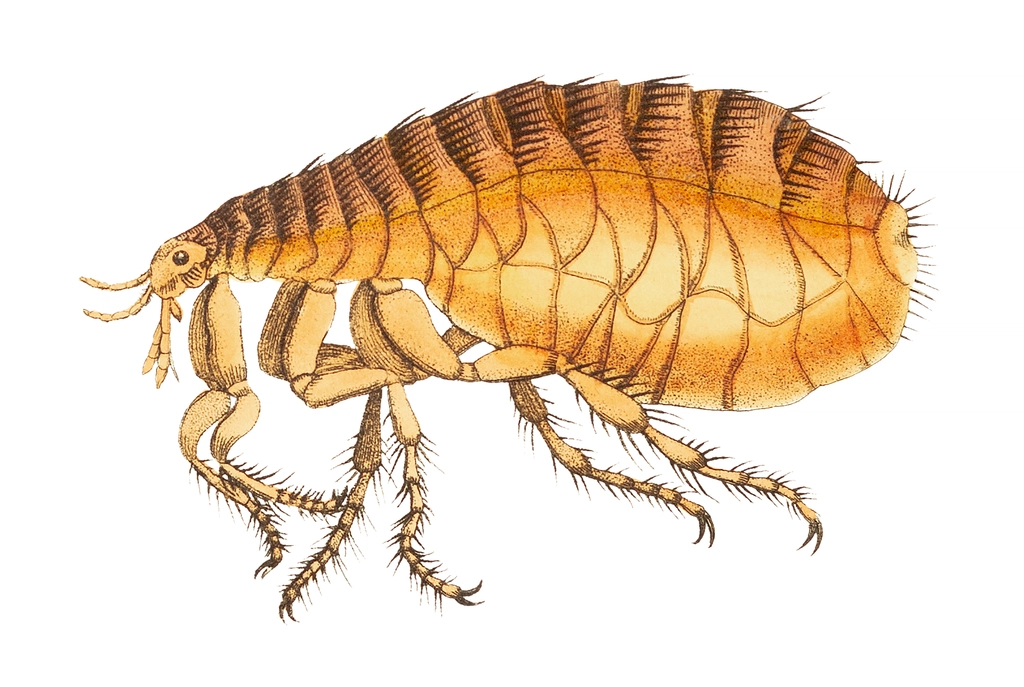 Photo Credit: bhl / Rawpixel
In the bustling world of the microscopic, the flea, scientifically known as Ctenocephalides, emerges as a tiny titan of survival. Picture a sun-drenched patch of grass, where the air is alive with the sounds of chirping birds and rustling leaves. Here, amidst the vibrant greenery, these minuscule insects leap with astonishing agility, their bodies perfectly designed for a life of parasitism. Fleas are not just any insects; they are remarkable jumpers, capable of leaping over 200 times their own body length. This extraordinary ability allows them to navigate their environment with ease, making them both elusive and fascinating to observe.
Fleas thrive in close association with their hosts, often found nestled in the fur of mammals or the feathers of birds. Their sleek, flattened bodies are equipped with specialized mouthparts that allow them to pierce the skin and feed on blood, which is essential for their survival. Scientists and nature enthusiasts alike are captivated by these tiny creatures, not only for their impressive jumping skills but also for their complex life cycle. A female flea can lay between 25 to 40 eggs each day, ensuring that their population remains robust. As we delve deeper into the world of fleas, we will uncover their intriguing behaviors, their role in ecosystems, and the unique relationships they share with other species, including humans. Join us on this adventure to explore the hidden life of these remarkable little insects!
Fleas are tiny yet intriguing members of the animal kingdom, occupying a unique niche in the vast tree of life. They belong to the phylum Arthropoda, which includes all animals with jointed legs and exoskeletons, like insects and spiders. Within this phylum, fleas are classified under the class Insecta, the largest group of animals on Earth. What sets fleas apart is their incredible ability to jump, which can be up to 200 times their body length! This remarkable skill, combined with their parasitic lifestyle, makes them both fascinating and sometimes troublesome for their hosts, primarily mammals and birds.
| Taxonomic Rank | Scientific Name | Meaning & Significance |
|---|---|---|
| Kingdom | Animalia | The name “Animalia” comes from the Latin word “animalis,” meaning “having breath.” This reflects the living, breathing nature of all animals, including fleas. |
| Phylum | Arthropoda | “Arthropoda” means “jointed legs” in Greek, highlighting the defining feature of this group, which includes insects, arachnids, and crustaceans. |
| Class | Insecta | The term “Insecta” is derived from the Latin word “insectum,” meaning “cut into sections.” This refers to the segmented body structure of insects, including the flea’s three-part body. |
| Order | Siphonaptera | “Siphonaptera” combines the Greek words “siphon,” meaning “tube,” and “aptera,” meaning “wingless.” This name reflects the flea’s tube-like mouthparts used for feeding and its lack of wings. |
| Family | Siphonapteridae | This family name is essentially a repetition of the order name, emphasizing the unique characteristics of fleas within this group. |
| Genus | Ctenocephalides | “Ctenocephalides” comes from the Greek words “cteno,” meaning “comb,” and “cephalides,” meaning “head.” This refers to the comb-like structures on the flea’s head that help it navigate through fur. |
Understanding the taxonomic classification of fleas reveals much about their evolutionary journey. As members of the arthropods, they share a common ancestry with a vast array of other creatures, showcasing the incredible diversity of life on Earth. Their specialized adaptations, such as their jumping ability and parasitic behavior, highlight how evolution shapes organisms to thrive in specific environments. Fleas may be small, but their place in the tree of life is a testament to the complexity and interconnectedness of all living things.
The evolutionary journey of fleas stretches back millions of years, tracing their lineage to ancient ancestors that roamed the Earth long before humans existed. These tiny parasites belong to the order Siphonaptera, which emerged during the late Cretaceous period, around 100 million years ago. As they evolved, fleas adapted to a life of blood-sucking, developing specialized features that allowed them to thrive in a world filled with larger mammals.
Fleas are believed to have descended from winged insects, but over time, they lost their wings, becoming more streamlined for their parasitic lifestyle. This transition marked a significant shift in their survival strategy, as they became adept at jumping from host to host. Their bodies became flattened, allowing them to navigate through the fur or feathers of their hosts with ease. Additionally, their mouthparts evolved into a specialized structure for piercing skin and sucking blood, which is essential for their nutrition and reproduction.
Fleas have thrived for millions of years due to these remarkable adaptations. Their ability to jump great distances allows them to evade danger and find new hosts, while their specialized mouthparts ensure they can feed effectively. The flattened body shape and resilient exoskeleton provide additional protection, enabling them to survive in diverse environments. Together, these features have made fleas successful survivors in the ever-changing tapestry of life on Earth.
Fleas are tiny marvels of nature, often overlooked due to their minuscule size. Measuring just about 1 milligram, these agile insects possess a body structure that is both compact and efficient. Their elongated legs are their most distinctive feature, allowing them to leap impressively far relative to their size. This remarkable adaptation not only aids in their movement but also plays a crucial role in their survival as they navigate through the fur or feathers of their hosts.
| Feature | Description |
|---|---|
| Size | Approximately 1 milligram, making them incredibly lightweight. |
| Color | Typically dark brown or black, which helps them blend into their environment. |
| Skin Type | Exoskeleton, providing protection and support for their tiny bodies. |
| Most Distinctive Feature | Long legs, enabling powerful jumps that can reach up to 200 times their body length. |
The combination of their lightweight structure, dark coloration, and powerful legs creates a perfect storm for survival. The exoskeleton shields them from predators and environmental hazards, while their ability to leap great distances allows them to escape danger quickly and find new hosts. This incredible design not only makes fleas efficient parasites but also showcases the wonders of evolution in adapting to life in a world filled with challenges.
Fleas are tiny yet tenacious insects that thrive in a variety of habitats, often found in close association with their hosts. These remarkable little creatures prefer environments where they can easily access mammals and birds, their primary sources of food. You might find them nestled in the fur of a dog, hiding in the feathers of a bird, or even lurking in the cozy corners of a home. Their habitats can range from lush forests to urban backyards, showcasing their adaptability and resourcefulness.
Fleas thrive in warm, humid climates, which are essential for their survival and reproduction. They prefer temperatures between 70°F and 85°F (21°C to 29°C) and high humidity levels, as these conditions help keep their bodies hydrated. In drier environments, fleas can struggle to survive, as they lose moisture quickly. This is why you often find them in places where their hosts live, as the warmth and moisture from the animals provide a perfect microhabitat.
To survive in these diverse environments, fleas have developed several clever adaptations. Their flattened bodies allow them to move easily through fur or feathers, while their powerful hind legs enable them to jump great distances—up to 200 times their own body length! This incredible ability helps them escape predators and find new hosts. Additionally, fleas have a keen sense of smell, allowing them to detect the presence of potential hosts nearby. These adaptations make fleas not just survivors, but successful inhabitants of a wide range of habitats around the world.
Fleas lead a life filled with activity, driven by their need to find food and reproduce. Each day, these tiny insects engage in a series of behaviors that revolve around their primary goal: survival. Fleas are known for their incredible jumping ability, which allows them to leap onto their hosts—often pets like dogs and cats—to feed on their blood. This feeding process is crucial, as it provides the nutrients they need to grow and lay eggs. After a satisfying meal, fleas often spend time resting in the warm, cozy fur of their host, where they can remain hidden from predators.
While fleas are primarily solitary creatures, their interactions with hosts and other fleas can be quite interesting. When a flea finds a suitable host, it can lead to a temporary gathering of fleas, especially if multiple fleas are present on the same animal. This can create a bustling environment where fleas communicate through subtle movements and vibrations. Although they do not form complex social structures like some insects, their ability to sense the presence of other fleas helps them navigate their world and find food more effectively.
| Behavior Type | Description |
|---|---|
| Feeding | Fleas jump onto their hosts to feed on blood, which is essential for their growth and reproduction. |
| Resting | After feeding, fleas often stay hidden in the fur of their host, providing warmth and protection. |
| Communication | Fleas communicate through vibrations and movements, helping them detect the presence of other fleas and potential hosts. |
| Solitary Behavior | Fleas are primarily solitary, but they can gather temporarily on a host when multiple fleas are present. |
These behaviors are vital for the survival of fleas. By efficiently finding food and utilizing their host’s environment, they ensure their continued existence. Their ability to jump and communicate, even in a solitary lifestyle, allows them to adapt and thrive in various conditions. In the grand tapestry of life, fleas may be small, but their daily activities are a testament to the resilience and ingenuity of nature.
Fleas are carnivorous parasites that primarily feed on the blood of their hosts, which can include mammals and birds. They have specialized mouthparts that allow them to pierce the skin and draw blood, making them efficient at obtaining the nutrients they need to survive. This feeding behavior is not just a means of sustenance; it also plays a crucial role in their reproductive cycle, as female fleas require a blood meal to produce eggs.
| Dietary Aspect | Details |
|---|---|
| Diet Type | Carnivore |
| Favorite Foods | Blood from mammals and birds |
| Prey Items | Hosts such as dogs, cats, rats, and birds |
| Hunting/Foraging Strategies | Jumping onto hosts and using specialized mouthparts to feed |
The diet of fleas significantly influences their ecology and daily activities. By feeding on the blood of their hosts, fleas not only sustain themselves but also contribute to the health dynamics of their ecosystems. Their presence can affect host populations and even the spread of diseases, making them important players in the natural world. As they hop from one host to another, fleas are constantly on the move, which shapes their behavior and interactions with other species.
Fleas have a fascinating mating ritual that often takes place in the warm months when conditions are just right for breeding. During this time, male fleas will perform a series of courtship behaviors to attract females. Once a female is receptive, mating occurs, and the female can lay hundreds of eggs in her lifetime. This reproductive strategy ensures that even in the face of challenges, such as predators or environmental changes, there will be a new generation ready to thrive.
| Reproductive Aspect | Details |
|---|---|
| Gestation Period | A week |
| Litter Size | Up to 50 eggs per batch |
| Age of Maturity | 3-4 weeks |
| Name of Young | Larvae |
After the eggs are laid, they fall into the environment, often landing in the fur of their host or in the surrounding area. The eggs hatch into larvae, which are small, worm-like creatures that feed on organic debris, including the feces of adult fleas. This diet helps them grow strong. As they mature, the larvae undergo a transformation, eventually spinning a cocoon and entering a pupal stage. After a few weeks, they emerge as adult fleas, ready to continue the cycle of life. Parental care is minimal, as adult fleas do not nurture their young; instead, they rely on the environment to provide the necessary conditions for their offspring to develop into independent adults.
Fleas play a crucial role in the food web, primarily as parasites that feed on the blood of their hosts, which include mammals and birds. While they may seem insignificant due to their small size, they are an important food source for various predators. This position makes them both vulnerable and essential in the ecosystem, as they help control host populations and serve as prey for larger animals.
To survive against these threats, fleas have developed several clever defensive behaviors. Their ability to jump great distances—up to 200 times their body length—allows them to escape quickly from predators. Additionally, their flat bodies make it easy for them to hide in the fur of their hosts or in the cracks of their environment, providing excellent camouflage. These adaptations, combined with their rapid reproduction rates, help ensure that fleas can persist even in the face of danger.
A keystone species is a vital part of an ecosystem, meaning its presence or absence can significantly impact the environment and other living things within it. Fleas, while small and often seen as mere pests, do play a keystone role in their ecosystems. Their interactions with hosts and other species create ripples that affect the balance of life around them.
Fleas primarily feed on the blood of mammals and birds, acting as parasites. This feeding behavior can influence the health of their hosts, sometimes leading to weakened animals that are more susceptible to disease. For example, when fleas infest a population of rodents, they can reduce the overall health of that population. This, in turn, affects the predators that rely on these rodents for food, creating a chain reaction throughout the food web. Additionally, fleas can serve as vectors for diseases, transmitting pathogens from one host to another, which can have broader implications for wildlife and even human health.
Fleas also contribute to nutrient cycling in their ecosystems. As they feed and reproduce, they produce waste that can enrich the soil, providing nutrients for plants. This process supports the growth of vegetation, which is essential for many other species in the ecosystem. Furthermore, the presence of fleas can influence the behavior and population dynamics of their hosts, leading to changes in habitat use and resource allocation.
If fleas were to disappear from their ecosystems, the consequences could be significant. Host populations might grow unchecked, leading to overgrazing or depletion of resources. This could destabilize the entire food web, affecting not just the hosts but also their predators and the plants that rely on the nutrients provided by flea waste. In essence, the absence of fleas could create a ripple effect, altering the balance of life in ways that are hard to predict. Their small size belies their importance, reminding us that even the tiniest creatures can have a monumental impact on the world around us.
Fleas may be tiny, but they play a surprisingly significant role in their ecosystems. As parasites, they primarily inhabit the fur and feathers of mammals and birds, where they feed on blood. This unique ecological niche allows them to influence the health and behavior of their hosts, as well as the broader environment. By living in close association with larger animals, fleas contribute to the complex web of life that connects various species in their habitats.
| Ecosystem Service | Impact |
|---|---|
| Host Regulation | Fleas can affect the population dynamics of their hosts by influencing their health and reproductive success. |
| Food Source | Fleas serve as prey for various small animals, including birds and other insects, thus supporting the food web. |
| Nutrient Cycling | As fleas die and decompose, they contribute organic matter to the soil, enriching it and supporting plant life. |
| Parasite Control | Fleas can help regulate the populations of other parasites by competing for resources on their hosts. |
Fleas influence their ecosystems in several specific ways. For instance, when a flea infests a mammal, it can lead to stress and health issues for the host, which may affect its ability to reproduce or find food. This, in turn, can impact the population of that species, creating a ripple effect throughout the ecosystem. Additionally, fleas are a food source for many small predators, such as birds and certain insects, which rely on them for sustenance. This connection highlights the importance of fleas in maintaining the balance of their habitats.
The broader ecological importance of fleas cannot be overlooked. As a keystone species, their presence can significantly influence the health of their ecosystems. By regulating host populations and serving as a food source, fleas help maintain the delicate balance of life. Their role in nutrient cycling also supports plant growth, which is essential for the survival of countless other species. In this way, even the smallest creatures can have a profound impact on the world around them, reminding us of the intricate connections that define our natural environment.
Symbiosis is a captivating concept in nature that describes how different species interact and depend on one another. These relationships can take many forms, from mutualism, where both species benefit, to parasitism, where one species gains at the expense of another. Fleas, those tiny bloodsuckers, are prime examples of these ecological connections. They primarily engage in parasitic relationships, but they can also be part of commensal interactions, showcasing the diverse ways life on Earth is interconnected.
| Species/Type | Relationship Type | Description |
|---|---|---|
| Mammals (e.g., dogs, cats) | Parasitic | Fleas feed on the blood of their mammal hosts, gaining nourishment while causing discomfort and potential health issues for the host. |
| Birds (e.g., sparrows, pigeons) | Parasitic | Similar to mammals, fleas can infest birds, feeding on their blood and sometimes leading to feather loss and skin irritation. |
| Fleas and their hosts | Commensal | In some cases, fleas may not significantly harm their hosts, living in their fur or feathers without causing major issues, thus benefiting from the host’s presence. |
The evolution of these relationships has been shaped by millions of years of adaptation and survival. Fleas have developed specialized mouthparts to pierce skin and draw blood, making them efficient parasites. Meanwhile, their hosts have evolved various defenses against these tiny invaders, leading to a constant battle of adaptation. These interactions not only highlight the complexity of ecosystems but also demonstrate how species can influence each other’s evolution, creating a rich tapestry of life that is both intricate and essential for the health of our planet.
Fleas may be small, but they are packed with surprises that can astonish even the most seasoned nature enthusiasts. These tiny insects have some remarkable adaptations and behaviors that make them truly unique in the animal kingdom.
Throughout history, fleas have had a complex relationship with humanity, often viewed as unwelcome guests. These tiny parasites have been part of human life for centuries, leaving their mark on culture and society. In ancient times, fleas were not just pests; they were also symbols of disease and misfortune. The infamous bubonic plague, carried by fleas that infested rats, devastated populations in the Middle Ages, forever linking these insects to human suffering. Yet, in some cultures, fleas have been depicted in art and literature, representing resilience and survival in the face of adversity.
In modern times, our interactions with fleas have evolved, reflecting both conflict and cooperation. While many people see fleas as nuisances that invade homes and pets, there is a growing awareness of their ecological role. Fleas are essential in the food web, serving as food for various animals, including birds and small mammals. Efforts to manage flea populations often involve a balance between protecting pets and maintaining healthy ecosystems. Additionally, some researchers are exploring the potential benefits of fleas in scientific studies, such as understanding their unique adaptations and behaviors.
As we look to the future, the relationship between fleas and humanity will likely continue to shift. With advancements in pest control and a deeper understanding of ecological balance, we may find new ways to coexist with these tiny insects. Education about their role in nature can help reduce the stigma surrounding fleas, allowing us to appreciate their place in the world. By fostering a respectful relationship with all creatures, even the smallest ones, we can contribute to a healthier planet for future generations.
Fleas, those tiny yet tenacious insects, currently hold a conservation status of “Least Concern” according to the International Union for Conservation of Nature (IUCN). This means that, overall, they are not facing immediate threats that could lead to their extinction. However, specific population trends are difficult to gauge, as their numbers can fluctuate widely based on environmental conditions and the availability of hosts. While we may not have precise population estimates, fleas are generally considered to be abundant in many areas where their hosts reside.
| Conservation Factor | Status/Details |
|---|---|
| IUCN Status | Least Concern |
| Estimated Population Size | Unknown |
| Population Trend | Stable |
Despite their current stable status, fleas face several threats that could impact their populations in the future. Changes in climate, such as rising temperatures and altered precipitation patterns, can affect the habitats where fleas thrive. Additionally, the widespread use of pesticides to control flea populations can inadvertently harm their numbers. These chemicals can disrupt the delicate balance of ecosystems, affecting not only fleas but also the various animals that rely on them for food.
Conservation efforts for fleas may not be as prominent as those for larger or more charismatic species, but their role in ecosystems is vital. Maintaining healthy populations of fleas is important for the animals that depend on them, including many mammals and birds. As we continue to learn more about these tiny insects, it becomes clear that even the smallest creatures play a significant role in the web of life. By promoting biodiversity and protecting natural habitats, we can help ensure that fleas and their ecosystems remain resilient for generations to come.
| Question | Answer |
|---|---|
| What is a flea's habitat? | Fleas are tiny insects that live on mammals and birds. They can be found in various habitats, including homes, forests, and grasslands, wherever their hosts reside. |
| What do fleas eat? | Fleas are carnivores, meaning they primarily feed on the blood of their hosts. They use their specialized mouthparts to pierce the skin and suck blood, which provides them with the nutrients they need to survive. |
| How do fleas behave? | Fleas are known for their incredible jumping ability, which helps them move between hosts. They are also very agile and can quickly hide in fur or feathers, making them hard to spot. |
| How do fleas reproduce? | Fleas reproduce quickly, with a female laying up to 50 eggs per day. These eggs fall off the host and develop into larvae, which eventually turn into adult fleas, ready to find a new host. |
| What threats do fleas face? | While fleas are currently classified as Least Concern in terms of conservation status, they can be affected by environmental changes and the use of pesticides. Their main threat comes from their hosts, as a lack of food can lead to population declines. |
| What is an interesting characteristic of fleas? | One of the most distinctive features of fleas is their long legs, which allow them to jump up to 200 times their body length! This incredible ability helps them escape predators and find new hosts. |
| Can fleas transmit diseases? | Yes, fleas can transmit diseases to both animals and humans. They are known carriers of bacteria and parasites, such as the plague and tapeworms, making them important to monitor in pet care and public health. |