Taxonomy & Classification
- Kingdom
- Animalia
- Phylum
- Chordata
- Class
- Reptilia
- Order
- Squamata
- Family
- Pythonidae
- Genus
- Morelia
- Species
- Morelia viridis

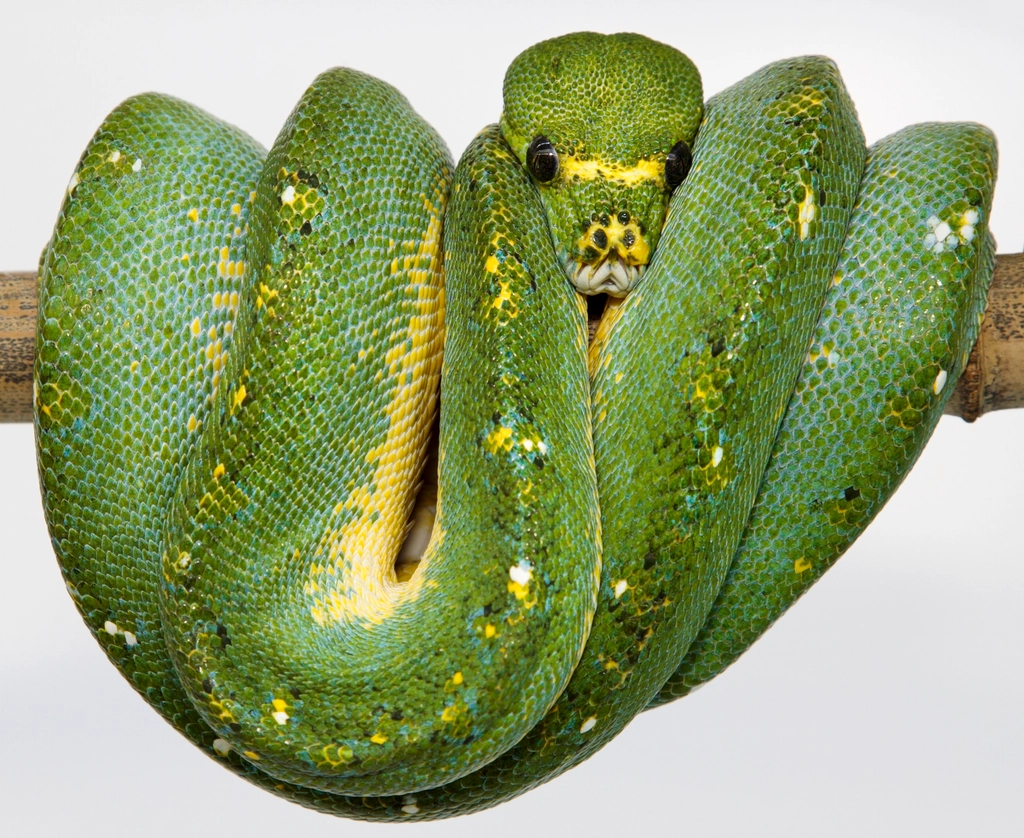 Photo Credit: Rawpixel
In the heart of the lush rainforests of New Guinea and Australia, the Green Tree Python, or Morelia viridis, weaves its way through the vibrant green foliage. This stunning snake, with its brilliant emerald scales, is a master of camouflage, blending seamlessly into the leaves and branches that surround it. As sunlight filters through the dense canopy, it creates a dappled effect on the snake’s sleek body, making it appear almost like a living jewel among the trees. With a length that can reach up to six feet, the Green Tree Python is not just a sight to behold; it is a marvel of nature’s design, captivating both scientists and nature enthusiasts alike.
What makes Morelia viridis particularly intriguing is its unique lifestyle and behavior. Unlike many snakes that slither along the ground, this python is an expert climber, spending most of its time coiled around branches, waiting patiently for unsuspecting prey. Its diet mainly consists of small mammals and birds, which it captures with a swift strike, showcasing its impressive hunting skills. The Green Tree Python’s nocturnal habits add an air of mystery to its existence, as it comes alive under the cover of darkness, navigating its arboreal world with grace and precision. As we explore the life of this remarkable snake, we will uncover the secrets of its habitat, diet, and the vital role it plays in the ecosystem, revealing why the Green Tree Python is a true gem of the rainforest.
The Green Tree Python, known scientifically as Morelia viridis, occupies a special place in the tree of life. This striking snake is a member of the kingdom Animalia, which includes all animals, and it belongs to the phylum Chordata, meaning it has a backbone. As a reptile in the class Reptilia, it shares its order, Squamata, with lizards and other snakes. What sets the Green Tree Python apart is its vibrant green coloration, which helps it blend seamlessly into the lush foliage of its rainforest habitat. This adaptation not only aids in camouflage but also plays a crucial role in its hunting strategy, allowing it to ambush unsuspecting prey.
| Taxonomic Rank | Scientific Name | Meaning & Significance |
|---|---|---|
| Kingdom | Animalia | This name signifies that the Green Tree Python is part of the vast group of multicellular organisms known as animals. |
| Phylum | Chordata | Chordata means “having a notochord,” which is a flexible rod that supports the body, a feature present in all vertebrates. |
| Class | Reptilia | Reptilia refers to reptiles, a class of cold-blooded vertebrates that typically lay eggs and have scaly skin. |
| Order | Squamata | Squamata means “scaly,” highlighting the characteristic scales that cover the skin of snakes and lizards. |
| Family | Pythonidae | This family name indicates that the Green Tree Python is part of the group of non-venomous constrictor snakes known as pythons. |
| Genus | Morelia | Morelia is derived from a Latin word meaning “to be in a coil,” reflecting the snake’s coiled resting position in trees. |
| Species | viridis | Viridis is Latin for “green,” aptly describing the snake’s vibrant coloration that helps it camouflage in its leafy environment. |
Understanding the Green Tree Python’s classification reveals much about its evolutionary journey. As a member of the Pythonidae family, it shares a common ancestor with other pythons, which have adapted to various environments around the world. The unique adaptations of the Green Tree Python, such as its striking color and arboreal lifestyle, showcase how evolution shapes species to thrive in specific habitats. This snake not only exemplifies the beauty of biodiversity but also highlights the intricate connections within the animal kingdom, reminding us of the wonders of nature’s design.
The evolutionary journey of the Green Tree Python, or Morelia viridis, stretches back millions of years, weaving through the lush landscapes of New Guinea, Australia, and nearby islands. This snake belongs to the family Pythonidae, which includes some of the largest and most fascinating snakes on Earth. The ancestors of modern pythons began to diverge from other snake lineages around 60 million years ago, adapting to various environments and developing traits that would help them thrive in their habitats.
The early ancestors of the Green Tree Python were likely ground-dwelling snakes, similar to other pythons. Over time, as they adapted to life in the trees, they developed several key features. One major transition was the evolution of their prehensile tails, which allow them to grasp branches securely. This adaptation was crucial for navigating the complex, three-dimensional world of the rainforest canopy. Additionally, their vibrant green coloration evolved as a form of camouflage, helping them blend seamlessly into the leaves and foliage, making it easier to ambush prey and avoid predators.
The adaptations of the Green Tree Python have been vital for its survival in the wild. The ability to navigate the treetops with a prehensile tail and the skillful use of camouflage have made it a master of stealth. Its heat-sensing pits enhance its hunting prowess, allowing it to locate prey even in darkness. With a slow metabolism, this snake can thrive in environments where food may not always be plentiful. Together, these traits have shaped the Green Tree Python into a successful predator, perfectly suited to its arboreal lifestyle.
The Green Tree Python is a stunning example of nature’s artistry, with a body that seems to flow like a ribbon through the branches of its rainforest home. Its slender form can reach lengths of up to 6.5 feet, allowing it to navigate the treetops with grace and agility. The snake’s vibrant green coloration, often accented with hints of yellow or blue, helps it blend seamlessly into the lush foliage, making it a master of camouflage. Its scales are smooth and shiny, reflecting light in a way that enhances its striking appearance while also providing protection.
| Feature | Description |
|---|---|
| Size | Up to 6.5 feet long |
| Color | Bright green with possible yellow or blue accents |
| Skin Type | Smooth, shiny scales |
| Body Structure | Slender and elongated, ideal for climbing |
These physical features work together to create a perfect predator in the treetops. The Green Tree Python’s vibrant green color not only provides excellent camouflage against the leaves but also helps it ambush unsuspecting prey. Its smooth scales reduce friction as it glides through branches, allowing for stealthy movements. This combination of size, color, and body structure makes the Green Tree Python a true marvel of adaptation, showcasing the incredible ways animals evolve to thrive in their environments.
The Green Tree Python thrives in the lush, vibrant rainforests of its native regions, where the air is thick with humidity and the canopy is alive with the sounds of wildlife. Picture a world where sunlight filters through a dense layer of leaves, casting dappled shadows on the forest floor below. This snake is perfectly at home among the branches, where it can easily blend in with the green foliage, making it a master of camouflage.
The climate in these areas is typically warm and humid, with temperatures often ranging from 70 to 90 degrees Fahrenheit (21 to 32 degrees Celsius). The Green Tree Python prefers environments that provide plenty of cover, such as thick vegetation and trees, which help maintain the moisture levels it needs to thrive. Rainfall is abundant, often exceeding 100 inches (254 centimeters) annually, creating a lush habitat that supports a diverse array of life.
To survive in these specific habitats, the Green Tree Python has developed several remarkable adaptations. Its vibrant green coloration not only helps it blend seamlessly into the leaves but also aids in thermoregulation, allowing it to maintain its body temperature in the warm environment. Additionally, its prehensile tail acts like a fifth limb, giving it the ability to navigate the treetops with ease, while its keen sense of smell helps it locate prey in the dense foliage. These adaptations make the Green Tree Python a true master of its arboreal domain.
The daily life of a Green Tree Python is a blend of patience and precision. These snakes are primarily nocturnal, meaning they are most active at night. As the sun sets, they emerge from their resting spots, often coiled around branches, ready to hunt. Their diet mainly consists of small mammals and birds, which they capture using a method called constriction. This means they wrap their bodies around their prey and squeeze until it can no longer breathe. During the day, they remain still, blending seamlessly into the green foliage, which helps them avoid predators and conserve energy.
In terms of social behavior, Green Tree Pythons are solitary creatures. They prefer to live alone, which is quite common among many snake species. This independence allows them to establish their own territories without the need for competition. While they may occasionally cross paths with other pythons, they do not form social groups or engage in cooperative behaviors. Communication among these snakes is subtle; they rely on body language and scent to convey their presence to potential mates or rivals.
| Behavior Type | Description |
|---|---|
| Activity Patterns | Nocturnal hunting, resting during the day, and using camouflage to blend into their surroundings. |
| Social Structure | Solitary lifestyle, with no social groups or cooperative behaviors. |
| Communication Methods | Body language and scent marking to signal presence to others. |
The behaviors of the Green Tree Python are finely tuned for survival in their rainforest habitat. By being solitary, they reduce competition for food and space, allowing them to thrive in a rich but challenging environment. Their nocturnal nature and ability to camouflage help them avoid predators while hunting effectively. Each aspect of their daily life is a testament to the intricate balance of nature, showcasing how these snakes have adapted to their surroundings over time.
The Green Tree Python is a carnivore, which means it primarily eats meat. This snake has a particular taste for small lizards and rodents, making it a skilled hunter in its rainforest habitat. With its vibrant green coloration, it blends seamlessly into the leaves and branches, allowing it to ambush unsuspecting prey. The Green Tree Python uses a method called constriction, where it wraps its body around its catch and squeezes until the prey can no longer breathe. This technique is both efficient and effective, ensuring the snake gets the nourishment it needs to thrive.
| Dietary Aspect | Details |
|---|---|
| Diet Type | Carnivore |
| Favorite Foods | Small lizards and rodents |
| Prey Items | Commonly hunts lizards and small mammals |
| Hunting/Foraging Strategies | Uses camouflage to ambush prey and constriction to subdue it |
The diet of the Green Tree Python plays a crucial role in its ecology and daily routine. By preying on small lizards and rodents, it helps maintain the balance of these populations in its environment. This snake’s hunting habits also influence its activity patterns, as it must remain alert and patient while waiting for the perfect moment to strike. The interplay between its diet and behavior showcases the intricate connections within the rainforest ecosystem, where every creature has a role to play.
The mating behavior of the Green Tree Python is a captivating spectacle that unfolds during the warmer months, typically from late spring to early summer. During this breeding season, males engage in a fascinating ritual of courtship, which often involves a dance-like display. They may wrap around each other and engage in gentle nudging, showcasing their strength and agility. This competition for the attention of females can be quite intense, as males strive to prove their fitness as potential mates.
| Reproductive Aspect | Details |
|---|---|
| Gestation Period | Approximately 30 to 40 days |
| Litter Size | Typically 6 to 15 eggs |
| Age of Maturity | About 2 to 3 years |
| Name of Young | Hatchlings |
Once the female lays her eggs, she takes on the role of protector. Green Tree Pythons are known for their remarkable maternal instincts. After laying her clutch, she coils around the eggs, providing warmth and protection. This behavior is crucial, as the eggs need a stable temperature to develop properly. The hatchlings emerge after about two months, ready to begin their journey in the world. These young snakes are independent from the moment they hatch, equipped with the skills to hunt small prey. As they grow, they will gradually develop the vibrant green coloration that makes them so iconic, transforming into the stunning adults that thrive in their rainforest homes.
The Green Tree Python plays a vital role in its ecosystem, sitting comfortably in the middle of the food web. As a skilled predator, it helps control the populations of small mammals and birds, ensuring a balance in its rainforest habitat. However, this beautiful snake is not without its challenges. It faces various threats from both natural predators and human activities that can disrupt its environment.
To survive these dangers, the Green Tree Python has developed several clever defensive strategies. Its vibrant green coloration allows it to blend seamlessly into the leaves and branches of the trees, making it nearly invisible to both predators and prey. When threatened, it can also remain motionless, relying on its camouflage to avoid detection. Additionally, this snake is known to be quite agile, allowing it to escape quickly into the treetops when danger approaches. Through these adaptations, the Green Tree Python continues to thrive in its lush, vibrant world.
A keystone species is an organism that has a disproportionately large impact on its environment relative to its abundance. These species play critical roles in maintaining the structure of an ecosystem. The Green Tree Python, or Morelia viridis, qualifies as a keystone species due to its significant influence on the populations of other animals in its rainforest habitat.
As a carnivore, the Green Tree Python primarily preys on small mammals and birds, which helps regulate their populations. By keeping these populations in check, the python ensures that no single species dominates the ecosystem, allowing for a diverse array of life to thrive. For example, if the python’s numbers were to decline, the populations of its prey could explode, leading to overgrazing of vegetation and a subsequent decline in plant diversity. This ripple effect can disrupt the entire ecosystem, affecting not just the plants but also the many other animals that rely on them for food and shelter.
Additionally, the Green Tree Python serves as a food source for larger predators, such as birds of prey and larger snakes. This connection highlights its role in the food web, where energy and nutrients flow from one organism to another. The python’s presence supports a balance among various species, contributing to the overall health of its rainforest environment.
If the Green Tree Python were to disappear, the consequences would be profound. Without this snake to regulate prey populations, small mammals and birds could proliferate unchecked. This overpopulation would lead to increased competition for food resources, ultimately resulting in habitat degradation. As plants struggle to survive under the pressure of overgrazing, the entire ecosystem could shift, leading to a loss of biodiversity and the collapse of the delicate balance that supports countless other species. The disappearance of the Green Tree Python would not just affect its immediate surroundings but could have far-reaching impacts throughout the rainforest ecosystem.
The Green Tree Python, or Morelia viridis, occupies a crucial ecological niche in the rainforests of New Guinea and Australia. As a skilled predator, this vibrant snake helps maintain the balance of its ecosystem by controlling the populations of small mammals and birds. Its presence ensures that no single species dominates the environment, allowing for a diverse array of life to thrive. By weaving through the branches and blending into the foliage, the Green Tree Python also plays a role in the intricate web of life that characterizes its lush habitat.
| Ecosystem Service | Impact |
|---|---|
| Population Control | Regulates the numbers of small mammals and birds, preventing overpopulation. |
| Prey for Larger Predators | Serves as a food source for larger animals, contributing to the food web. |
| Habitat Structure | Influences the distribution of plant species by preying on herbivorous animals. |
| Seed Dispersal | Indirectly aids in plant reproduction by controlling herbivore populations. |
The Green Tree Python’s influence extends beyond its role as a predator. By keeping the populations of its prey in check, it allows various plant species to flourish, which in turn supports a multitude of other organisms. For instance, when the snake preys on small rodents, it helps prevent these animals from overgrazing on young plants. This balance is essential for maintaining the health of the rainforest, where every species, from the tiniest insect to the tallest tree, plays a part in the ecosystem’s overall function.
The broader ecological importance of the Green Tree Python cannot be overstated. As a keystone species, its presence is vital for the stability of its environment. Without it, the delicate balance of the rainforest could be disrupted, leading to a decline in biodiversity. This snake not only shapes its immediate surroundings but also contributes to the resilience of the entire ecosystem, ensuring that the vibrant life of the rainforest continues to thrive for generations to come.
In the intricate web of life, symbiosis plays a vital role in shaping ecosystems. This term refers to the close interactions between different species, which can be beneficial, harmful, or neutral. These relationships can take many forms, such as mutualism, where both species gain advantages, parasitism, where one benefits at the other’s expense, and commensalism, where one species benefits while the other is neither helped nor harmed. The Green Tree Python, with its striking green scales and arboreal lifestyle, engages in various ecological relationships that highlight the interconnectedness of life in its rainforest habitat.
| Species/Type | Relationship Type | Description |
|---|---|---|
| Birds (e.g., treecreepers) | Commensal | These birds often share the same habitat as the Green Tree Python, benefiting from the snake’s presence by finding insects disturbed by its movements without affecting the python. |
| Small mammals (e.g., rodents) | Parasitic | While not a traditional parasite, the Green Tree Python preys on small mammals, which are harmed as they become food for the snake. |
| Fungi and bacteria in the environment | Mutualistic | These microorganisms help decompose organic matter in the rainforest, enriching the soil, which in turn supports the growth of trees that provide habitat for the Green Tree Python. |
The evolution of these relationships is a testament to nature’s adaptability and resilience. Over time, the Green Tree Python and its partners have developed ways to coexist, each benefiting from the other in various ways. The python’s role as a predator helps control populations of small mammals, while the presence of birds can indicate a healthy ecosystem. These interactions not only enhance the survival of individual species but also contribute to the overall health of the rainforest, showcasing the delicate balance of life that thrives in these vibrant habitats.
The Green Tree Python is a captivating snake that enchants both nature lovers and scientists alike. With its vibrant green color and unique behaviors, this species offers a treasure trove of surprises.
The Green Tree Python, or Morelia viridis, has long captivated human imagination and culture. Indigenous peoples of New Guinea and surrounding islands have revered this striking snake, often incorporating it into their folklore and art. Its vibrant green color and graceful movements have made it a symbol of the lush rainforests it inhabits. Historically, encounters with this snake have sparked curiosity and respect, leading to a deeper understanding of the delicate balance within these ecosystems. As humans have explored these regions, the Green Tree Python has become a part of the narrative of our relationship with nature, embodying both beauty and mystery.
In modern times, interactions between humans and Green Tree Pythons have evolved significantly. Conservation efforts are underway to protect their habitats from deforestation and climate change, which threaten their survival. However, conflicts can arise when these snakes venture into human settlements, often leading to fear and misunderstanding. Some people may even attempt to domesticate them, drawn by their striking appearance and calm demeanor. This has led to a growing interest in keeping Green Tree Pythons as exotic pets, which raises questions about their welfare and the ethics of keeping wild animals in captivity.
As we look to the future, the relationship between humans and the Green Tree Python holds both promise and challenges. With increased awareness and education, there is potential for a more harmonious coexistence. By prioritizing conservation and understanding the ecological importance of this snake, we can ensure that future generations will continue to marvel at its beauty in the wild. The journey ahead will require collaboration and respect for the natural world, reminding us that we are all part of the same intricate web of life.
The Green Tree Python, known scientifically as Morelia viridis, currently holds a conservation status of “Least Concern” according to the International Union for Conservation of Nature (IUCN). This means that, at present, the species is not facing an immediate threat of extinction. While population estimates are not precisely defined, the Green Tree Python is generally considered to be stable across its range, which includes the lush rainforests of New Guinea and parts of Australia. However, ongoing monitoring is essential to ensure that this beautiful snake continues to thrive in its natural habitat.
| Conservation Factor | Status/Details |
|---|---|
| IUCN Status | Least Concern |
| Population Estimates | Stable, but not precisely quantified |
| Trend Direction | Stable |
The main threats to the Green Tree Python stem from habitat loss and degradation, primarily due to deforestation for agriculture and logging. As rainforests are cleared, these snakes lose their homes and the rich biodiversity that supports their prey. Additionally, the illegal pet trade poses a risk, as some individuals are captured and sold, disrupting local populations. Climate change also looms as a potential threat, altering the delicate balance of their rainforest ecosystems.
Conservation efforts are underway to protect the Green Tree Python and its habitat. Organizations are working to promote sustainable land-use practices and raise awareness about the importance of preserving rainforests. Protected areas are being established to safeguard these vibrant ecosystems, ensuring that the Green Tree Python can continue to thrive. With ongoing commitment and action, the outlook for this striking snake remains hopeful, allowing future generations to marvel at its beauty in the wild.
| Question | Answer |
|---|---|
| What is the habitat of the Green Tree Python? | The Green Tree Python is typically found in the rainforests of New Guinea, Indonesia, and Australia. They prefer to live in trees, where they can easily blend in with the leaves and branches, making them excellent ambush predators. |
| What do Green Tree Pythons eat? | Green Tree Pythons are carnivores, meaning they primarily eat other animals. Their diet mainly consists of small mammals and birds, which they catch using their strong, coiled bodies and sharp teeth. |
| How do Green Tree Pythons behave? | These snakes are known for their calm demeanor, often hanging motionless on branches. They are mostly nocturnal, meaning they are active at night, and they use their keen sense of smell to locate prey. |
| How do Green Tree Pythons reproduce? | Green Tree Pythons are oviparous, which means they lay eggs. A female can lay between 5 to 15 eggs, and she will coil around them to keep them warm until they hatch, showing a remarkable level of parental care. |
| What threats do Green Tree Pythons face? | While Green Tree Pythons are currently listed as Least Concern, they still face threats from habitat destruction due to logging and agriculture. Additionally, they can be hunted for the pet trade, which can impact local populations. |
| What are some interesting characteristics of Green Tree Pythons? | One fascinating feature of Green Tree Pythons is their vibrant green color, which helps them camouflage in the trees. They also have a unique ability to change color as they mature, often starting as yellow or blue before becoming green. |
| How long do Green Tree Pythons live? | In captivity, Green Tree Pythons can live for over 20 years with proper care. In the wild, their lifespan is generally shorter due to predation and environmental factors. |