Taxonomy & Classification
- Kingdom
- Animalia
- Phylum
- Arthropoda
- Class
- Insecta
- Order
- Diptera
- Family
- Muscidae
- Genus
- Musca
- Species
- Musca domestica

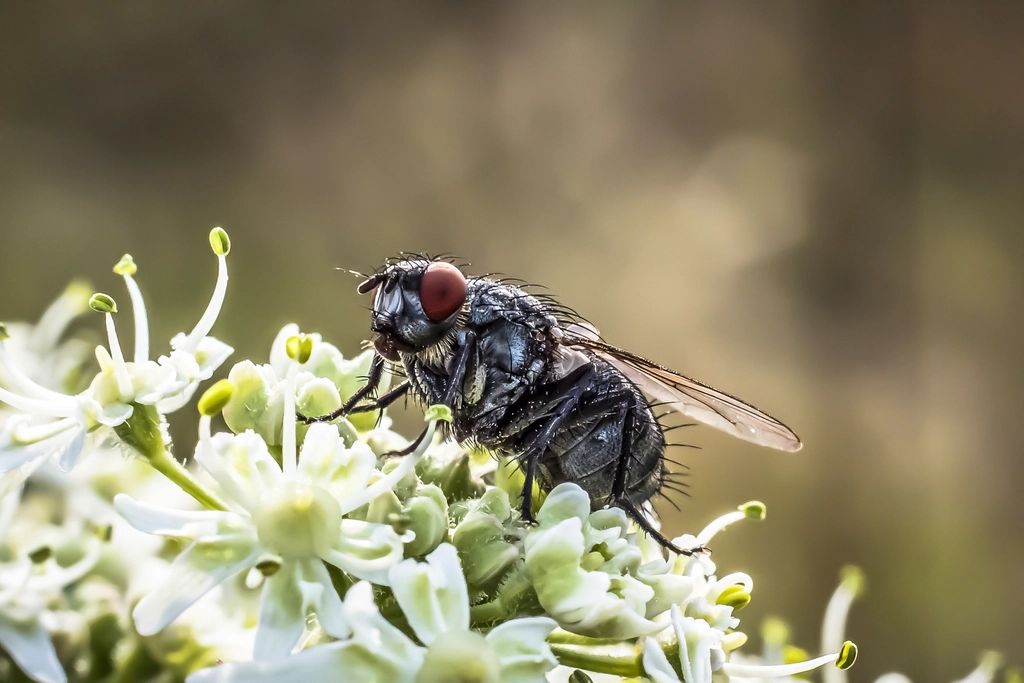 Photo Credit: Rawpixel
In the bustling world of Musca domestica, better known as the housefly, life is a whirlwind of activity. Picture a sunlit kitchen, where the aroma of freshly baked bread wafts through the air. Here, the housefly flits about, its tiny body measuring just a quarter of an inch long, glistening with a sheen that catches the light. With its large, multifaceted eyes, the housefly can see in nearly every direction, making it a master of evasion. This little insect, often dismissed as a mere nuisance, plays a surprisingly vital role in our ecosystem, captivating scientists and nature enthusiasts alike.
Houseflies are not just common pests; they are remarkable survivors, thriving in diverse environments from urban homes to rural farms. Their omnivorous diet allows them to feast on a wide range of organic materials, from sugary fruits to decaying matter. This adaptability is one reason why they are found almost everywhere humans are. As they buzz around, they also contribute to the cycle of life, helping to break down waste and serving as a food source for various predators. With their fascinating behaviors and essential ecological roles, houseflies invite us to look closer and appreciate the intricate connections that sustain life all around us.
The housefly, scientifically known as Musca domestica, holds a special place in the tree of life. As a member of the kingdom Animalia, it belongs to the phylum Arthropoda, which includes all animals with jointed legs and exoskeletons. This tiny insect is part of the class Insecta, making it one of the most diverse groups of animals on Earth. What sets the housefly apart is its incredible adaptability and resilience, allowing it to thrive in various environments, from bustling cities to quiet farms. With its unique life cycle and ability to reproduce rapidly, the housefly plays a significant role in ecosystems, serving as both a pollinator and a food source for other animals.
| Taxonomic Rank | Scientific Name | Meaning & Significance |
|---|---|---|
| Kingdom | Animalia | The name “Animalia” comes from the Latin word “animalis,” meaning “having breath” or “living.” This reflects the vital, breathing nature of all animals, including the housefly. |
| Phylum | Arthropoda | “Arthropoda” means “jointed feet” in Greek, highlighting the housefly’s segmented body and jointed legs, which are essential for its agility and movement. |
| Class | Insecta | The term “Insecta” is derived from the Latin word “insectum,” meaning “cut into,” referring to the segmented body structure of insects like the housefly. |
| Order | Diptera | “Diptera” translates to “two wings” in Greek, which is a defining characteristic of houseflies, as they possess a single pair of functional wings for flight. |
| Family | Muscidae | The name “Muscidae” comes from the Latin word “musca,” meaning “fly.” This family includes many common flies, emphasizing their widespread presence. |
| Genus | Musca | Similar to its family name, “Musca” also means “fly” in Latin, reinforcing the housefly’s identity within this group of insects. |
| Species | Musca domestica | “Domestica” means “domestic” in Latin, indicating the housefly’s close association with human habitats and its adaptability to living alongside people. |
Understanding the housefly’s classification reveals much about its evolutionary journey. As a member of the Diptera order, it shares a common ancestor with other two-winged insects, showcasing how evolution has shaped its unique adaptations. The housefly’s ability to thrive in human environments highlights its remarkable resilience and adaptability, traits that have allowed it to survive and flourish alongside us for thousands of years. This tiny insect is not just a nuisance; it is a testament to the intricate web of life and the evolutionary processes that connect all living beings.
The evolutionary journey of the housefly, or Musca domestica, stretches back millions of years, weaving through the tapestry of life on Earth. This tiny insect is a member of the family Muscidae and has adapted remarkably to thrive alongside humans. Its ancestors roamed the planet during the late Cretaceous period, around 100 million years ago, when dinosaurs still ruled the land. Over time, these early flies evolved through various stages, leading to the resilient and ubiquitous housefly we see today.
The story begins with the ancestors of modern flies, which were likely small, winged insects that emerged from a group known as Diptera, meaning “two wings.” These early insects developed the ability to fly, a significant advantage that allowed them to escape predators and explore new habitats. As they evolved, they adapted to different environments, leading to the diversification of species. One major transition occurred when flies developed specialized mouthparts for feeding on liquids, enabling them to consume a variety of substances, from nectar to decaying organic matter. This adaptability opened up new food sources and ecological niches.
These adaptations have been crucial for the survival of houseflies in a constantly changing world. Their ability to fly not only helps them evade predators but also allows them to explore diverse environments. The specialized mouthparts enable them to take advantage of different food sources, while their rapid reproduction ensures that they can bounce back quickly from population declines. Together, these traits have made the housefly a resilient companion to humans, thriving in our homes and cities around the globe.
The housefly is a small yet intriguing insect that captures our attention with its busy, buzzing presence. With a body that typically measures about 0.2 to 0.3 inches long, it may seem unassuming at first glance. However, its sleek, streamlined form is perfectly designed for agility and speed. The housefly’s exoskeleton, a hard outer covering, provides protection while allowing it to dart around with impressive quickness. Its large, multifaceted eyes give it a wide field of vision, making it adept at avoiding obstacles as it flits from one spot to another.
| Feature | Description |
|---|---|
| Weight | Between 0.00007 and 0.0016 ounces |
| Skin Type | Exoskeleton |
| Most Distinctive Feature | Limbs are used to taste food; large, multifaceted eyes |
These features work together to enhance the housefly’s survival in a variety of environments. The lightweight body allows for rapid movement, which is crucial for escaping predators. Its exoskeleton not only shields it from harm but also helps retain moisture, a vital aspect for survival in diverse climates. The housefly’s unique limbs, which are equipped with taste receptors, enable it to sample food sources quickly, ensuring it can find nourishment efficiently. Together, these adaptations make the housefly a resilient and resourceful inhabitant of our world.
The housefly, known scientifically as Musca domestica, thrives in a variety of environments, making it one of the most widespread insects on the planet. Picture a bustling kitchen, a sunny park, or even a farmyard filled with animals. These are just a few of the many places where houseflies can be found, flitting about in search of food and shelter. Their adaptability allows them to live alongside humans and in natural settings, making them a common sight in our daily lives.
Houseflies prefer warm climates, as they are more active in temperatures ranging from 75 to 95 degrees Fahrenheit. They thrive in environments that provide easy access to food sources, such as decaying organic matter, garbage, and even animal waste. These insects are not picky; they can adapt to various conditions, but they do require moisture to survive. This is why you often see them buzzing around damp areas, where they can find the nutrients they need.
To flourish in such diverse habitats, houseflies have developed several clever adaptations. Their ability to reproduce quickly means that they can establish populations in new areas almost overnight. With a life cycle that can be completed in just a week under ideal conditions, they can bounce back from challenges like changes in weather or food availability. Their keen sense of smell helps them locate food from a distance, while their strong wings allow them to navigate through crowded spaces with ease. This combination of traits ensures that houseflies remain a familiar presence in both urban and rural landscapes.
The daily life of a housefly is a whirlwind of activity, filled with buzzing and darting from one spot to another. These tiny insects typically start their day by searching for food, which can include anything from sugary substances to decaying organic matter. With their keen sense of smell, houseflies can detect food from quite a distance. Once they find a meal, they land, using their specialized mouthparts to sip up liquids or break down solid food. Throughout the day, they engage in a variety of behaviors, including grooming their wings and legs, resting in sunny spots, and, of course, buzzing around in search of their next snack.
While houseflies are often seen alone, they can also be found in small groups, especially when food is plentiful. Their social behavior is quite simple; they tend to gather in areas where food is abundant, but they do not form complex social structures like some other insects. Instead, they communicate through pheromones, which are chemical signals that can attract other flies to food sources or alert them to danger. This means that while they may not be the most social of insects, they still rely on each other to some extent for survival.
| Behavior Type | Description |
|---|---|
| Feeding | Houseflies feed on liquids and decaying matter, using their spongy mouthparts to absorb nutrients. |
| Grooming | They spend time cleaning their wings and legs to maintain hygiene and improve flight efficiency. |
| Resting | Houseflies often rest in warm, sunny spots to conserve energy between feeding bouts. |
| Communication | They use pheromones to signal food sources and warn others of potential threats. |
The behaviors of houseflies are finely tuned to ensure their survival in a variety of environments. By efficiently locating food and maintaining their hygiene, they can thrive in both urban and rural settings. Their ability to communicate, even in simple ways, helps them navigate their world and find resources. In this bustling life, every buzz and flutter plays a crucial role in the ongoing dance of survival, making the housefly a small but significant player in the ecosystem.
The housefly, or Musca domestica, is an omnivore, meaning it enjoys a varied diet that includes both plant and animal matter. These little insects are not picky eaters; they thrive on a wide range of foods. Houseflies are particularly attracted to decaying organic material, such as fruits, vegetables, and even waste. Their feeding behavior is quite fascinating. They use their spongy mouthparts to soak up liquids, allowing them to consume their meals quickly and efficiently.
| Dietary Aspect | Details |
|---|---|
| Diet Type | Omnivore |
| Favorite Foods | Decaying fruits, vegetables, and organic waste |
| Prey Items | Microorganisms and decaying matter |
| Hunting/Foraging Strategies | Soaking up liquids with spongy mouthparts |
The housefly’s diet plays a crucial role in its ecology and daily routine. By feeding on decaying organic matter, houseflies help break down waste, recycling nutrients back into the environment. This not only supports their survival but also contributes to the health of ecosystems. Their constant search for food keeps them buzzing around, making them an essential part of the natural world.
The mating behavior of houseflies is a lively affair, often taking place in warm weather when food is plentiful. During the breeding season, male houseflies engage in a courtship dance, buzzing around females and performing aerial displays to attract their attention. Once a female is impressed, she will mate with the male, and the pair can reproduce multiple times throughout their lives. This reproductive strategy helps ensure that their offspring have the best chance of survival in a world full of challenges.
| Reproductive Aspect | Details |
|---|---|
| Gestation Period | One day |
| Litter Size | Up to 150 eggs at a time |
| Age of Maturity | About 10 days |
| Name of Young | Larvae |
After mating, the female lays her eggs in suitable environments, often near decaying organic matter where the larvae can find food. Within just a day, the eggs hatch into larvae, commonly known as maggots. These young houseflies are voracious eaters, consuming organic material to fuel their rapid growth. Over the course of about a week, they will molt several times, shedding their skin as they grow larger. Eventually, they enter the pupal stage, where they undergo a remarkable transformation. After about a week in this stage, they emerge as adult houseflies, ready to start the cycle anew. While houseflies do not provide parental care, their rapid development and adaptability help ensure that their species continues to thrive in diverse environments.
The housefly, or Musca domestica, plays a crucial role in the food web, serving as both a consumer and a prey species. These small insects are often found buzzing around our homes, but they are also an important food source for many animals. In the grand scheme of nature, houseflies help transfer energy from the organic matter they consume to the predators that rely on them for sustenance. This connection highlights their significance in maintaining ecological balance.
To survive against these various threats, houseflies have developed several clever defensive behaviors. They are incredibly agile fliers, capable of rapid changes in direction to evade predators. Their large, multifaceted eyes provide a wide field of vision, allowing them to spot danger from almost any angle. Additionally, houseflies can quickly land and blend into their surroundings, making it harder for predators to spot them. These survival strategies, combined with their ability to reproduce rapidly, help ensure that houseflies continue to thrive despite the many dangers they face.
A keystone species is an organism that has a disproportionately large impact on its environment relative to its abundance. This means that if it were removed, the ecosystem would change dramatically. The housefly, or Musca domestica, while not a traditional keystone species like wolves or sea otters, does play an important role in its ecosystem. Its presence influences various ecological processes, making it a significant player in the web of life.
Houseflies contribute to the ecosystem in several ways. First, they are essential decomposers, breaking down organic matter like food scraps and animal waste. This process helps recycle nutrients back into the soil, promoting plant growth. Additionally, houseflies serve as a food source for many animals, including birds and small mammals. Their larvae, often found in decaying matter, provide a rich source of protein for these predators.
Moreover, houseflies are important pollinators, albeit not as effective as bees. They visit flowers while searching for food, inadvertently transferring pollen from one bloom to another. This helps plants reproduce, ensuring the continuation of various plant species. Their omnivorous diet allows them to thrive in diverse environments, from kitchens to parks, making them adaptable and widespread.
If houseflies were to disappear, the effects would ripple through the ecosystem. Decomposition rates would slow down, leading to an accumulation of waste and organic matter. This could result in nutrient depletion in the soil, affecting plant growth and, in turn, the animals that rely on those plants for food. The loss of houseflies would also mean fewer food sources for predators, potentially leading to declines in their populations. Overall, the absence of houseflies would disrupt the balance of many ecosystems, highlighting their unexpected yet vital role in nature.
The housefly, known scientifically as Musca domestica, occupies a vital ecological niche that influences many aspects of its environment. These small insects are found almost everywhere humans are, from bustling kitchens to parks and farms. Their ability to thrive in diverse habitats makes them a common sight, and their presence is felt in various ways. Houseflies are not just annoying pests; they play essential roles in nutrient cycling and serve as food for many animals, making them integral to the ecosystems they inhabit.
| Ecosystem Service | Impact |
|---|---|
| Decomposition | Houseflies help break down organic matter, such as food waste and animal droppings, returning nutrients to the soil. |
| Pollination | While not as effective as bees, houseflies can contribute to the pollination of some plants, aiding in plant reproduction. |
| Food Source | They serve as a food source for various predators, including birds, amphibians, and other insects, supporting the food web. |
| Pathogen Transmission | Houseflies can carry diseases, which can impact animal and human health, highlighting their role in disease dynamics. |
Houseflies influence their surroundings in several specific ways. For instance, when they feed on decaying organic material, they help decompose it, which enriches the soil with nutrients. This process is crucial for plant growth, as healthy soil supports a diverse range of vegetation. Additionally, houseflies can inadvertently assist in pollination, although they are not the primary pollinators like bees. Their presence in gardens and fields can help some plants reproduce, contributing to the overall health of the ecosystem. Furthermore, they are a key food source for many animals, including birds and small mammals, which rely on them for sustenance.
The broader ecological importance of houseflies cannot be overstated. As a keystone species, their activities help maintain the balance of their ecosystems. If houseflies were to disappear, the effects would ripple through the food web, affecting not only their predators but also the plants that rely on nutrient-rich soil. Their role in decomposition and nutrient cycling is essential for sustaining healthy ecosystems. By understanding the multifaceted impact of houseflies, we can appreciate their place in the natural world and recognize that even the smallest creatures can have a significant influence on the environment.
In the intricate web of life, symbiosis plays a crucial role in shaping the relationships between different species. Symbiosis refers to the close interactions between organisms, which can be beneficial, harmful, or neutral. These ecological relationships can be classified into three main types: mutualism, where both species benefit; parasitism, where one species benefits at the expense of another; and commensalism, where one species benefits while the other is neither helped nor harmed. The housefly, or Musca domestica, engages in various partnerships that illustrate these fascinating dynamics in nature.
| Species/Type | Relationship Type | Description |
|---|---|---|
| Microorganisms (bacteria) | Mutualistic | Houseflies often carry bacteria that help decompose organic matter, benefiting the environment while also providing a food source for the flies. |
| Parasites (like nematodes) | Parasitic | Some nematodes can infect houseflies, using them as hosts to complete their life cycle, which can harm the flies. |
| Birds (like sparrows) | Commensal | Houseflies may benefit from the presence of birds, as they often scavenge near bird feeders, gaining access to food scraps without affecting the birds. |
These relationships have evolved over time, shaped by the needs and behaviors of the species involved. The housefly’s ability to thrive in diverse environments has allowed it to form connections with various organisms. Mutualistic relationships, like those with bacteria, enhance nutrient cycling in ecosystems, while parasitic interactions remind us of the delicate balance of life. Commensal relationships highlight how species can coexist, benefiting from each other without direct interaction. Understanding these connections helps us appreciate the complexity of ecosystems and the roles that even the smallest creatures play in maintaining the health of our planet.
The housefly, or Musca domestica, is often seen as a pesky intruder in our homes, but this tiny insect is full of surprises that reveal its fascinating role in nature.
The housefly, known scientifically as Musca domestica, has been a part of human history for thousands of years. These tiny insects have buzzed around our homes, farms, and cities, often seen as unwelcome guests. Yet, they hold a significant place in various cultures. In ancient Egypt, houseflies were symbols of resurrection and rebirth, often depicted in art and jewelry. Their presence has sparked curiosity and even fear, leading to a complex relationship with humanity that has evolved over time.
Today, our interactions with houseflies are multifaceted. While they are often viewed as pests, they also play important roles in ecosystems and human health. Houseflies are known to carry diseases, which can lead to conflicts with humans, especially in urban areas where sanitation is crucial. However, they also contribute to the decomposition of organic matter, helping to recycle nutrients back into the soil. In some cases, researchers are exploring ways to utilize houseflies in waste management and even as a source of protein in animal feed, showcasing a potential for domestication and conservation efforts.
As we look to the future, the relationship between houseflies and humanity may continue to evolve. With increasing urbanization and climate change, understanding how to coexist with these insects will be essential. By recognizing their ecological roles and potential benefits, we can shift our perspective from viewing them solely as pests to appreciating their contributions to our environment. This shift could lead to innovative solutions that benefit both humans and houseflies, fostering a more harmonious relationship in the years to come.
The housefly, or Musca domestica, currently holds a conservation status of “Not Listed” according to the International Union for Conservation of Nature (IUCN). This means that there are no immediate concerns regarding its population levels or survival. In fact, houseflies are incredibly abundant and can be found in nearly every corner of the globe, thriving in environments where humans are present. Their adaptability and resilience have allowed them to maintain a stable population trend, making them a common sight in our daily lives.
| Conservation Factor | Status/Details |
|---|---|
| IUCN Status | Not Listed |
| Population Estimates | Abundant worldwide |
| Trend Direction | Stable |
Despite their abundance, houseflies face several threats that can impact their populations. One of the main challenges is the use of pesticides, which are chemicals designed to kill pests. While these substances can reduce housefly numbers in specific areas, they can also disrupt the balance of ecosystems and harm other beneficial insects. Additionally, urbanization and habitat destruction can limit the places where houseflies can thrive, although they are remarkably adaptable and often find new niches in human-dominated environments.
Looking ahead, the outlook for houseflies remains positive. Since they are not currently at risk, there are no specific conservation efforts aimed at protecting them. However, understanding their role in ecosystems is essential. Houseflies contribute to nutrient cycling by breaking down organic matter, and they serve as food for various predators. As long as humans continue to coexist with these tiny insects, their populations are likely to remain stable, reminding us of the intricate connections we share with the natural world.
| Question | Answer |
|---|---|
| Where do houseflies live? | Houseflies can be found almost everywhere in the world. They thrive in warm environments and are often seen in homes, farms, and garbage areas where food is available. |
| What do houseflies eat? | Houseflies are omnivores, which means they eat a variety of foods. They are particularly attracted to decaying organic matter, sugary substances, and even animal waste. |
| How do houseflies behave? | Houseflies are known for their quick movements and ability to fly in all directions. They often land on surfaces to taste food with their feet, which have taste receptors. |
| How do houseflies reproduce? | Houseflies reproduce quickly, with a female laying up to 500 eggs in her lifetime. The eggs hatch into larvae, commonly known as maggots, which develop into adult flies in about a week. |
| What threats do houseflies face? | While houseflies are not currently endangered, they face threats from pesticides and habitat loss. Their populations can also be affected by changes in climate and food availability. |
| What are some interesting characteristics of houseflies? | One of the most distinctive features of houseflies is their large, compound eyes, which allow them to see in almost all directions. Additionally, their limbs are used to taste food, making them unique among insects. |
| How do houseflies contribute to the ecosystem? | Houseflies play a role in the ecosystem by helping to decompose organic matter. As they feed on decaying materials, they help recycle nutrients back into the soil, which is essential for plant growth. |