Taxonomy & Classification
- Kingdom
- Animalia
- Phylum
- Chordata
- Class
- Reptilia
- Order
- Squamata
- Family
- Chamaeleonidae
- Genus
- Trioceros
- Species
- Trioceros jacksonii

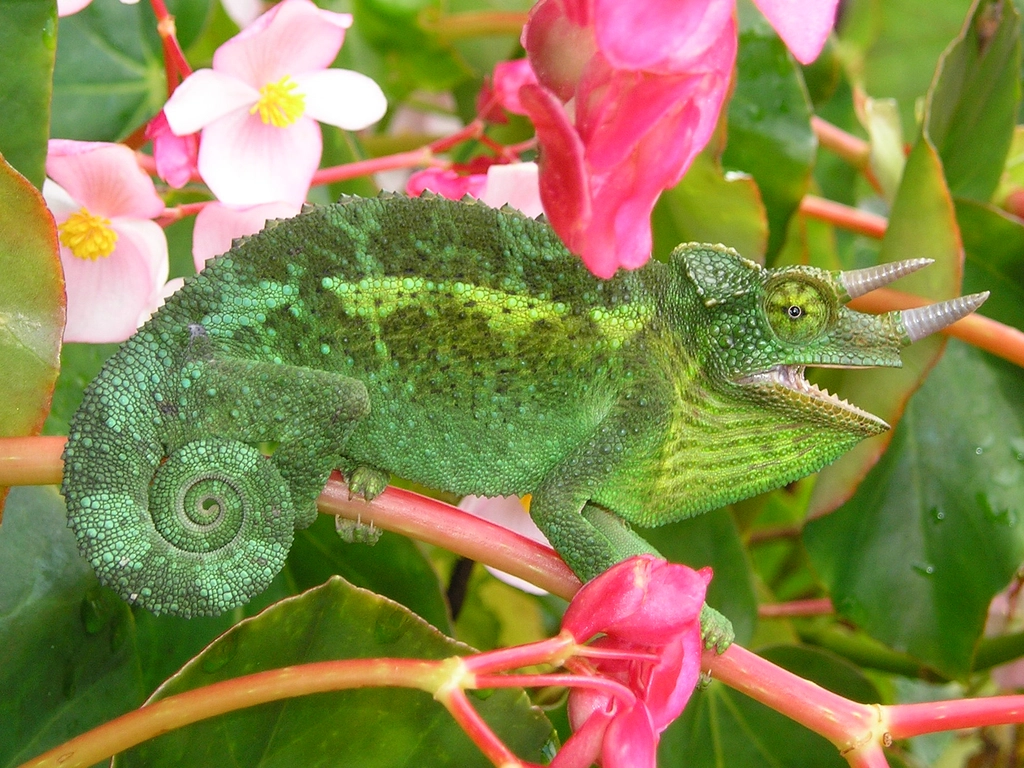 Photo Credit: Rawpixel
In the heart of East Africa’s lush woodlands, the Jackson’s Chameleon, or Trioceros jacksonii, makes its home among the vibrant green leaves and dappled sunlight. This enchanting reptile is hard to miss, with its striking colors that can shift from bright greens to deep blues, creating a living canvas that captivates anyone lucky enough to spot it. One of its most distinctive features is the three prominent horns on its head, which give it a regal appearance and set it apart from other chameleons. These horns are not just for show; they play a role in attracting mates and establishing dominance among rivals.
As the sun rises, the Jackson’s Chameleon awakens, basking in the warm rays to regulate its body temperature. With its long, sticky tongue, it expertly snatches up insects, showcasing its carnivorous diet. Scientists and nature enthusiasts alike are drawn to this remarkable creature not only for its vibrant colors and unique adaptations but also for its role in the ecosystem. By controlling insect populations, the Jackson’s Chameleon helps maintain the balance of its forest home. As we delve deeper into the life of this fascinating reptile, we will explore its behaviors, habitat, and the challenges it faces in a changing world.
The Jackson’s Chameleon, scientifically known as Trioceros jacksonii, occupies a special place in the tree of life. This vibrant reptile belongs to the family Chamaeleonidae, which includes all chameleons, and is known for its striking colors and unique physical features. One of the most distinctive traits of the Jackson’s Chameleon is its three prominent horns, which resemble those of a triceratops. This feature not only sets it apart from other chameleons but also plays a role in mating displays and territorial battles. With its ability to change color and its specialized tongue for catching prey, the Jackson’s Chameleon is a captivating example of adaptation in the animal kingdom.
| Taxonomic Rank | Scientific Name | Meaning & Significance |
|---|---|---|
| Kingdom | Animalia | This name signifies that Jackson’s Chameleon is part of the vast group of multicellular organisms known as animals, which are characterized by their ability to move and respond to their environment. |
| Phylum | Chordata | Chordata means “having a notochord,” a flexible rod that supports the body. This phylum includes all animals with a backbone, highlighting the chameleon’s place among vertebrates. |
| Class | Reptilia | Reptilia refers to reptiles, a class of cold-blooded animals that typically have scaly skin. This classification emphasizes the chameleon’s adaptations for life on land. |
| Order | Squamata | Squamata means “scaly,” which is fitting for this order that includes lizards and snakes, showcasing the chameleon’s unique skin texture. |
| Family | Chamaeleonidae | This family name comes from the Greek word “chamaeleon,” meaning “ground lion,” reflecting the chameleon’s ability to blend into its surroundings and its predatory nature. |
| Genus | Trioceros | Trioceros translates to “three horns,” a direct reference to the Jackson’s Chameleon’s most notable feature, which is crucial for its mating rituals and defense. |
The classification of the Jackson’s Chameleon reveals much about its evolutionary journey. As a member of the Chamaeleonidae family, it shares a common ancestor with other chameleons, showcasing a lineage that has adapted to diverse environments. The unique features of the Jackson’s Chameleon, such as its three horns and color-changing abilities, highlight the evolutionary pressures it has faced, including the need for camouflage and competition for mates. Understanding its taxonomic position not only helps us appreciate its biological traits but also connects us to the broader story of life on Earth, illustrating how species evolve and adapt over time.
The evolutionary journey of Jackson’s Chameleon, or Trioceros jacksonii, stretches back millions of years, tracing its roots to the ancient ancestors of modern chameleons. These reptiles emerged during the late Cretaceous period, around 100 million years ago, when dinosaurs roamed the Earth. Over time, chameleons adapted to various environments, leading to the diverse species we see today, including the vibrant Jackson’s Chameleon, which is native to the lush forests of East Africa.
The ancestors of Jackson’s Chameleon were likely small, insect-eating reptiles that thrived in warm, tropical climates. As they evolved, they developed specialized features to help them survive in their habitats. One major transition was the development of their unique color-changing ability, which allows them to blend into their surroundings, communicate with other chameleons, and regulate their body temperature. This adaptation was crucial for avoiding predators and attracting mates.
These adaptations have played a vital role in the survival of Jackson’s Chameleon. The ability to change color not only aids in camouflage but also helps them communicate during mating rituals. Their prehensile tail and independent eye movement enhance their agility and awareness in the treetops, where they hunt for insects. With a long, sticky tongue, they can snatch prey quickly, ensuring they get enough food to thrive. Together, these evolutionary traits make Jackson’s Chameleon a master of its forest home, perfectly equipped to navigate the challenges of its environment.
The Jackson’s Chameleon is a striking reptile that captures the imagination with its vibrant colors and unusual features. This lizard boasts a robust body structure, typically measuring around 30 centimeters long. Its most eye-catching characteristic is the trio of horns protruding from its head, giving it a regal appearance reminiscent of a tiny dinosaur. The combination of its vivid hues and unique shape makes it a standout in the lush environments it inhabits.
| Feature | Description |
|---|---|
| Weight | 90 to 150 grams |
| Skin Type | Scales |
| Most Distinctive Feature | Three horns |
The Jackson’s Chameleon’s features are not just for show; they serve important survival purposes. The three horns, for instance, are used in displays to attract mates and assert dominance over rivals. Its colorful skin, covered in scales, can change shades to blend into its surroundings, a clever trick that helps it avoid predators. Together, these adaptations make the Jackson’s Chameleon a master of camouflage and a fascinating example of nature’s ingenuity.
The Jackson’s Chameleon thrives in lush woodlands and dense forests, where the dappled sunlight filters through the leaves, creating a mosaic of light and shadow. These vibrant reptiles are often found perched on branches, blending seamlessly with their surroundings. The rich greenery provides not only a stunning backdrop but also essential resources for their survival, including food and shelter.
This chameleon prefers a warm and humid climate, which is crucial for its well-being. The temperatures in its habitat typically range from 70 to 85 degrees Fahrenheit (21 to 29 degrees Celsius), allowing it to maintain its body heat. The humidity levels are also important, as they help keep the chameleon hydrated and support its skin health. These environmental conditions create a perfect setting for the Jackson’s Chameleon to thrive.
Adaptations have finely tuned the Jackson’s Chameleon to its forested homes. Its ability to change color not only serves as a stunning display but also helps it camouflage against predators and communicate with other chameleons. Additionally, its prehensile tail acts like a fifth limb, allowing it to grasp branches securely as it navigates through the trees. These features enable the Jackson’s Chameleon to live harmoniously in its vibrant, leafy world.
As the sun rises over the lush forests of East Africa, Jackson’s Chameleon begins its day. These colorful reptiles are most active during the day, basking in the warm sunlight to regulate their body temperature. They spend their mornings slowly moving through the branches, using their long, sticky tongues to catch insects like crickets and grasshoppers. With their keen eyesight, they can spot prey from a distance, making their hunting efficient and precise. Throughout the day, they may change colors, not just for camouflage but also to express their mood or communicate with other chameleons.
While Jackson’s Chameleons are primarily solitary creatures, they do have interesting social behaviors when they encounter one another. Males are known to be particularly territorial, often displaying vibrant colors and puffing up their bodies to assert dominance. This colorful display serves as a warning to other males to keep their distance. Females, on the other hand, are less aggressive and tend to be more passive. When it comes to mating, males will perform elaborate courtship displays, showcasing their bright colors and unique patterns to attract a female’s attention.
| Behavior Type | Description |
|---|---|
| Activity Patterns | Jackson’s Chameleons are diurnal, meaning they are active during the day. They bask in the sun and hunt for insects, using their long tongues to catch prey. |
| Social Structure | These chameleons are mostly solitary, with males being territorial and displaying vibrant colors to ward off rivals. |
| Communication Methods | Color changes are a key form of communication, used to express mood, attract mates, or signal aggression. |
The behaviors of Jackson’s Chameleons are finely tuned to ensure their survival in the wild. By being active during the day, they can effectively hunt and bask in the sun, which is crucial for their body temperature regulation. Their solitary nature helps them avoid conflicts, while their vibrant displays and color changes allow them to communicate effectively without direct confrontation. This combination of behaviors not only aids in their survival but also enriches the intricate tapestry of life in their forest habitat.
Jackson’s Chameleon is a carnivore, which means it primarily eats other animals. This fascinating reptile has a diverse diet that includes a variety of small creatures. With its long, sticky tongue, the chameleon expertly captures its prey, which can range from insects to small lizards. Its keen eyesight allows it to spot potential meals from a distance, making it an efficient hunter in its forest home.
| Dietary Aspect | Details |
|---|---|
| Diet Type | Carnivore |
| Favorite Foods | Insects, centipedes, isopods, millipedes, spiders, lizards, birds, and snails |
| Prey Items | Small insects and other invertebrates, as well as small vertebrates like lizards and birds |
| Hunting/Foraging Strategies | Uses its long, sticky tongue to catch prey, relies on excellent vision to spot food |
The diet of Jackson’s Chameleon plays a crucial role in its ecology and daily routine. By feeding on a variety of small animals, it helps control insect populations in its habitat, contributing to the balance of the ecosystem. Its hunting techniques not only showcase its adaptability but also influence its activity patterns, as it spends much of its day searching for food. This vibrant reptile’s feeding habits are a key part of its life in the lush forests of East Africa, where every meal is a chance to thrive in a dynamic environment.
When it comes to reproduction, Jackson’s Chameleon has some intriguing behaviors. The breeding season typically occurs during the warmer months, when food is plentiful and the environment is just right for raising young. Males are known for their vibrant displays, showcasing their bright colors and even puffing up their bodies to attract females. This courtship ritual is not just about looks; it also involves head-bobbing and other movements to impress potential mates. Once a female selects a male, they will mate, and the female will begin the process of developing her eggs.
| Reproductive Aspect | Details |
|---|---|
| Gestation Period | 5-6 months |
| Litter Size | Varies, typically around 10-30 eggs |
| Age of Maturity | 5 months |
| Name of Young | Hatchlings |
After the gestation period, which lasts about five to six months, the female lays her eggs in a safe, hidden spot. These eggs will eventually hatch into tiny hatchlings, ready to face the world. Interestingly, Jackson’s Chameleons do not provide parental care after the eggs are laid. Instead, the hatchlings are born fully formed and must fend for themselves right from the start. They are miniature versions of their parents, equipped with the skills they need to survive in their lush forest habitat. As they grow, these young chameleons will develop their vibrant colors and unique features, gradually transforming into the stunning adults they are destined to become.
Jackson’s Chameleon, or Trioceros jacksonii, plays a vital role in its ecosystem, nestled within the food web of East African forests. As a carnivore, it helps control the populations of insects and other small creatures, while also serving as a meal for various predators. This delicate balance is crucial for maintaining the health of its habitat, but it also places the chameleon in a precarious position, where it must constantly navigate threats from the natural world.
To survive these dangers, Jackson’s Chameleon has developed several clever defensive behaviors. One of its most famous strategies is its ability to change color, blending seamlessly into its surroundings to avoid detection. This camouflage helps it escape the watchful eyes of predators. Additionally, when threatened, the chameleon can puff up its body to appear larger and more intimidating. By using these tactics, it enhances its chances of survival in a world filled with potential dangers.
A keystone species is an organism that has a disproportionately large impact on its environment relative to its abundance. This means that if it were removed, the ecosystem would change dramatically. Jackson’s Chameleon, or Trioceros jacksonii, qualifies as a keystone species in its habitat. Its role as a predator helps maintain the balance of insect populations, which is crucial for the health of the forest ecosystem.
In the lush woodlands and forests of East Africa, Jackson’s Chameleon plays a vital role in controlling insect populations. By preying on various insects, it helps prevent any one species from becoming too dominant. For example, if the chameleon were to disappear, the number of insects it typically consumes, such as crickets and grasshoppers, could explode. This surge in insect populations could lead to overgrazing of plants, disrupting the delicate balance of the forest.
Moreover, Jackson’s Chameleon serves as a food source for larger predators, such as birds and snakes. Its presence supports these higher trophic levels, or layers of the food web, ensuring that energy flows through the ecosystem. The chameleon’s unique ability to blend into its surroundings also plays a role in its survival, allowing it to evade predators while contributing to the biodiversity of its habitat.
If Jackson’s Chameleon were to vanish from its environment, the consequences could be severe. The unchecked growth of insect populations would likely lead to significant plant damage, altering the forest structure and reducing habitat for other species. This ripple effect could destabilize the entire ecosystem, demonstrating just how crucial this vibrant reptile is to the health of its woodland home.
The Jackson’s Chameleon, known scientifically as Trioceros jacksonii, plays a vital role in its ecosystem, particularly in the lush woodlands and forests of East Africa. This colorful reptile occupies a unique ecological niche as a carnivore, meaning it primarily feeds on other animals. By preying on insects and small invertebrates, Jackson’s Chameleon helps maintain a balanced population of these creatures, preventing any one species from overwhelming the environment. Its presence is crucial for the health of its habitat, as it contributes to the intricate web of life that supports various other species.
| Ecosystem Service | Impact |
|---|---|
| Insect Population Control | Regulates the number of insects, preventing overpopulation and promoting biodiversity. |
| Prey for Larger Animals | Serves as a food source for birds and other predators, supporting the food web. |
| Seed Dispersal | Indirectly aids in plant reproduction by consuming insects that may harm plants. |
The influence of Jackson’s Chameleon extends beyond its immediate diet. For instance, by controlling insect populations, it helps protect the plants in its habitat from being overgrazed by pests. This, in turn, allows for a diverse range of flora to thrive, which is essential for other animals that rely on these plants for food and shelter. Additionally, as a prey species, Jackson’s Chameleon supports larger predators, creating a balanced ecosystem where various species can coexist. Its vibrant colors and unique behaviors also attract the attention of researchers and nature enthusiasts, further highlighting the importance of preserving its habitat.
In a broader ecological context, the Jackson’s Chameleon exemplifies the interconnectedness of life within its environment. As a keystone species, its presence significantly influences the structure and health of its ecosystem. The loss of this chameleon could lead to cascading effects, disrupting the balance of predator and prey relationships and ultimately affecting plant life and other animal species. By understanding and protecting the Jackson’s Chameleon, we not only safeguard a beautiful reptile but also the intricate web of life that depends on it.
In the intricate web of life, symbiosis refers to the close interactions between different species, which can take on various forms. These relationships can be mutualistic, where both species benefit; parasitic, where one benefits at the expense of the other; or commensal, where one benefits while the other is neither helped nor harmed. The Jackson’s Chameleon, with its vibrant colors and unique adaptations, engages in several ecological partnerships that illustrate the beauty and complexity of nature.
| Species/Type | Relationship Type | Description |
|---|---|---|
| Insects (various species) | Mutualistic | Jackson’s Chameleons help control insect populations, benefiting the ecosystem while feeding on these insects for sustenance. |
| Birds (certain species) | Commensal | Some birds may benefit from the insects disturbed by the chameleons as they hunt, while the chameleons remain unaffected. |
| Parasites (like mites) | Parasitic | These tiny organisms can live on the chameleons, feeding on their skin or blood, which can harm the chameleons over time. |
The evolution of these relationships showcases the adaptability of the Jackson’s Chameleon and its role in the ecosystem. Over time, these interactions have developed to enhance survival and reproduction for the species involved. By controlling insect populations, the chameleons contribute to a balanced ecosystem, while their relationships with birds and parasites highlight the diverse ways life forms can coexist. Understanding these connections helps us appreciate the delicate balance of nature and the importance of every species in maintaining ecological harmony.
The Jackson’s Chameleon is a captivating reptile that showcases a blend of vibrant colors and fascinating behaviors. This unique lizard, native to East Africa, is not just a pretty face; it has some surprising traits that make it truly special.
The relationship between Jackson’s Chameleon and humanity has deep historical roots, particularly in East Africa, where these vibrant reptiles are native. For centuries, local cultures have admired their striking colors and unique ability to change hues. In some communities, these chameleons have been symbols of adaptability and transformation, often featured in folklore and traditional stories. Their captivating appearance has also made them popular in the exotic pet trade, leading to a blend of admiration and exploitation.
Today, interactions between Jackson’s Chameleon and humans are complex. While conservation efforts are underway to protect their natural habitats, the pressures of urbanization and deforestation pose significant threats. In some areas, these chameleons face conflicts with humans as their habitats are destroyed for agriculture or development. Additionally, the pet trade continues to impact their populations, raising concerns about sustainability and ethical practices. Some enthusiasts advocate for responsible ownership and breeding programs to ensure the species thrives in captivity while preserving its wild counterparts.
Looking ahead, the future of the relationship between Jackson’s Chameleon and humanity hinges on our ability to balance admiration with responsibility. As awareness grows about the ecological importance of these reptiles, there is hope for more sustainable practices in both conservation and the pet trade. By fostering a deeper understanding of their role in the ecosystem, we can ensure that Jackson’s Chameleons continue to thrive, both in the wild and in our hearts.
The conservation status of Jackson’s Chameleon, scientifically known as Trioceros jacksonii, is currently classified as Threatened. This means that while the species is not yet endangered, it faces significant risks that could lead to a decline in its population if not addressed. The overall population trend is concerning, as habitat loss and other pressures have led to a decrease in numbers in certain areas.
| Conservation Factor | Status/Details |
|---|---|
| IUCN Status | Threatened |
| Population Estimates | Unknown, but declining in some regions |
| Trend Direction | Decreasing |
One of the main threats to Jackson’s Chameleon is habitat destruction, primarily due to deforestation and land conversion for agriculture. As forests are cleared, these colorful reptiles lose their homes and the rich biodiversity that supports them. Additionally, the illegal pet trade poses a significant risk, as many chameleons are captured and sold, further reducing their numbers in the wild. Climate change also plays a role, altering the delicate ecosystems where these chameleons thrive.
Conservation efforts are underway to protect Jackson’s Chameleon and its habitat. Organizations are working to raise awareness about the importance of preserving these vibrant reptiles and their ecosystems. Initiatives include habitat restoration and legal protections against poaching. The outlook for Jackson’s Chameleon can improve with continued conservation actions and community involvement, ensuring that future generations can enjoy the beauty of this remarkable species in its natural environment.
| Question | Answer |
|---|---|
| What is the natural habitat of Jackson's Chameleon? | Jackson's Chameleon is typically found in woodlands and forests. These environments provide the perfect mix of trees and shrubs for climbing and hiding, which helps them stay safe from predators. |
| What do Jackson's Chameleons eat? | Jackson's Chameleons are carnivores, meaning they primarily eat other animals. Their diet mainly consists of insects like crickets and grasshoppers, which they catch with their long, sticky tongues. |
| How do Jackson's Chameleons behave in the wild? | These chameleons are known for their unique ability to change color, which helps them communicate and blend into their surroundings. They are generally solitary creatures, preferring to live alone rather than in groups. |
| How do Jackson's Chameleons reproduce? | Jackson's Chameleons are ovoviviparous, which means they give birth to live young rather than laying eggs. After a gestation period of about six months, females can give birth to anywhere from 10 to 30 baby chameleons at a time. |
| What threats do Jackson's Chameleons face? | Jackson's Chameleons are currently classified as threatened due to habitat loss and the pet trade. Deforestation and urban development reduce their natural habitats, making it harder for them to survive in the wild. |
| What is a distinctive feature of Jackson's Chameleon? | One of the most striking features of Jackson's Chameleon is its three horns, which resemble those of a triceratops. These horns are more prominent in males and are used during mating displays and territorial fights. |
| Can Jackson's Chameleons change color? | Yes, Jackson's Chameleons can change color, which is one of their most fascinating traits. They do this not just for camouflage, but also to express emotions, regulate their body temperature, and communicate with other chameleons. |