Taxonomy & Classification
- Kingdom
- Animalia
- Phylum
- Arthropoda
- Class
- Insecta
- Order
- Neuroptera
- Family
- Ascalaphidae

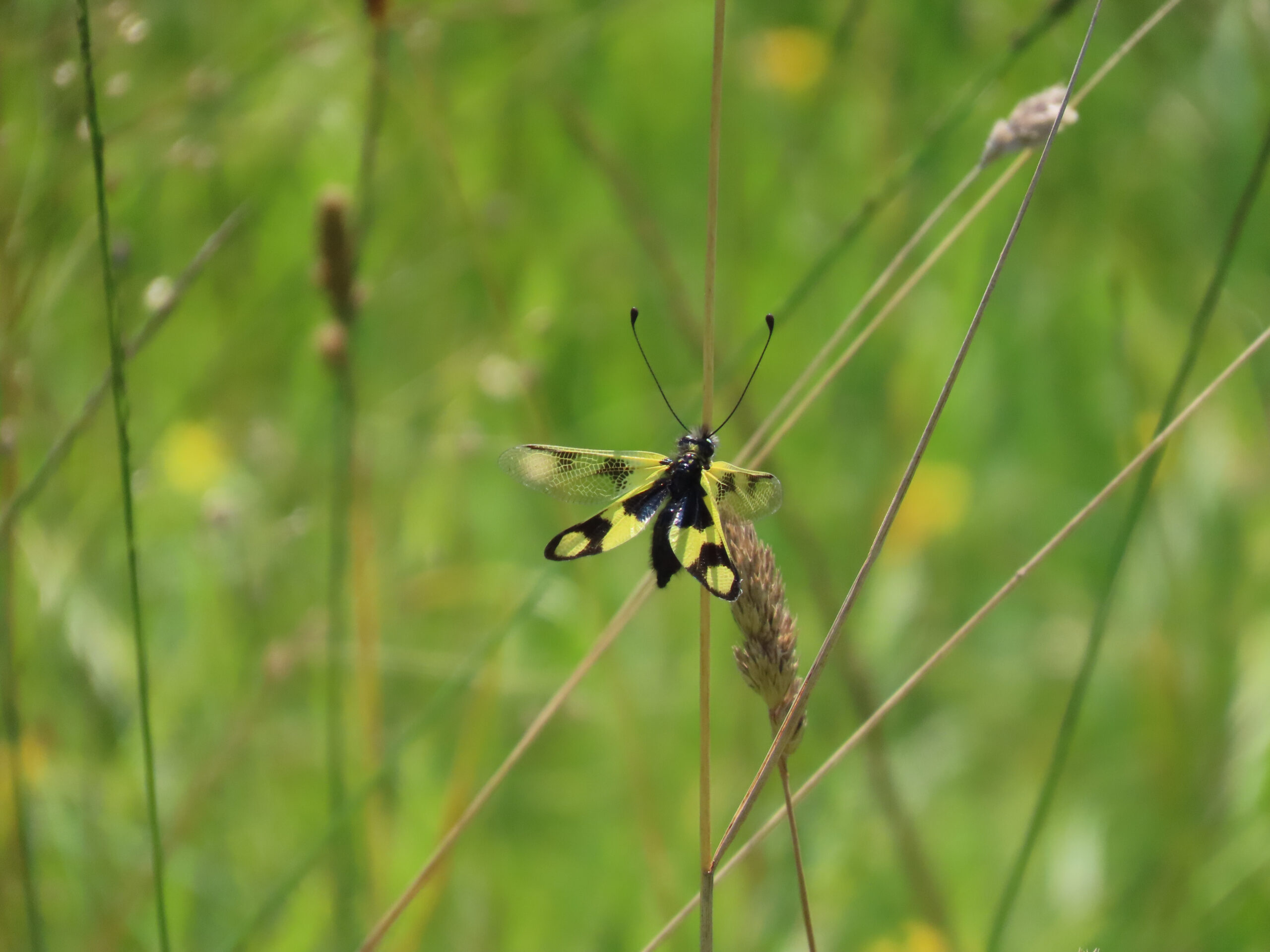 Photo Credit: MilanIlic553 / Wikimedia Commons
In the twilight hours of a warm summer evening, the Owlfly, scientifically known as Ascalaphidae, flits gracefully through the air, its delicate wings shimmering in the fading light. With a body that can stretch up to three inches, this enchanting insect resembles a miniature dragonfly, yet it possesses its own unique charm. Its large, bulging eyes give it an almost whimsical appearance, allowing it to spot prey with remarkable precision. As it dances among the flowers and grasses, the Owlfly captures the attention of both curious onlookers and dedicated scientists alike, who are drawn to its captivating beauty and intriguing behaviors.
These nocturnal hunters are not just a pretty sight; they play a vital role in their ecosystems. Owlfies thrive in diverse habitats, from sun-drenched meadows to lush forest glades, where they help control insect populations by preying on smaller flies and other insects. Their unique life cycle and mating rituals, which include elaborate aerial displays, add to the mystery surrounding these fascinating creatures. As we explore the world of the Owlfly, we will uncover the secrets of its behavior, diet, and the important role it plays in the delicate balance of nature. Join us on this adventure to learn more about these remarkable insects that often go unnoticed, yet are essential to the health of their environments.
The Owlfly, belonging to the family Ascalaphidae, occupies a distinctive niche in the vast tree of life. These enchanting insects are part of the order Neuroptera, which is known for its delicate wings and intricate life cycles. Owlfies are particularly captivating due to their large, owl-like eyes that give them excellent vision, especially at dusk. This unique feature not only aids in their hunting but also sets them apart from many other insects. With their graceful flight and striking appearance, Owlfies are a testament to the diversity and adaptability of life on Earth.
| Taxonomic Rank | Scientific Name | Meaning & Significance |
|---|---|---|
| Kingdom | Animalia | This name signifies that Owlfies are part of the animal kingdom, which includes all multicellular organisms that are not plants, fungi, or bacteria. |
| Phylum | Arthropoda | Meaning “jointed legs,” this name reflects the Owlfly’s segmented body and jointed appendages, a characteristic of all arthropods. |
| Class | Insecta | This term means “insect,” highlighting that Owlfies are part of the largest group of animals on Earth, known for their three-part bodies and six legs. |
| Order | Neuroptera | Translating to “nerve wing,” this name refers to the intricate network of veins in the wings of Owlfies and their relatives, which are often beautifully patterned. |
| Family | Ascalaphidae | This name is derived from the Greek word “askalaphos,” meaning “owl,” which points to the large, prominent eyes that resemble those of an owl, enhancing their night vision. |
Understanding the taxonomic classification of the Owlfly reveals much about its evolutionary journey. As members of the Neuroptera order, Owlfies share a common ancestry with lacewings and antlions, showcasing a lineage that has adapted to various ecological niches. Their unique adaptations, such as their exceptional eyesight and hunting prowess, highlight the evolutionary pressures that have shaped their development over millions of years. By studying these fascinating insects, we gain insight into the complex web of life and the intricate relationships that bind all living organisms together.
The evolutionary journey of the Owlfly, a member of the family Ascalaphidae, stretches back millions of years, tracing its roots to the ancient order Neuroptera. This lineage emerged during the late Permian period, around 250 million years ago, a time when the Earth was teeming with diverse life forms. As the planet evolved, so did the owlfly, adapting to changing environments and ecological niches, leading to the fascinating insect we see today.
Ancestral forms of owlfly were likely similar to other early neuropterans, characterized by their delicate wings and predatory habits. Over time, these insects underwent significant evolutionary transitions, including the development of large, prominent eyes that enhance their ability to hunt in low light. This adaptation is crucial for spotting prey, as owlfies are primarily nocturnal. Additionally, their elongated bodies and unique wing structure evolved to improve flight efficiency, allowing them to glide gracefully through the air while pursuing insects.
These evolutionary adaptations have been vital for the survival of owlfies in their habitats. Their keen eyesight and agile flight allow them to thrive as predators, capturing small insects with precision. The combination of specialized mouthparts and unique wing structures enhances their hunting efficiency, ensuring they can find food even in challenging environments. As a result, owlfies continue to flourish, showcasing the incredible power of evolution in shaping life on Earth.
The Owlfly is a captivating insect that draws the eye with its striking appearance. With a slender body and long, delicate wings, it resembles a miniature dragonfly, yet it possesses its own unique charm. The most notable feature is its large, bulging eyes, which give it an almost owl-like expression, perfect for spotting prey in the dim light of dusk. Its exoskeleton, a hard outer covering, provides protection while allowing for flexibility and movement as it flits gracefully through the air.
| Feature | Description |
|---|---|
| Size | Typically ranges from 1 to 2 inches in length |
| Color | Often features a mix of earthy tones, including browns and greens, which help it blend into its surroundings |
| Skin Type | Exoskeleton, providing both protection and support |
| Eyes | Large and bulging, enhancing vision for hunting |
The combination of these features not only makes the Owlfly visually striking but also serves essential survival purposes. Its large eyes are finely tuned for detecting movement, allowing it to hunt effectively during twilight hours when many of its prey are active. The earthy colors of its body help it camouflage against the backdrop of leaves and branches, making it less visible to both predators and prey. Together, these adaptations create a perfect balance of beauty and functionality, enabling the Owlfly to thrive in its environment.
The Owlfly thrives in a variety of habitats that are as diverse as its appearance. Picture a sun-drenched meadow or a lush forest glade, where the air is filled with the gentle hum of life. These insects are often found flitting about in warm, open spaces, where they can easily spot their prey. Their preferred environments are rich in vegetation, providing both shelter and hunting grounds. The Owlfly’s delicate wings shimmer in the sunlight, making it a beautiful sight as it dances among the flowers and grasses.
Owlfies are particularly fond of climates that offer warmth and humidity. They flourish in areas where temperatures are mild to warm, as these conditions support the growth of the plants they rely on for shelter and hunting. The presence of water sources, like streams or ponds, is also crucial, as these insects often need moisture in their environment. The combination of sunlight and shade in their habitats creates a perfect balance, allowing them to thrive while avoiding extreme weather conditions.
To survive in these specific habitats, Owlfies have developed several clever adaptations. Their long, slender bodies and large, membranous wings allow them to maneuver gracefully through dense vegetation. This agility helps them evade predators and catch their favorite meals—small insects. Additionally, their camouflage, which blends seamlessly with the foliage, makes it easier for them to hide from both prey and threats. These adaptations not only enhance their survival but also make them a vital part of the ecosystems they inhabit.
As the sun dips below the horizon, the Owlfly begins its nightly adventures. These nocturnal insects are most active after dark, flitting gracefully through the air in search of food. With their keen eyesight, they navigate the night, hunting for small insects like moths and beetles. Their long, delicate wings allow them to glide silently, making them stealthy predators. As they soar through the moonlit sky, they rely on their acute senses to detect movement and locate their next meal.
While Owlfies are primarily solitary creatures, they do exhibit interesting behaviors when it comes to finding mates. During the mating season, males perform elaborate aerial displays to attract females. These displays can include intricate flight patterns and even the release of pheromones, which are chemical signals that convey information about their readiness to mate. Once a female is attracted, the pair may engage in a brief courtship before mating. Afterward, the female lays her eggs in suitable locations, ensuring the next generation has a chance to thrive.
| Behavior Type | Description |
|---|---|
| Activity Patterns | Nocturnal hunting for small insects, using keen eyesight and silent flight. |
| Social Structure | Primarily solitary, with brief social interactions during mating season. |
| Communication Methods | Aerial displays and pheromones used by males to attract females. |
The behaviors of the Owlfly are finely tuned to ensure their survival in the wild. By being active at night, they avoid many daytime predators and can hunt more effectively. Their solitary nature allows them to be stealthy and less conspicuous, while their mating displays help them find partners without the need for constant social interaction. This combination of strategies not only enhances their chances of survival but also ensures the continuation of their species in the ever-changing tapestry of nature.
The Owlfly, a captivating member of the insect world, has a diverse diet that primarily consists of other insects. As an omnivore, it enjoys a varied menu, but its favorite foods are often smaller flying insects. With its keen eyesight and agile flight, the Owlfly employs a fascinating hunting strategy, swooping through the air to catch its prey mid-flight. This ability to hunt effectively at night makes it a skilled predator in its environment.
| Dietary Aspect | Details |
|---|---|
| Diet Type | Omnivore |
| Favorite Foods | Smaller flying insects |
| Prey Items | Various insects, including moths and small beetles |
| Hunting/Foraging Strategies | Active nocturnal hunters that catch prey mid-flight |
The Owlfly’s diet plays a crucial role in its ecological niche, helping to control insect populations in its habitat. By preying on smaller insects, it contributes to the balance of the ecosystem, ensuring that no single species becomes too dominant. This dietary behavior also influences its daily routine, as the Owlfly must be vigilant and agile during its nighttime hunts, showcasing the intricate dance of predator and prey in the natural world.
When it comes to mating, Owlfies engage in a captivating dance that showcases their delicate beauty. During the breeding season, which typically occurs in warmer months, males perform elaborate aerial displays to attract females. These displays often involve fluttering and swooping through the air, demonstrating their agility and strength. Once a female is impressed, she will mate with the male, and together they will embark on the next stage of their life cycle.
| Reproductive Aspect | Details |
|---|---|
| Gestation Period | Approximately 2 to 3 weeks |
| Litter Size | Varies, typically several dozen eggs |
| Age of Maturity | About 2 to 3 months |
| Name of Young | Larvae |
After mating, the female lays her eggs on suitable surfaces, often near water or in moist environments where the larvae can thrive. Once the eggs hatch, the young Owlfies emerge as larvae, which are quite different from their adult forms. These larvae are voracious predators, feeding on small insects and growing rapidly. As they develop, they undergo several molts, shedding their skin to accommodate their growing bodies. This transformation is a crucial part of their journey to adulthood, where they will eventually take to the skies, continuing the cycle of life in the enchanting world of Owlfies.
The Owlfly plays a crucial role in the food web, serving as both predator and prey. As a skilled hunter, it feasts on smaller insects, helping to control their populations. However, this delicate balance also places the Owlfly in the sights of various predators, making its survival a constant challenge in the wild.
To evade these threats, Owlfies have developed several clever survival strategies. Their nocturnal lifestyle allows them to avoid many daytime predators, while their delicate, camouflaged wings help them blend into their surroundings. When threatened, some Owlfies can also perform erratic flight patterns, making it harder for predators to catch them. These adaptations showcase the Owlfly’s resilience and ingenuity in the face of danger, allowing it to thrive in a world full of challenges.
A keystone species is an organism that has a disproportionately large impact on its environment relative to its abundance. This means that even if it is not the most numerous species, its presence is crucial for maintaining the structure and health of its ecosystem. The Owlfly, belonging to the family Ascalaphidae, can be considered a keystone species due to its role as both a predator and prey in various habitats, particularly in tropical and temperate regions.
Owlfies are skilled hunters, primarily feeding on smaller insects. By controlling the populations of these insects, they help maintain a balance in the ecosystem. For example, if Owlfies were to disappear, the populations of their prey could explode, leading to overgrazing of plants and a decline in plant diversity. This, in turn, would affect other species that rely on those plants for food and shelter. Additionally, Owlfies serve as a food source for larger predators, such as birds and bats. Their presence supports a diverse food web, ensuring that energy flows through the ecosystem efficiently.
The Owlfly’s solitary behavior also contributes to its ecological impact. By hunting alone, they reduce competition for food resources among other insect species. This allows for a more stable environment where various insects can thrive without being overwhelmed by competition. Furthermore, their nocturnal activity means they occupy a unique niche, feeding at night when many other predators are inactive, thus helping to balance the ecosystem’s dynamics.
If Owlfies were to vanish from their ecosystems, the ripple effects could be significant. Without these insects to keep smaller insect populations in check, we might see a surge in pests that could damage crops and disrupt local flora. This could lead to a decline in plant diversity, which would affect not only the plants themselves but also the animals that depend on them for food and habitat. The loss of Owlfies would ultimately destabilize the intricate web of life they help support, demonstrating just how vital these small but mighty insects are to their environments.
The Owlfly, a member of the family Ascalaphidae, plays a vital role in its ecosystem, particularly in tropical and temperate regions. As a nocturnal insect, it occupies a unique ecological niche, hunting for food under the cover of darkness. This lifestyle allows it to interact with various species and contribute to the balance of its environment. By preying on smaller insects, the Owlfly helps regulate their populations, ensuring that no single species overwhelms the ecosystem.
| Ecosystem Service | Impact |
|---|---|
| Predation | Controls populations of smaller insects, preventing overpopulation. |
| Pollination | While primarily a predator, Owlfies can also assist in pollinating plants as they move from flower to flower. |
| Food Source | Serves as prey for various birds and other predators, contributing to the food web. |
The Owlfly’s influence extends beyond its immediate hunting habits. For instance, by keeping the populations of smaller insects in check, it indirectly supports plant health and growth. When insect populations are balanced, plants can thrive without being overgrazed. Additionally, as Owlfies flit from flower to flower, they may inadvertently assist in pollination, helping plants reproduce and maintain biodiversity. This dual role as both predator and occasional pollinator showcases the interconnectedness of life in its habitat.
The broader ecological importance of the Owlfly cannot be overstated. As a keystone species, its presence helps maintain the stability of its ecosystem. By regulating insect populations and contributing to plant reproduction, the Owlfly supports a diverse range of life forms. This delicate balance is crucial for the health of ecosystems, highlighting how even the smallest creatures can have a significant impact on the world around us. Understanding the role of the Owlfly encourages us to appreciate the intricate web of life that sustains our planet.
In the intricate web of life, symbiosis refers to the close interactions between different species, which can take on various forms. These relationships can be mutualistic, where both species benefit, parasitic, where one benefits at the other’s expense, or commensal, where one benefits while the other is neither helped nor harmed. Understanding these connections helps us appreciate the delicate balance of ecosystems and the roles that each species plays within them.
| Species/Type | Relationship Type | Description |
|---|---|---|
| Ants | Mutualistic | Owlfies may benefit from ants by receiving protection from predators, while ants can enjoy the sugary secretions produced by the Owlfly larvae. |
| Parasitic Wasps | Parasitic | Some parasitic wasps lay their eggs in Owlfly larvae, using them as a host for their young, which can lead to the death of the Owlfly. |
| Fungi | Commensal | Fungi growing on decaying organic matter can provide a habitat for Owlfly larvae, offering shelter without affecting the fungi. |
The evolution of these relationships showcases the adaptability of species like the Owlfly. Over time, they have developed strategies to thrive alongside other organisms, whether by forming beneficial partnerships or navigating the challenges posed by parasites. These interactions not only enhance the survival of the Owlfly but also contribute to the overall health of their ecosystems, demonstrating the interconnectedness of life on our planet.
Owlflies are enchanting insects that often go unnoticed, yet they possess some truly surprising traits that make them stand out in the natural world.
Throughout history, owlfies have captured the imagination of many cultures. These delicate insects, with their graceful flight and striking appearance, have often been associated with mystery and magic. In various folklore, they are seen as symbols of wisdom and transformation, much like their nocturnal habits suggest. Ancient civilizations may have marveled at their beauty, weaving them into stories and art, while modern societies continue to appreciate their role in the ecosystem. The owlfly’s unique characteristics have made it a subject of curiosity, inspiring both scientific inquiry and cultural narratives.
Today, the relationship between owlfies and humanity is largely centered around conservation and ecological awareness. As habitats change due to urbanization and climate change, these insects face challenges that threaten their populations. Conservation efforts aim to protect their natural environments, ensuring that owlfies can continue to thrive. While they are not domesticated animals, their presence in gardens and parks can indicate a healthy ecosystem. People are increasingly recognizing the importance of these insects in controlling pest populations, which can lead to a more balanced environment.
As we look to the future, the relationship between owlfies and humanity holds promise. With growing awareness of environmental issues, more people are advocating for the protection of natural habitats. By fostering a deeper understanding of these enchanting insects, we can ensure that they continue to play their vital roles in our ecosystems. As we learn to coexist with owlfies, we not only enrich our own lives but also contribute to the health of the planet. Together, we can create a world where owlfies and humans thrive side by side, celebrating the wonders of nature.
The conservation status of the Owlfly, belonging to the family Ascalaphidae, is currently not listed by the International Union for Conservation of Nature (IUCN). This means that there is not enough information to determine whether their populations are declining or stable. While some species within this family may be thriving in their habitats, others could be facing challenges that remain largely undocumented. As a result, the overall population trends for owlfies are not well understood, leaving a gap in our knowledge about their conservation needs.
| Conservation Factor | Status/Details |
|---|---|
| IUCN Status | Not Listed |
| Population Estimates | Unknown |
| Trend Direction | Uncertain |
Despite their enchanting presence, owlfies face several threats that could impact their survival. Habitat loss is a significant concern, as urban development and agricultural expansion can destroy the natural environments where these insects thrive. Additionally, pesticide use poses a danger, as these chemicals can reduce the availability of prey and directly harm owlfies. Climate change also plays a role, altering weather patterns and potentially disrupting the delicate balance of ecosystems that support these fascinating insects.
Conservation efforts for owlfies are still in their infancy, primarily due to the lack of detailed research on their populations and habitats. However, raising awareness about the importance of preserving natural habitats can help protect these insects and their ecosystems. By promoting sustainable agricultural practices and reducing pesticide use, we can create a safer environment for owlfies and other beneficial insects. The outlook for their conservation will depend on our commitment to understanding and safeguarding the delicate web of life in which they play a role.
| Question | Answer |
|---|---|
| What is the habitat of owlfly? | Owlflies are found in both tropical and temperate regions around the world. They prefer areas with plenty of vegetation, such as forests and gardens, where they can easily hunt for food and find places to rest. |
| What do owlfly eat? | Owlflies are omnivores, which means they eat a variety of foods. Their diet mainly consists of small insects, but they may also consume nectar from flowers, making them important for pollination. |
| How do owlfly behave? | Owlflies are known for their unique hunting style. They often hover in the air, using their large bulging eyes to spot prey, and then swoop down to catch it with their long, slender bodies. |
| How do owlfly reproduce? | During mating, male owlfies perform elaborate courtship displays to attract females. After mating, the female lays her eggs on the leaves of plants, where the larvae will hatch and begin their life cycle. |
| What threats do owlfly face? | Owlflies are not currently listed as endangered, but they can be affected by habitat loss due to deforestation and urban development. Pesticides used in agriculture can also harm their populations by reducing their food sources. |
| What is an interesting characteristic of owlfly? | One of the most distinctive features of owlfly is their large, bulging eyes, which give them excellent vision. This adaptation helps them hunt effectively, especially in low light conditions, making them fascinating creatures to observe. |
| Are owlfly beneficial to the environment? | Yes, owlfies play a beneficial role in their ecosystems. By controlling insect populations and pollinating plants, they help maintain the balance of their habitats, making them important contributors to biodiversity. |