
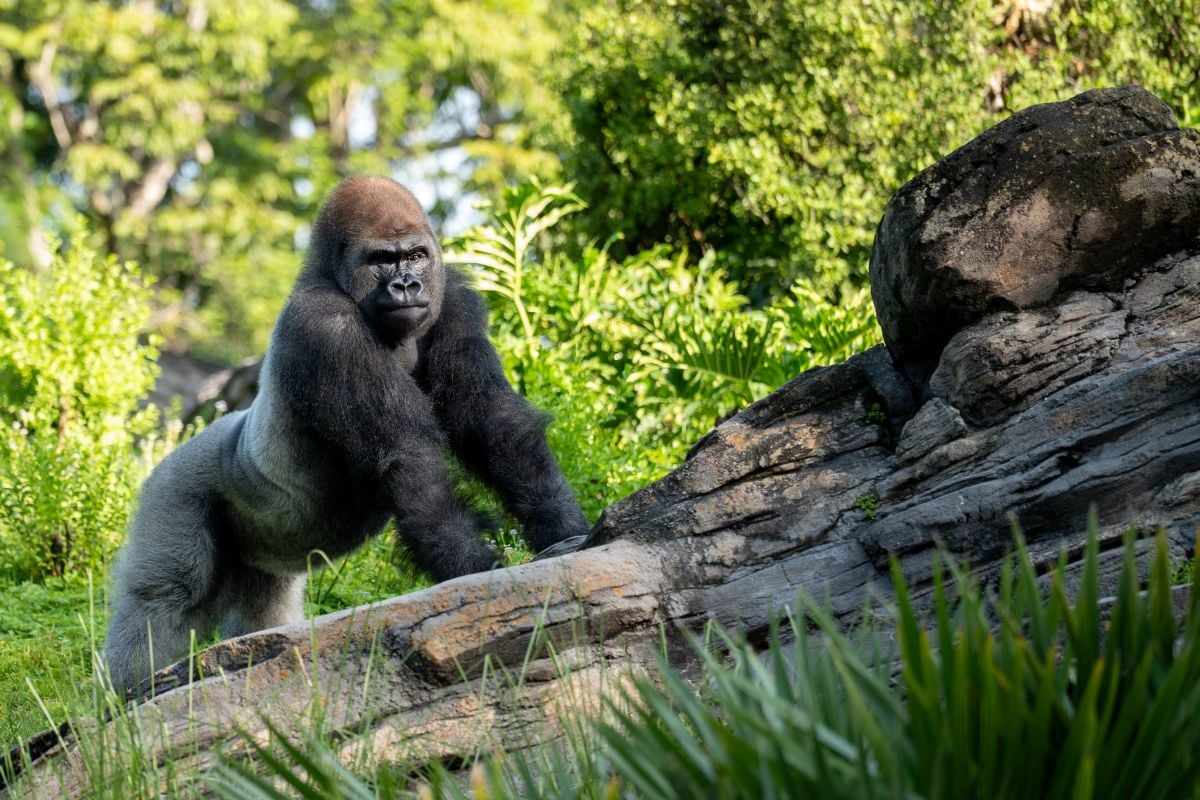

The western lowland gorilla arrived from the Saint Louis Zoo and has stepped into a role left open by Gino, the opening-day silverback who died last September.
Guests walking the Gorilla Falls Exploration Trail at Disney’s Animal Kingdom are getting their first looks at the park’s new troop leader. Bakari, a 21-year-old male western lowland gorilla, has finished his acclimation period behind the scenes and is now appearing in the habitat alongside the rest of the family group, though sightings depend on where the gorillas choose to spend their day.
Bakari’s arrival closes out a transition that began nearly a year ago. He is the first new silverback the park has had since it opened, taking over a position held for almost three decades by Gino, a beloved opening-day resident who died in September 2025 at the age of 44.
From A Bachelor Group In Missouri To A Family Troop In Florida
Bakari was born at Brookfield Zoo in Illinois in 2005 and moved to Missouri in 2011, where he spent roughly 15 years in the bachelor troop at the Saint Louis Zoo’s Jungle of the Apes.
That living arrangement was not incidental. Bachelor groups mirror what happens in the wild, where young males leave their birth troop and travel together for years before attempting to lead a family of their own. Accredited zoos use them as a kind of apprenticeship, giving maturing males time to work out social dynamics with peers before they are responsible for females and offspring. The Saint Louis Zoo pioneered the approach for this species in North America and continues to house one of the most established bachelor groups in the country.
His transfer to Walt Disney World came through the Association of Zoos and Aquariums Species Survival Plan for western lowland gorillas, a cooperative program that tracks pedigrees across accredited institutions and issues breeding and transfer recommendations designed to keep the managed population genetically diverse. Under that recommendation, Bakari is expected to eventually father offspring with the females at Animal Kingdom.
A Slow, Deliberate Introduction
Disney’s animal care team is not rushing the process. According to the park’s announcement, Bakari and the females began by seeing one another through a protected barrier while keepers watched for signs of comfort or tension. Only as those interactions went well did the team begin allowing closer contact, including the opportunity to touch.
Rachel, an animal care manager with Disney’s Animals, Science and Environment, described the transition as bittersweet, given what it means about Gino’s absence, while calling Bakari <a href=”https://disneyparksblog.com/wdw/meet-bakari-the-gorilla-at-disneys-animal-kingdom/”>”the future of this family troop.”</a> Keepers have reported that he has been calm and observant so far, taking his time to study his surroundings rather than asserting himself immediately.
That temperament matters more than it might seem. In a gorilla troop, the silverback is not simply the largest animal present. He settles disputes among females, decides when the group moves and where it feeds, keeps watch for threats, and tolerates a remarkable amount of roughhousing from juveniles. A troop that loses its silverback typically fractures. Rebuilding that structure around a new male is one of the more delicate things a zoo can attempt, which is why the introduction is being measured in months rather than weeks. You can read more about how these social groups function in on our gorilla facts page.
The Legacy Bakari Inherits
Gino set a high bar. He arrived for the park’s April 1998 opening, fathered 14 offspring over his lifetime, and was among the first gorillas anywhere to voluntarily participate in cardiac ultrasounds without anesthesia, a training breakthrough that has since improved heart monitoring for great apes at other institutions. Heart disease is a leading cause of death in male gorillas in human care, so the cooperation of animals like Gino has real diagnostic value.
He also lived unusually long. Silverbacks in the wild generally do not reach their mid-40s, and Gino would have turned 45 that December.
Why The Transfer Matters Beyond The Park
Western lowland gorillas were reclassified as critically endangered by the IUCN in 2007, and the outlook has not improved much since. Populations have fallen by more than 60 percent over roughly a quarter century, driven by commercial bushmeat hunting, logging that opens remote forest to poachers, and repeated Ebola outbreaks that have wiped out entire regional populations. Researchers estimate the species would need something like 75 years to recover even if every major threat disappeared tomorrow.
Because gorillas share about 96 percent of their DNA with humans, they are highly vulnerable to human pathogens without the immune defenses people have developed against them. That vulnerability is part of what makes the managed North American population a meaningful hedge, and part of why a single transfer between two zoos gets planned years in advance.
For visitors, all of that context sits behind a fairly simple experience: a large, quiet animal moving through a wooded habitat in central Florida, doing the ordinary work of learning a new family.
