
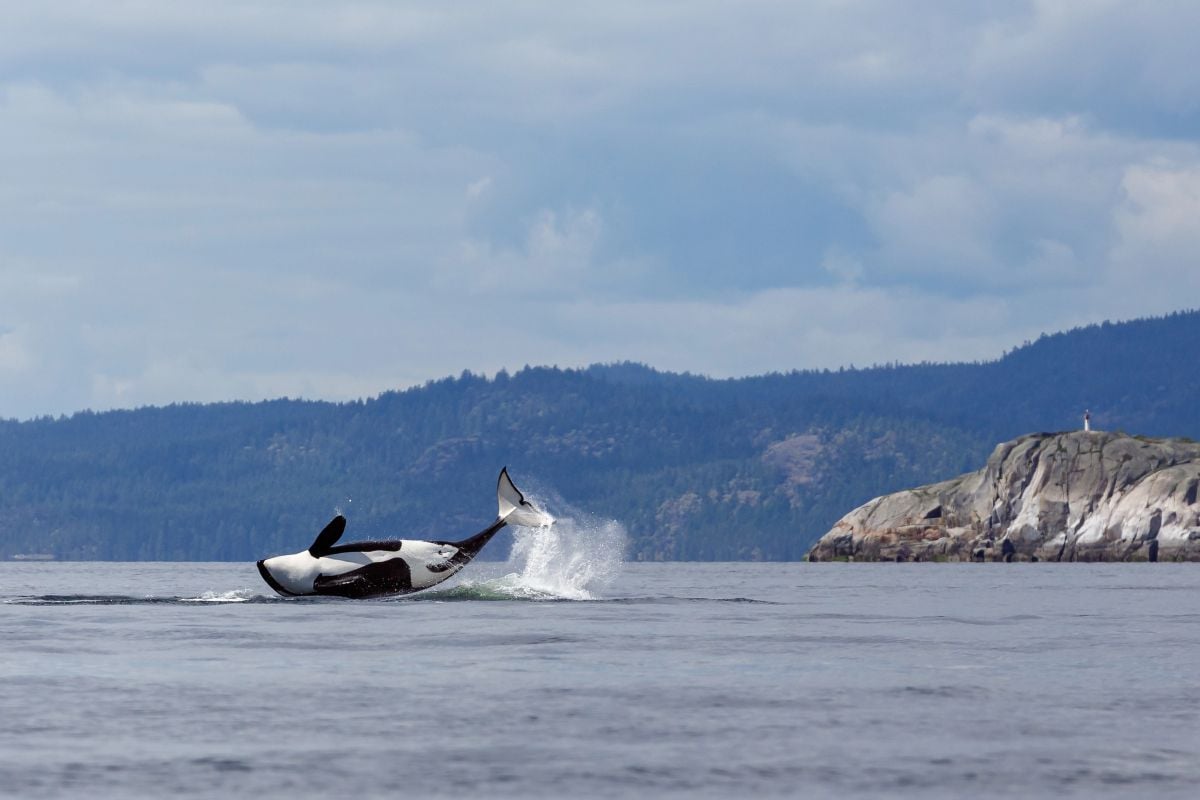

A pair of encounters filmed off Baja California Sur have given marine biologists their first close look at a hunting move that leaves a fish weighing hundreds of pounds in pieces. In each case, one orca gripped a sharptail sunfish, held it steady in open water, and released it a fraction of a second before a second orca arrived at full speed. The impact scattered fragments of the fish across the water column, where the youngest members of the group swept in to feed.
The observations appear in a new paper in Frontiers in Ethology describing what the authors call a ram-to-fragment foraging strategy. Lead author Kathryn Ayres, a research scientist with the ocean conservation nonprofit Beneath the Waves, recorded the first event on July 29, 2024, at an offshore seamount near San José del Cabo.
A tourism operator captured the second on September 7, 2025, in the channel at Isla Cerralvo. Ayres, whose research focuses on sharks, told CNN that she had seen orcas use similar coordinated ramming against a whale shark before this, which is part of why the sunfish encounter caught her attention.
Why a sunfish is a difficult meal
The prey in both videos was Masturus lanceolatus, the sharptail sunfish, a relative of the more familiar ocean sunfish and a genuinely awkward animal to eat. Adults can reach well over a thousand pounds. Their skin is thick, rubbery, and heavily reinforced with collagen, and there is comparatively little muscle underneath it. An orca that wants a meal out of one has to get through the packaging first, and orcas do not have hands.
Robert Pitman, a marine ecologist at Oregon State University who was not involved in the research, reads the behavior primarily as a practical solution to that problem. He has watched orcas swim around with sunfish held flat in their jaws for years without understanding what came next. Older orcas that specialize in sharks often wear their teeth down to the gum line, and calves have not grown a full set yet. For both groups, a fish that has already been broken apart is far easier to handle than one that has not.
Study co-author Erick Higuera, a marine biologist at Conexiones Terramar, arrived at a similar reading and has pushed back on the idea that the violence of the scene says anything about the animals’ temperament. What looks gruesome on video, he argues, is “highly specialized biology” rather than cruelty.
The open question is whether it is also play
Orcas have a long documented history of doing things that look a great deal like recreation. Populations off Washington State revived a decades-old habit of balancing dead salmon on their heads. Young orcas off the Iberian Peninsula spent several seasons ramming sailboat rudders with no evident nutritional payoff. Playing with food is well within the species’ repertoire.
Higuera has laid out what it would take to call this behavior play in the technical sense: it would need to be voluntary, rewarding in itself, and involve exaggerated or modified versions of ordinary movements.
Both filmed events do have the shape of a cooperative game, with one animal setting up a target and another taking the shot. But both also ended with juveniles eating, which is exactly what you would expect if the adults were preparing a meal for animals that could not process it themselves.
His proposed test is straightforward. If researchers eventually record adults doing this with no toothless orcas nearby, and then leaving the fragments uneaten, the case for pure entertainment gets much stronger.
For now the sample size is two, both from the same stretch of the Gulf of California, and the researchers suspect they may be looking at a local tradition rather than a species-wide technique.
Whether the same behavior turns up in orca populations elsewhere is the next thing worth watching, and given how thoroughly the species transmits hunting knowledge within pods, the answer will say something about how these innovations spread.
